

Why Is My Furnace Making a Banging Noise When It Turns On for the First Time?
That Startling First-Turn-On Bang: What Your Furnace is Trying to Tell You
The calendar flips to September, early fall arrives, and a sudden evening chill prompts you to test your heating system for the season. You adjust the thermostat, wait a few moments for the cycle to begin, and are suddenly startled by a loud boom echoing from the utility closet. If you find yourself searching, "Why is my furnace making a banging noise when it turns on for the first time?", you are certainly not alone. This startling sound is a frequent occurrence after months of system dormancy. However, while some operational noises are perfectly normal, a forceful bang is your equipment's way of signaling a serious issue that should never be ignored.
Whether you need comprehensive heating services or a quick professional assessment, addressing this specific noise promptly is the key to safe, reliable warmth all winter long.
Mountain View's remarkably mild summers mean that residential furnaces often sit completely dormant for six months or more. During this extended period of inactivity, the internal components of your heating system are left exposed to circulating household dust, fluctuating humidity, and settling debris. When you finally call for heat on that first chilly evening in September, the system attempts to ignite under less-than-ideal conditions.
Understanding the sequence of a healthy furnace:
• The thermostat calls for heat: A signal is sent to the control board.
• The draft inducer motor starts: This clears residual gases from the heat exchanger.
• The igniter activates: Depending on your model, a hot surface igniter glows bright orange, or a spark igniter begins clicking.
• The gas valve opens: Fuel flows into the burners and should ignite instantly and smoothly.
When that final step fails to happen instantaneously, the result is a loud, unsettling bang. Homeowners are immediately faced with a critical decision point: trying to determine if this is just harmless metal expanding as it warms up, or a dangerous delayed gas ignition that requires an immediate professional inspection. The short answer is that a true "bang" or "boom" that vibrates the cabinet is almost always a sign of delayed ignition, a recognized safety hazard that demands expert attention.
The Mechanics of Delayed Ignition Explained
Delayed ignition occurs when gas accumulates in a furnace's combustion chamber because the burners are obstructed. When the igniter finally catches this pooled gas, it creates a miniature explosion, producing a loud bang or boom that physically shakes the furnace cabinet.
To truly understand why this happens, it helps to look at the precise physics of your heating equipment. In a properly functioning system, the gas valve releases fuel directly into the burner assembly, where it meets an active ignition source. The gas catches fire immediately, creating a steady, controlled row of blue flames that are drawn into the heat exchanger. The entire process is designed to be seamless, quiet, and highly controlled.
However, when the burner ports are blocked, the gas cannot flow smoothly toward the igniter. The gas valve remains open, continuing to pump raw fuel into the enclosed combustion chamber. Seconds pass. The gas continues to build up, filling the space with a highly combustible mixture of fuel and oxygen. Eventually, this expanding cloud of gas reaches the igniter. Because there is now a large volume of fuel present rather than a small, controlled stream, it all combusts at the exact same fraction of a second.
The rapid expansion of this combusting gas creates a sudden, forceful shockwave. This shockwave strikes the metal walls of the furnace cabinet, resulting in the loud boom you hear upstairs. This is not a minor mechanical quirk; heating safety guidelines classify delayed ignition as a significant hazard. The force of these miniature explosions can blow out the pilot light on older models, damage sensitive internal sensors, and, most alarmingly, put immense stress on the heat exchanger.
If you suspect your system is experiencing this issue, scheduling a professional furnace repair and inspection is the only safe way to accurately diagnose and resolve the underlying blockage.
Why Does This Happen Specifically After Summer Dormancy?
You might wonder why this frightening phenomenon seems to happen exclusively when you turn the heater on for the very first time after summer. The answer lies in the specific environmental conditions your equipment endures while sitting idle in Mountain View, CA.
Even when your furnace is turned off, the air inside your home continues to circulate—especially if you use a central air conditioning system that shares the same ductwork and blower motor. Over the course of six or more months, a substantial amount of airborne particulate matter moves through the system. This includes pet dander, textile fibers, skin cells, and general household dust. Because the burners are completely inactive, this debris settles directly onto the burner orifices and the igniter itself.
Furthermore, Mountain View's coastal-adjacent climate plays a significant role. The region is known for its morning moisture and rolling marine fog. This ambient humidity makes its way into your utility closets, basements, and attics. When this airborne moisture mixes with the settled dust on your furnace components, it creates a sticky, caked-on layer of grime. In some cases, this moisture can even cause minor surface rust or corrosion on the metal burner tubes.
Common summer culprits that block furnace burners:
• Caked-on dust and lint: Bound together by summer humidity, creating a physical barrier over the gas ports.
• Spider webs: Spiders frequently seek out the dark, quiet, cylindrical tubes of a dormant burner assembly to spin dense webs, which completely obstruct gas flow.
• Surface rust: Minor corrosion from coastal moisture that flakes off and clogs the precision-drilled holes of the burner.
• Soot buildup: Leftover carbon deposits from the previous winter that hardened over the summer months.
This physical buildup acts as a dam, preventing the smooth flow of gas to the igniter and setting the stage for delayed ignition. This is exactly why a comprehensive pre-heating season tune-up is so critical. A professional technician physically removes this summer debris before it has the chance to cause a miniature explosion on your first chilly autumn evening.
Harmless Metal Pops vs. Dangerous Gas Booms
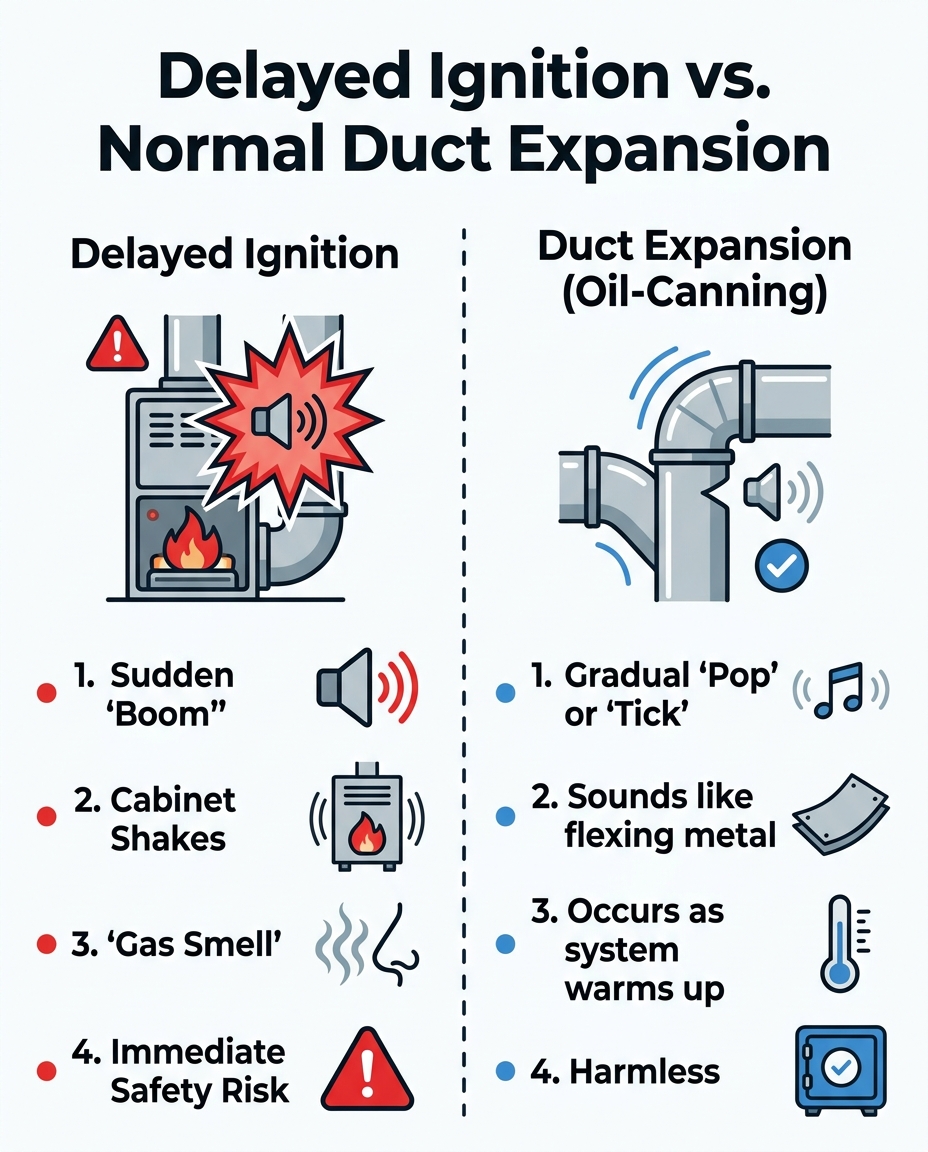
One thing we see often is homeowners confusing the dangerous sound of delayed ignition with the completely harmless sound of thermal expansion. It is vital to know the difference between the two so you can respond appropriately.
Sheet metal ductwork is highly susceptible to temperature changes. When your furnace kicks on and begins pushing warm air through ducts that have been sitting cold, the metal rapidly expands. This expansion causes the sheet metal to flex outward, a phenomenon commonly referred to in the HVAC industry as "oil-canning." Oil-canning produces a distinct popping, ticking, or pinging sound. While it can be annoying, it is entirely harmless and simply a byproduct of basic thermodynamics.
Delayed ignition, on the other hand, originates from the furnace cabinet itself, not the ductwork running through your walls or ceilings. It happens instantly upon ignition, rather than gradually as the house warms up. If you are asking, "Why is my furnace making a banging noise when it turns on for the first time?", comparing the symptoms is the best way to determine your next steps.
• Type of Sound — Duct Expansion (Oil-Canning): Ticking, pinging, or a metallic "pop" — Delayed Ignition (Gas Boom): Deep, forceful "boom" or loud "bang"
• Location of Sound — Duct Expansion (Oil-Canning): Along the walls, ceilings, or floor vents — Delayed Ignition (Gas Boom): Directly inside the main furnace cabinet
• Timing — Duct Expansion (Oil-Canning): Gradually, a few minutes after the warm air starts flowing — Delayed Ignition (Gas Boom): Instantly, at the exact moment the burner attempts to light
• Physical Reaction — Duct Expansion (Oil-Canning): None (ducts flex silently behind drywall) — Delayed Ignition (Gas Boom): The metal furnace cabinet may physically shake or vibrate
• Safety Severity — Duct Expansion (Oil-Canning): Harmless annoyance — Delayed Ignition (Gas Boom): Critical safety hazard requiring immediate attention

Honest Diagnostics: Why a Scary Noise Doesn't Always Mean a Dead Furnace
Hearing a loud explosion from your utility closet is undeniably stressful. It is incredibly common for homeowners in Mountain View, CA, to panic, assuming that this terrifying noise means their entire heating system has catastrophically failed and needs to be completely replaced. Unfortunately, there are some companies that will use this exact fear to aggressively push a brand-new system installation when it simply isn't necessary.
At Plum HVAC, our focus is on thorough, safe diagnostics and honest repairs. We understand that while delayed ignition is dangerous, the root cause is frequently a highly fixable maintenance issue. A dirty burner assembly does not mean your equipment is dead; it just means it requires professional remediation.
When you call for Mountain View HVAC service to address a banging noise, a qualified technician will perform a rigorous, step-by-step diagnostic process. We don't just guess; we rely on hard data and visual evidence.
What a professional diagnostic inspection entails:
• Burner assembly inspection: We remove the burners to check for rust, spider webs, and caked-on summer dust.
• Igniter and flame sensor testing: We measure the electrical resistance of the igniter to ensure it is glowing hot enough, fast enough, to catch the gas immediately.
• Gas pressure calibration: We use a manometer to verify that the gas valve is releasing fuel at the exact pressure specified by the manufacturer. Too much pressure can also cause a forceful ignition.
• Heat exchanger structural check: Because repeated mini-explosions can stress the metal, we thoroughly inspect the heat exchanger for hairline cracks using specialized cameras.
By taking the time to properly diagnose the precise cause of the delayed ignition, we ensure that you aren't pushed into an unnecessary replacement for an issue that can be safely and effectively repaired.
Frequently Asked Questions About Banging Furnaces
Is it dangerous if my furnace bangs when it turns on?
Yes, if the noise is caused by delayed ignition, it is a significant fire and safety hazard that must be addressed immediately. The loud bang is the sound of a miniature gas explosion occurring inside the combustion chamber. Over time, these repeated explosive forces can severely stress the internal components of your heating system. Most notably, the shockwaves can crack the heat exchanger, which is the metal shield that separates the combustion gases from the breathing air in your home. A cracked heat exchanger can lead directly to carbon monoxide leaking into your living spaces, making this a symptom you should never ignore.
Can a furnace explode from delayed ignition?
While a catastrophic, house-level explosion is extremely rare due to the multiple built-in safety limits and roll-out switches in modern equipment, the mini-explosions inside the cabinet can cause severe internal damage. The force of delayed ignition is often strong enough to blow out pilot flames, damage sensitive electrical sensors, and compromise the structural integrity of the metal housing. Even if it does not cause a massive external fire, the internal damage caused by these controlled explosions will drastically shorten the lifespan of your equipment and create ongoing safety risks for your household.
What causes delayed ignition in a furnace?
The most common cause of delayed ignition is dirty burners that have become obstructed by dust, rust, pet hair, or lint during the long summer off-season. When these ports are blocked, gas cannot flow smoothly to the igniter, causing it to pool in the chamber until it finally catches all at once. Other potential causes include misaligned burners that misdirect the gas flow, weak or failing igniters that don't get hot enough quickly enough, or improper gas pressure coming from a malfunctioning gas valve. Regardless of the specific trigger, the result is always a dangerous buildup of unburned fuel.
Can a dirty furnace cause a loud bang?
Absolutely. Dirt is the primary catalyst for delayed ignition and the loud banging noise associated with it. Modern heating systems operate on a highly precise gas-to-air ratio, and even a remarkably small layer of summer dust can disrupt this delicate balance. When moisture from the air mixes with household dust, it forms a crust over the tiny ports where the gas is supposed to exit. Because the gas cannot escape evenly, it backs up and pools, leading directly to the miniature explosion when the igniter finally manages to light the fuel.
How do I fix a banging furnace?
You should never attempt to clean burners, adjust gas valves, or fix delayed ignition yourself. Turn off the furnace immediately at the thermostat and schedule a professional inspection to clean the assembly and verify safe operation. Working with natural gas appliances requires specialized training, diagnostic tools, and a thorough understanding of safety regulations. Attempting a DIY fix on a gas valve or burner assembly can easily result in gas leaks, voided manufacturer warranties, or a significantly increased risk of fire. Always trust a licensed professional to handle combustion issues.
Restore Safe, Quiet Heating Before Winter Arrives
Testing your heater in September or early fall should bring peace of mind, not a startling explosion that leaves you worried about the safety of your home. A loud bang upon startup is a clear, undeniable warning sign that your system is experiencing delayed ignition. While the root cause is often simply a buildup of summer dust and debris on the burner assembly, the resulting miniature gas explosions require immediate professional intervention, never a DIY fix.
You rely on your heating system to keep your family comfortable and safe through the coldest nights of the year. Don't let a highly fixable maintenance issue turn into a cracked heat exchanger or a compromised system. By enrolling in a preventative maintenance plan, you can ensure that your equipment is thoroughly cleaned, inspected, and calibrated long before you actually need it. Schedule a professional diagnostic visit today, and enjoy the profound satisfaction of a clean, safely operating system all winter long.
hear what our satisfied clients have to say

.svg)
Service areas
.avif)