Home Maintenance Tips and Troubleshooting: Normal Furnace Smells vs. System Hazards
Is That Burning Smell Normal When Turning On the Heater?
If you are urgently looking for home maintenance tips and troubleshooting advice because you just turned on your heater and noticed a sudden, alarming burning smell, you are not alone. Every year during the mid-fall October heating startup, our team at Plum HVAC receives panicked calls from local homeowners who experience a moment of panic when a distinct burning odor fills their living spaces. You walk past a vent, catch a whiff of something that smells heavily toasted, and immediately wonder if your equipment is catching fire.
Here is the thing: transitioning your home's climate control for the season always involves a brief adjustment period. When you finally shut down your air conditioning systems for the year and command your thermostat to call for heat, the internal mechanics of your HVAC unit shift gears. The immediate decision point you face is determining whether this scent is a harmless, expected seasonal occurrence or a serious hazard that requires professional maintenance—or even a completely new heat pump installation.
Most of the time, that initial odor is simply the result of dust burning off internal components. However, relying on guesswork when it comes to combustion equipment is never a safe strategy. By understanding exactly how your system operates after months of sitting idle, you can confidently distinguish between a normal seasonal quirk and a mechanical emergency.
The Science of System Dormancy: Why Dust Accumulates on Heat Exchangers
To understand why your heater smells like a dusty campfire on its first run, you have to look at the physical mechanics of system dormancy. In our years of experience providing HVAC solutions throughout Mountain View and the surrounding Bay Area, we see firsthand how our mild regional climate results in extended furnace dormancy. Most local heating systems sit completely unused from March through October. That is eight long months of inactivity, which creates the perfect environment for airborne particles to settle heavily on your internal heating components.
When you finally initiate that first heating cycle, a specific sequence of events occurs inside the cabinet of your gas furnaces or heat handlers:
1. Extended Accumulation: Throughout the spring and summer, household dust, pet dander, and microscopic lint bypass minor gaps in your ductwork and settle directly onto the cold metal surface of the heat exchanger.
2. Initial Ignition: When the thermostat calls for heat, the burners ignite, rapidly raising the temperature of the heat exchanger metal to several hundred degrees.
3. The Flash Burn-Off: The accumulated layer of dust cannot withstand this sudden, intense heat. The particles literally incinerate upon contact with the hot metal, producing a distinct, temporary odor that the blower motor immediately pushes through your air vents.
4. System Clearing: As the equipment continues to run, the remaining particulate matter finishes burning away, and the fresh airflow eventually purges the smell from your ductwork.
This process is entirely physical and expected. Your most important tool during this phase is simple visual and olfactory observation. You should never attempt to open the sealed combustion chamber or manually wipe down the heat exchanger yourself, as these components are highly sensitive and require professional handling.
How Long Should the Smell Last?
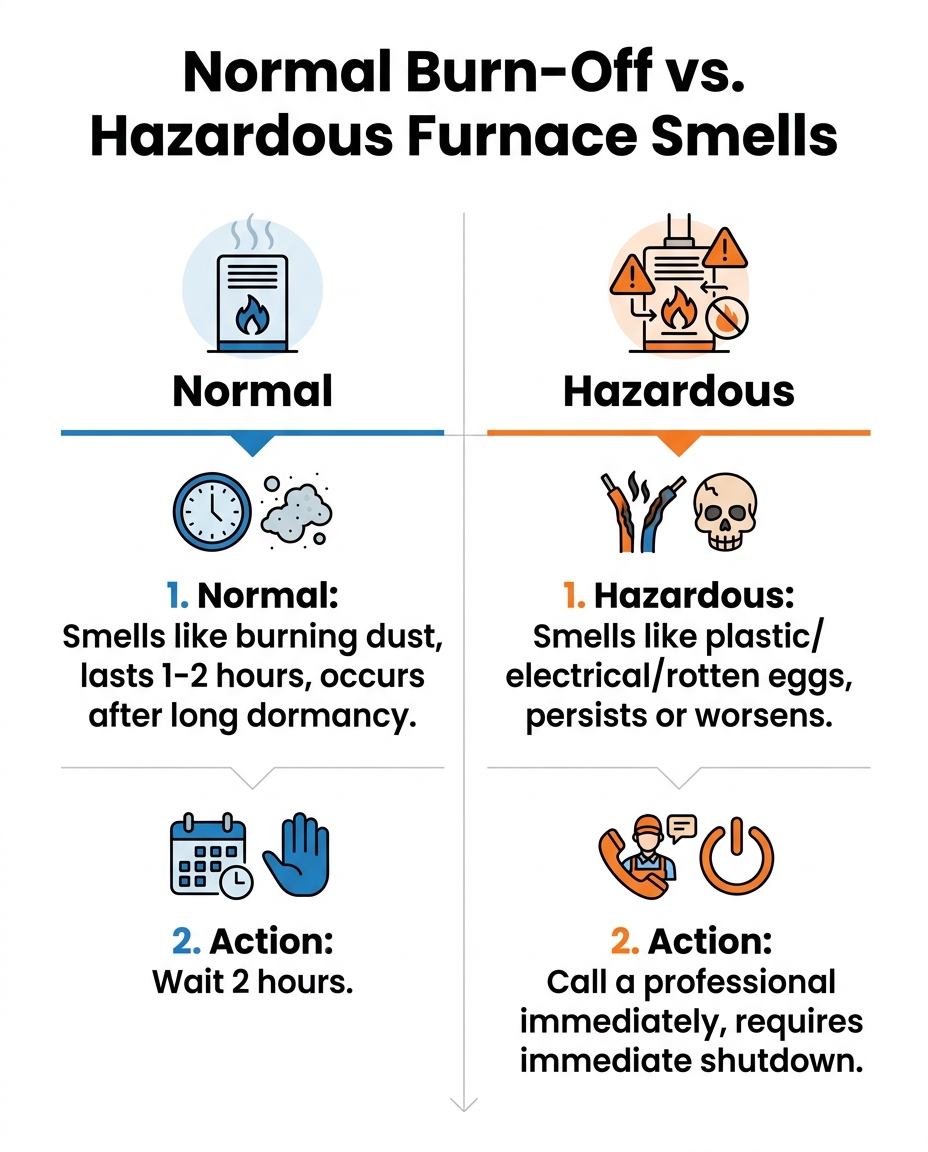
The short answer is that a harmless dust burn-off odor should dissipate relatively quickly. In most Mountain View homes we service, the smell peaks within the first 15 to 30 minutes of operation and completely fades after 1 to 2 hours of active running time. If your home has excellent airflow and you open a few windows to provide cross-ventilation during this initial cycle, the scent will clear out even faster. Our technicians always advise that if the odor lingers beyond that two-hour window, or if it grows noticeably stronger and more acrid, you are no longer dealing with simple settled dust.
Comparing Normal Dust Burn-Off vs. Hazardous Furnace Odors
Peace of mind comes from clear differentiation between normal odors and mechanical hazards. When we dispatch technicians for a mid-fall October heating startup, we often remind homeowners that their nose is the first diagnostic tool available. While burning dust is harmless, other scents act as immediate warning sirens that something inside your equipment is failing.
Use this comparison table to safely diagnose the type of smell you are experiencing and determine your next steps:
• Toasted / Burning Dust — Likely Cause: Settled household debris incinerating on the heat exchanger. — Expected Duration: 1 to 2 hours maximum. — Recommended Homeowner Action: Monitor the system. Open a window to help ventilate the room.
• Burning Plastic or Rubber — Likely Cause: Melting wire casings, a failing fan belt, or a foreign object caught in the blower. — Expected Duration: Persistent; usually worsens as the system runs. — Recommended Homeowner Action: Shut off the system at the thermostat immediately. Call a professional.
• Electrical / Metallic Ozone — Likely Cause: An overheating blower motor, failing capacitor, or electrical short. — Expected Duration: Persistent; often accompanied by humming or clicking noises. — Recommended Homeowner Action: Turn off power at the breaker panel. Do not run the system. Call a professional.
• Rotten Eggs / Sulfur — Likely Cause: A natural gas leak near the combustion chamber or gas valve. — Expected Duration: Immediate and highly dangerous. — Recommended Homeowner Action: Evacuate the home immediately. Call your gas utility provider and emergency services.
The rule of thumb is simple: any smell resembling gas, melting plastic, or an electrical fire requires immediate professional intervention. Never ignore these hazardous scents in the hopes that they will eventually fade away.
How Equipment Quality Impacts Seasonal Startup Performance
Not all heating systems handle the long off-season equally. The way your equipment manages dust accumulation and internal airflow plays a massive role in how noticeable that initial startup smell will be. When comparing features and warranties of top residential HVAC brands, you quickly see that modern, high-efficiency systems are engineered to minimize these seasonal nuisances.
Let's look at the pros and cons of different equipment tiers when it comes to handling seasonal transitions in the Mountain View and surrounding Bay Area:
• Pros of Premium Equipment: High-end systems utilize advanced, airtight cabinet sealing that physically prevents ambient basement or attic dust from infiltrating the heat exchanger during the summer. Furthermore, they often feature variable-speed blower motors and high-MERV media filter cabinets that capture microscopic particles before they ever reach the internal components. The result is a significantly milder burn-off odor.
• Cons of Standard Systems: Entry-level equipment often relies on basic fiberglass filters that only catch large debris. Their metal cabinets may have slight gaps that allow dust to settle freely on the burners and heat exchanger over the eight-month dormancy period, leading to a much heavier, more pungent burning smell on day one.
While every system will experience some degree of burn-off, equipment quality dictates how well the unit protects your indoor air quality over the long haul. Plum HVAC's extensive local experience means we don't just read the spec sheets—we know which brands actually have reliable parts availability and responsive manufacturer support in the Bay Area when a startup issue arises. Because we've spent years diagnosing fall startup issues, we know that if a smell actually points to a failing component rather than just dust, having a brand with strong local backing ensures your home doesn't stay cold for long.
Protecting Your Home's Air Quality During Autumn Transitions
The first use of your heating equipment rarely happens in a vacuum. It often coincides with major external environmental shifts that already challenge your respiratory comfort. In our region, we frequently observe that the timing of the heating startup directly aligns with local October wind events. These strong gusts stir up external particulate matter, pollen, and dry debris, heavily impacting the air you breathe.
When you combine the internal dust burning off your heat exchanger with the external pollutants entering your home during these wind events, you face a compounding effect that can drastically lower your indoor air quality. Spikes in indoor AQI levels during fall wind events are a common pattern we see on our service calls, leading to dry throats, irritated sinuses, and increased allergy symptoms right as the weather turns cold.
To combat this, proactive filtration management is essential. Before you even turn on the heater for the first time, you should inspect your ductwork registers and replace your primary air filter. Maintaining clean pathways ensures that the blower motor doesn't push months of accumulated vent dust into your living room alongside the burn-off odor.
Choosing the Right Filter for the Season
Upgrading your filter before the heating season begins is one of the most effective ways to protect your home's air. MERV (Minimum Efficiency Reporting Value) ratings determine how effectively a filter traps particles. While a basic MERV 4 fiberglass filter only stops large dust bunnies, our team typically recommends upgrading to a MERV 11 or MERV 13 pleated filter, which allows your system to capture fine household dust, pet dander, and external smoke particulates.
However, you must be careful not to over-filter. We have repaired countless blower motors that overheated because homeowners installed an overly restrictive filter their specific equipment was not designed to handle. This creates a severe pressure drop, forcing your blower motor to work twice as hard, which can lead to overheating and an electrical burning smell that has nothing to do with normal dust burn-off.
When to Schedule a Professional Pre-Winter Inspection
Observation is an excellent first step, but there comes a point where expert intervention is absolutely necessary. A comprehensive fall tune-up is your best defense against mid-winter breakdowns and hazardous operation. You should never attempt to dismantle your furnace to clean the burners or test the electrical relays yourself.
If you notice any of the following symptoms alongside high indoor AQI levels during fall wind events, it is time to schedule a professional inspection:
• Persistent Odors: If the burning dust smell lasts longer than two hours, or if you detect any hint of melting plastic or electrical ozone.
• Loud, Unusual Noises: Grinding, squealing, or heavy banging sounds upon startup indicate failing bearings, a loose blower wheel, or delayed gas ignition.
• Short-Cycling: If the heater turns on, runs for three minutes, and abruptly shuts off before warming the house, the system is likely overheating and engaging its safety limit switch.
• Yellow Burner Flames: If you can safely see the burner flames through the front grate and they are burning yellow or orange instead of a crisp blue, your system is experiencing incomplete combustion.
During a professional pre-winter inspection, a licensed technician performs critical safety checks that go far beyond a simple filter change. They verify heat exchanger integrity to prevent carbon monoxide leaks, tighten electrical connections to prevent shorts, and calibrate gas pressure for safe, efficient combustion. Seeking out qualified HVAC services in Mountain View ensures your equipment is fully prepared to handle the dropping temperatures safely.
Frequently Asked Questions About Furnace Smells and Fall Maintenance
Why does my heater smell like burning dust?
This happens because dust and airborne particles settle on your heat exchanger during the long months your system sits idle. When you turn the heater on for the first time in the fall, the sudden high temperatures incinerate these settled particles. The blower motor then pushes that temporary burnt odor through your ductwork and into your living spaces. It is a normal physical reaction to extended system dormancy.
How long does the burning smell last when you turn on the heater?
A normal dust burn-off smell typically peaks within the first 30 minutes and should completely disappear within 1 to 2 hours of continuous operation. Opening a few windows to improve ventilation can help clear the odor from your home much faster. If the smell persists beyond two hours, it is no longer just settled dust and requires professional attention.
When should I be worried about furnace smells?
You should be immediately concerned if the odor smells like melting plastic, burning electrical wires, metallic ozone, or rotten eggs. Additionally, if a standard burning dust smell continues for several hours or grows stronger over time, it indicates a larger issue. These specific scents point to overheating components, failing motors, or dangerous gas leaks that require urgent professional repair.
Is it safe to run a furnace that smells like burning?
It is only safe if the smell is strictly the scent of burning dust during the first 1 to 2 hours of the season's initial startup. If you detect any electrical, plastic, or sulfur-like odors, it is absolutely not safe to continue running the equipment. You should turn off the system immediately at the thermostat or breaker panel and contact a licensed technician.
Can a dirty air filter cause a burning smell?
Yes, a severely clogged air filter can restrict airflow so heavily that it causes the internal blower motor to overheat. When the motor strains against the restricted air pressure, its electrical components run too hot, producing an electrical burning smell. Regularly replacing your filter before the mid-fall October heating startup prevents this dangerous strain on your equipment.
How often should I schedule professional fall HVAC maintenance?
You should schedule a professional heating inspection once a year, ideally in the early fall before you need to rely on the system daily. Annual maintenance allows a technician to clean internal components, verify proper gas pressure, and inspect the heat exchanger for microscopic cracks. This proactive approach ensures safe operation and prevents unexpected breakdowns during the coldest weeks of the year.
Home Maintenance Tips and Troubleshooting: Ensuring a Safe, Odor-Free Heating Season
Navigating the transition into cooler weather doesn't have to be a stressful experience. Remember that a brief burning dust smell is a completely normal part of seasonal transitions in the Mountain View and surrounding Bay Area. As long as the odor fades within a couple of hours and isn't accompanied by strange noises or hazardous scents, your equipment is simply clearing its throat for the winter ahead.
However, your comfort and safety should never rely on guesswork. If you have any doubts about the odors coming from your vents, or if you want to ensure your system is operating at peak efficiency before the cold truly sets in, proactive home maintenance tips and troubleshooting always point toward expert help. Our team at Plum HVAC is here to assist—schedule a professional pre-winter inspection today to secure the reliable, odor-free warmth your home deserves.
hear what our satisfied clients have to say

.svg)
Service areas
.avif)