

Meeting Title 24 Requirements During a Fall HVAC Replacement in California
Navigating Mandatory State Energy Codes Before Winter Arrives
Your old furnace is finally giving out, and you are ready to schedule a replacement, only to discover a maze of state regulations standing between you and a warm house. Meeting Title 24 requirements during a fall HVAC replacement in California is a critical step that catches many homeowners off guard. As temperatures begin to drop and the early fall pre-heating season gets underway, our team at Plum HVAC has seen firsthand how understanding these mandatory energy efficiency codes becomes just as important as choosing the right equipment. These regulations dictate strict testing and verification processes that directly impact how and when your new system is installed.
Many property owners mistakenly assume that duct testing and sealing are optional services or contractor upsells. In reality, these are state-mandated compliance measures required to finalize your building permits. When navigating heating systems and planning a furnace replacement, partnering with an experienced contractor who understands the regulatory landscape ensures your project stays on schedule. By addressing these requirements proactively, we help you avoid unexpected delays and ensure your home is comfortable, compliant, and ready long before the severe winter weather arrives.
What is Title 24 and Why Does It Apply to HVAC Changeouts?
Title 24, specifically Part 6 of the California Code of Regulations, serves as the state's Building Energy Efficiency Standards. Enacted in 1978 and updated on a regular cycle, this comprehensive energy code is designed to reduce wasteful energy consumption in newly constructed and existing buildings. For the homeowners we serve in Mountain View CA, we always explain that these standards mean any significant alteration to a home's mechanical systems—including replacing a furnace, heat pump, or air conditioning unit—triggers mandatory compliance checks.
The Trigger for Mandatory Compliance
The state of California views an HVAC replacement as a major opportunity to improve a home's overall energy envelope. When our crew replaces a heating or cooling unit, the existing ductwork typically remains in place. If those older ducts are riddled with leaks, connecting them to a brand-new, high-efficiency furnace is like pouring premium fuel into a car with a punctured gas tank. To prevent this, Title 24 requires that whenever a central heating or cooling system is altered or replaced in most California climate zones, the ductwork must be tested for leakage.
Consumer Protection and Winter Comfort
While the paperwork and testing might feel like a bureaucratic hurdle, Title 24 is fundamentally a consumer protection measure. Addressing duct leaks mandated by Title 24 directly prevents expensive heat loss during the Bay Area's chilly, damp winter months. Without these standards, homeowners could spend heavily on premium heating equipment only to have a significant portion of their conditioned air escape into uninsulated attics or crawlspaces.
• System Efficiency — Without Title 24 Verification: Equipment works harder to compensate for lost air, reducing lifespan. — With Title 24 Compliance: Equipment operates at manufacturer-rated efficiency levels.
• Energy Consumption — Without Title 24 Verification: Higher monthly utility bills due to wasted heat in unconditioned spaces. — With Title 24 Compliance: Optimized energy usage, keeping operational costs under control.
• Indoor Air Quality — Without Title 24 Verification: Negative pressure can pull dust and allergens from crawlspaces. — With Title 24 Compliance: Sealed ducts prevent cross-contamination from attics and walls.
• Winter Comfort — Without Title 24 Verification: Uneven heating, cold spots, and drafts throughout the home. — With Title 24 Compliance: Consistent, balanced temperatures in every room.
By enforcing these standards, the state ensures that the high-efficiency equipment you purchase actually delivers the performance, comfort, and energy savings promised on the box. Compliance is not just a suggestion; it is a strict legal requirement for finalizing building permits with your local municipality.
The Mandatory HERS Duct Testing Process Explained
To ensure that duct testing is conducted fairly and accurately, California mandates the use of a third-party Home Energy Rating System (HERS) rater. This independent verification process separates the installation from the inspection, guaranteeing that the results are objective. When you schedule a Mountain View HVAC installation with us, the HERS rater acts as an impartial auditor to confirm that our installation work meets the state's stringent energy standards.
What Exactly Does a HERS Rater Do?
A certified HERS rater uses specialized diagnostic equipment to measure the precise amount of air escaping from your duct system. The most common method involves a "duct blaster" test. The rater temporarily seals all the supply and return registers inside the home, connects a calibrated fan to the central return, and pressurizes the ductwork. By measuring the airflow required to maintain that pressure, the rater can calculate the exact percentage of leakage.
• Initial inspection: The rater verifies the equipment matches the permit details.
• Pressurization: The duct system is sealed and pressurized to simulate operating conditions.
• Measurement: Diagnostic software calculates the leakage percentage.
• Reporting: The results are uploaded directly to the state's HERS registry.
The 15% Leakage Limit
Under current Title 24 guidelines, existing ductwork must typically demonstrate a leakage rate of 15% or less to pass the inspection. If your home has entirely new ductwork installed alongside the new heating system, the standard is even stricter, generally requiring a leakage rate of 5% or less. Given that many older homes we service in Mountain View CA have original, unsealed metal or flex ducts, failing the initial test is a scenario our technicians resolve frequently.
What Happens If the Ducts Fail?
If the ductwork exceeds the allowable leakage limit, it does not mean your project is doomed. It simply means that remedial action is required. Our installation team will locate the leaks—often found at joints, plenums, or disconnected runs—and seal them using mastic or approved foil tape. Once the repairs are complete, the HERS rater returns to perform a retest. This process guarantees that by the time the permit is closed, your system is genuinely delivering the expected comfort and efficiency without wasting heated air in your attic.
How Compliance Impacts Your Installation Timeline
Understanding the sequence of events during a compliant HVAC replacement is crucial for setting realistic expectations. Because Title 24 introduces third-party verification into the mix, the timeline extends beyond the actual day of installation. Scheduling this process during the early fall pre-heating season provides a strategic advantage, allowing us to navigate the bureaucratic steps before the severe winter backlog hits.
The Chronological Steps of a Compliant Installation
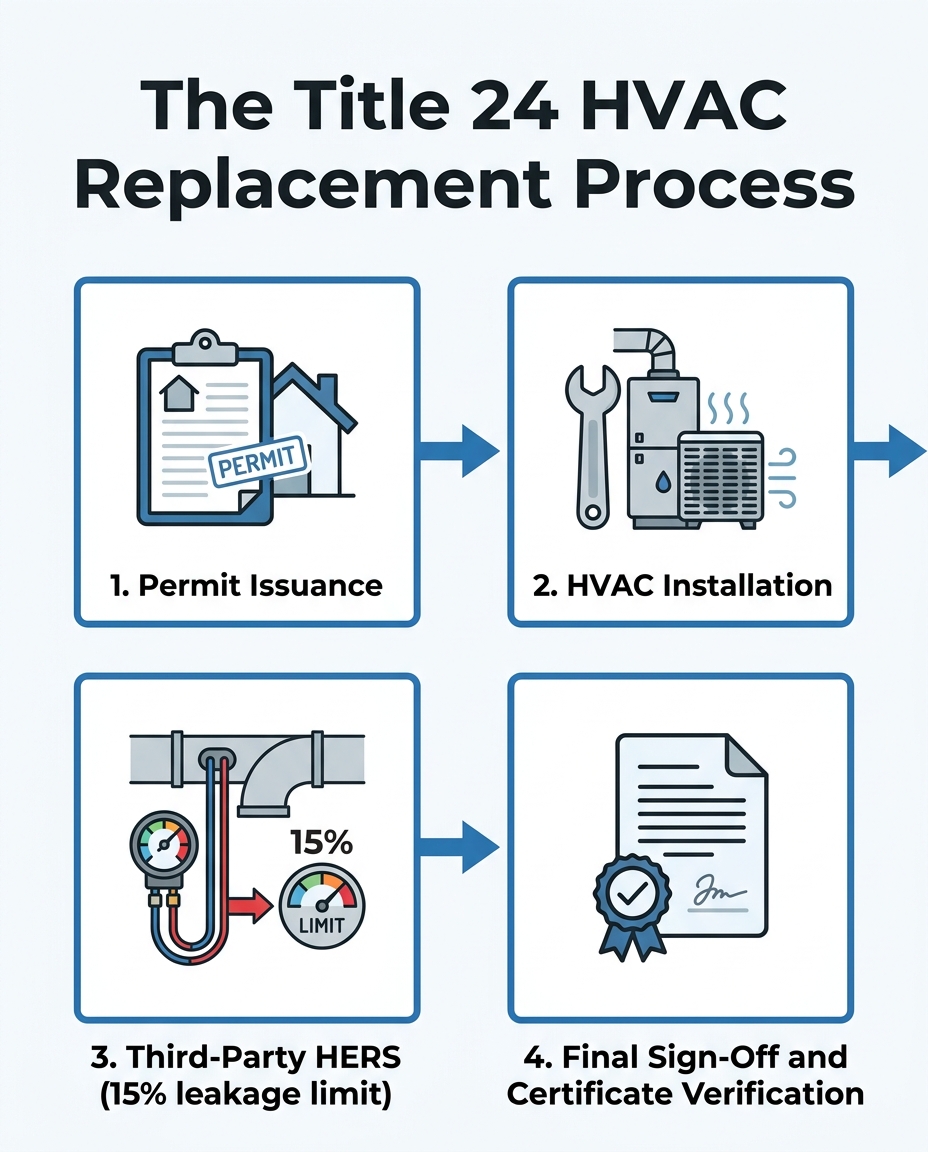
1. Permit Issuance: Before any work begins, our team pulls the necessary mechanical permits from the local building department. This involves submitting initial compliance forms detailing the scope of work.
2. Equipment Installation: The installation crew removes the old system and installs the new furnace or heat pump. This phase usually takes one to two days, during which your home will be without central heating.
3. Third-Party HERS Testing: Once the installation is complete and operational, a certified HERS rater is scheduled to perform the duct leakage test. This step requires coordination between the homeowner, our team, and the independent rater.
4. Remediation (If Necessary): If the ducts fail the initial test, we return to seal the leaks, followed by a subsequent retest by the HERS rater.
5. Final Sign-Off and Certificate Verification: After a passing score is recorded in the HERS registry, the final compliance certificates are generated. The local building inspector then visits the home to review the paperwork and finalize the permit.
Managing Expectations During the Testing Phase
Because coordinating a third-party HERS rater adds an extra step to the project timeline, homeowners should be prepared for a brief gap between the installation and the final sign-off. During the early fall pre-heating season, we find that raters are generally more available, making it easier to schedule prompt inspections. In contrast, waiting until the middle of a winter cold snap can lead to scheduling delays due to high demand. While your new heating system will be fully operational and keeping your home warm while you wait for the HERS test and final municipal inspection, the permit remains open until all Title 24 requirements are satisfied.
Navigating Permitting and Certificate Verification
The bureaucratic side of Title 24 compliance bridges state-level energy mandates with local building department enforcement. Municipalities require a clear paper trail proving that the newly installed system meets all efficiency standards before they will close a permit. For homeowners, the alphabet soup of compliance forms can be overwhelming, which is why working with a contractor who handles the administrative heavy lifting is essential.
The Paperwork Trail: CF-1R to CF-3R
The Title 24 compliance process relies on three primary certificates, each serving a distinct purpose in the state's HERS registry. Understanding these forms helps clarify why local HVAC permits and building codes require such rigorous documentation.
• CF-1R (Certificate of Compliance) — What It Is: Details the proposed scope of work and the specific energy features required for the project. — Who Completes It: The installing contractor or system designer before pulling the permit.
• CF-2R (Certificate of Installation) — What It Is: Verifies that the equipment installed matches the specifications outlined in the CF-1R. — Who Completes It: The installing contractor upon completion of the physical installation.
• CF-3R (Certificate of Verification) — What It Is: The official passing grade confirming the ductwork meets the state's leakage standards. — Who Completes It: The independent, third-party HERS rater after successful testing.
Local Enforcement in Santa Clara County
Local building departments are the ultimate enforcers of Title 24. In Mountain View CA and throughout Santa Clara County, building inspectors will not grant a final sign-off without seeing the completed CF-3R form generated by the HERS registry. Managing this documentation requires meticulous attention to detail. A minor clerical error in the registry can delay permit closure for weeks. At Plum HVAC, we act as your compliance advocate, handling the complex Santa Clara County permitting and Title 24 HERS registry processes on your behalf to ensure that all paperwork is filed correctly, sequentially, and on time.
Are There Exemptions to Title 24 Duct Testing?
While Title 24 casts a wide net over HVAC replacements, the state recognizes that certain regulatory edge cases make duct testing impractical, unsafe, or redundant. Deep localized knowledge of these exemptions can save time, provided the home legitimately qualifies. However, assuming an exemption applies without proper verification can lead to failed municipal inspections and costly delays.
Common Exemption Scenarios
The California Energy Commission outlines several specific scenarios where mandatory HERS duct testing may be waived during a system replacement. In our daily operations, the most frequently encountered exemptions include:
• Minimal Ductwork: Homes with less than 40 linear feet of total ductwork (both supply and return combined) are generally exempt from the leakage testing requirement. This is common in smaller properties or homes where the equipment is located centrally with very short duct runs.
• Asbestos-Containing Materials: If the existing ductwork contains asbestos, it cannot be safely pressurized for testing or disturbed for sealing. In these cases, testing is waived to protect the health of the occupants and the technicians. An asbestos exemption requires visual verification and documentation.
• Previously Certified Systems: If the duct system was previously tested, sealed, and certified under recent Title 24 codes (typically within the last few code cycles), and that documentation is accessible in the HERS registry, a new test may not be required.
How to Verify Your Exemption Status
It is crucial to understand that exemptions are not loopholes to be exploited; they are specific conditional waivers that must be formally documented. Only a licensed professional or the local building department in Mountain View CA can confirm whether your specific situation qualifies for an exemption. Our team must still file the appropriate CF-1R and CF-2R forms, noting the specific exemption code, which the municipal inspector will verify during the final site visit.
Upgrading to High-Efficiency Systems Under Current Codes
Connecting regulatory compliance to the broader benefits of modern system upgrades changes the perspective on Title 24. Rather than viewing the testing as a penalty, we encourage homeowners to see it as a baseline guarantee that your investment in high-efficiency technology will yield the expected returns. When you navigate these requirements during the early fall pre-heating season, you set your home up for optimal performance all winter long.
Why System Sizing Matters Under Title 24
Modern heating systems are designed to operate with precise airflow parameters. If a system is connected to leaky ducts, it must run longer cycles to satisfy the thermostat, negating the benefits of a high-efficiency rating. Title 24 compliance ensures that the infrastructure delivering the air is as efficient as the equipment generating the heat. This transition toward high-efficiency options, including heat pump upgrades, easily meets or exceeds state standards when paired with a sealed, verified duct system.
Leveraging Generic Incentives and Rebates
Because the state of California heavily incentivizes energy efficiency, upgrading your system in compliance with Title 24 often opens the door to financial benefits. While specific program details fluctuate, homeowners who install qualifying high-efficiency equipment and complete the required HERS verification frequently become eligible for generally applicable energy rebates or tax credits. For instance, federal tax credits may apply to qualifying heat pump installations. We always advise homeowners to verify current programs with their utility provider or a tax professional to maximize the return on their compliant HVAC investment.
Ensure a Compliant and Efficient Heating Installation This Fall
Navigating the complexities of California's energy codes requires proactive planning and a clear understanding of the rules. Title 24 duct testing is not an arbitrary hurdle; it is a vital process that ensures your new heating system operates at peak efficiency, keeping your energy usage manageable and your home comfortable. By addressing these compliance requirements during the early fall pre-heating season, you secure a smooth installation process before the winter weather creates a surge in demand.
Preparing for a compliant HVAC changeout means partnering with professionals who understand both the mechanical and bureaucratic demands of the state. Take the time to schedule a thorough early fall inspection of your current system and consult with our local experts at Plum HVAC. We can handle the equipment replacement, the HERS registry, and the municipal permitting process seamlessly from start to finish.
Frequently Asked Questions
What is Title 24 for HVAC?
Title 24 is California's Building Energy Efficiency Standards code. For HVAC systems, it mandates specific energy conservation measures, primarily requiring that ductwork be tested for leaks by an independent third party whenever a central heating or cooling system is replaced or significantly altered.
Is a HERS test required for a new furnace in California?
Yes, in most California climate zones, replacing a furnace triggers a mandatory HERS (Home Energy Rating System) test. An independent, certified rater must pressurize the existing ductwork to verify that air leakage falls within the state's allowable limits before the building permit can be finalized.
What happens if my air ducts fail the Title 24 test?
If your ducts fail the initial HERS test by exceeding the allowable leakage limit, the installation contractor must locate and seal the leaks. Once the necessary repairs are made using approved materials, the HERS rater will perform a retest to ensure the system now meets compliance standards.
How much duct leakage is allowed under Title 24?
For existing ductwork connected to a newly installed HVAC system, Title 24 typically requires a leakage rate of 15% or less. If the project involves installing entirely new ductwork along with the new equipment, the standard is much stricter, generally requiring a leakage rate of 5% or less.
Does Title 24 apply to HVAC replacements?
Yes, Title 24 applies to HVAC replacements, also known as changeouts or alterations. The state considers a replacement to be a major modification to the home's energy profile, thereby triggering the requirement to verify that the existing duct system is not wasting the efficiency of the new equipment.
Do I need a permit to replace my HVAC in California?
Yes, replacing an HVAC system requires a mechanical permit from your local city or county building department. Obtaining this permit is a legal requirement, and closing it successfully requires documented proof of Title 24 compliance, including the final certificates from the HERS registry.
hear what our satisfied clients have to say

.svg)
Service areas
.avif)