Scheduling Your Annual HVAC Maintenance Before the First Real Cold Snap Hits
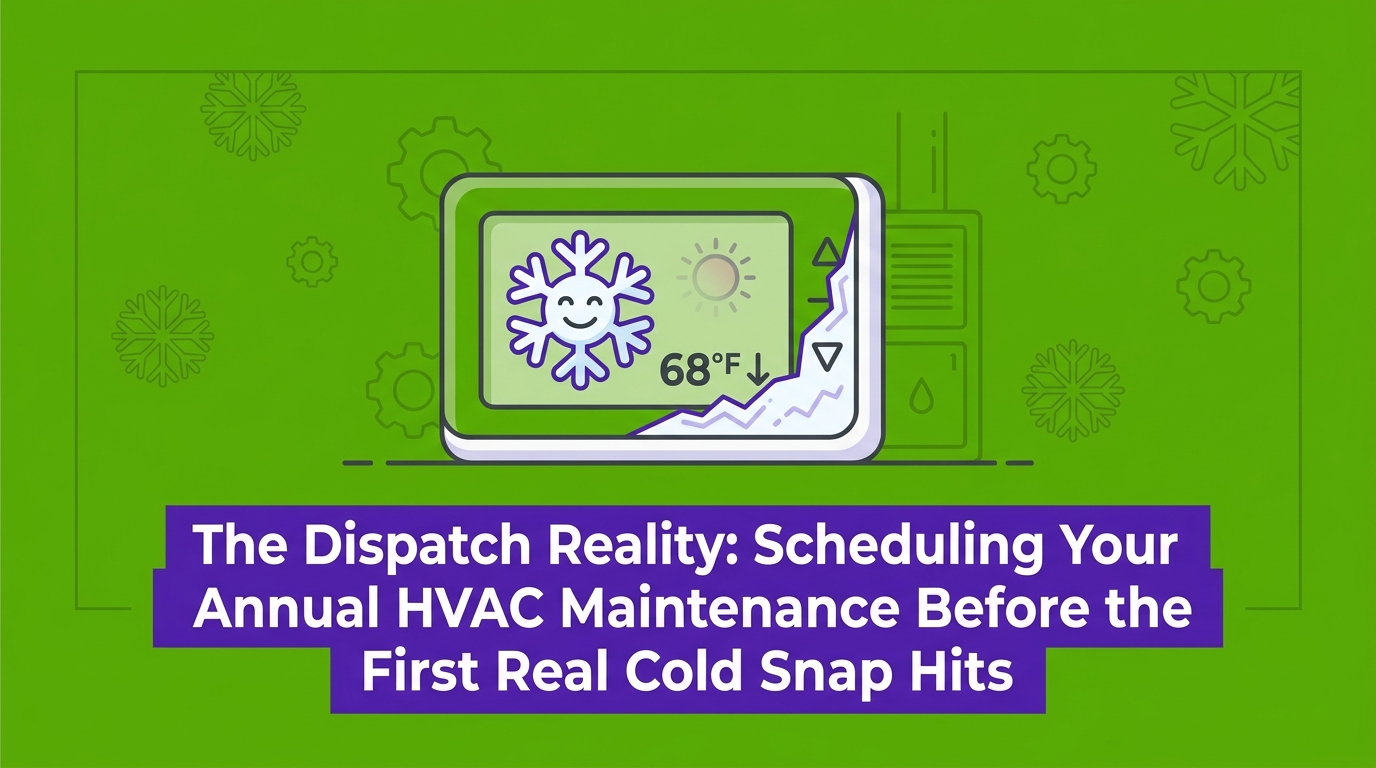
The Shift from Mild Autumns to Freezing Nights
Autumn in the Bay Area is just around the corner, and the secret to a stress-free winter is scheduling your annual HVAC maintenance before the first real cold snap hits. Right now, your furnace has likely been sitting idle since last spring, and the weather outside still feels incredibly forgiving. This creates a deceptive sense of security for many homeowners. You might look at the thermostat, see a comfortable indoor temperature, and push furnace preparation to the bottom of your to-do list. However, this procrastination is exactly what leads to widespread heating failures when the weather finally turns.
To keep your system running smoothly and avoid the seasonal rush, explore our heating services and secure your spot today.
The core problem lies in the predictability of human behavior combined with the unpredictability of regional weather. During the September early fall transition, days remain warm and nights are only slightly brisk. It feels entirely unnecessary to turn on a furnace. But weather patterns in our region do not gradually ease into winter. Instead, they drop off a cliff. One day you are wearing short sleeves, and the next evening, temperatures plummet.
When that sudden drop occurs, a massive regional consequence unfolds instantly. Thousands of homeowners walk to their thermostats on the exact same evening and switch their systems from "cool" to "heat." A significant percentage of those systems will fail to ignite, blow cold air, or shut down completely. This synchronized failure creates an immediate, overwhelming demand for heating technicians across the entire region. By choosing to book early, you make a strategic decision to bypass this chaotic bottleneck entirely.
Behind the Scenes of a November Dispatch Board
To truly understand why early booking matters, you need to see what happens inside an HVAC company when the weather shifts. A typical pattern we see is that dispatch boards run smoothly during mild weather, with technicians completing thorough tune-ups and proactive repairs. But the moment the first freezing night arrives, the logistical reality of the industry completely changes.
During a November cold snap, the incoming call volume does not just double; it multiplies exponentially overnight. When this happens, HVAC companies are forced to implement strict triage protocols. Industry standards dictate that emergency "no-heat" calls—especially for vulnerable households—must take absolute precedence over routine maintenance requests.
The Anatomy of a Service Spike
When the first freeze hits, the transition from a normal schedule to a full-blown service spike happens in a matter of hours. Here is how that escalation plays out:
• Overnight volume surges: Dispatchers arrive in the morning to hundreds of voicemails and online requests from homeowners who woke up to a freezing house.
• Technicians are rerouted: Any open slots in the schedule are immediately filled with critical failures. Technicians are sent to restore heat to homes with broken furnaces, pushing non-emergency tune-ups further down the queue.
• Wait times compound: Because emergency repairs take longer to diagnose and fix than routine maintenance, the schedule backs up quickly. A normal wait time of one day can instantly transform into a multi-day waiting list.
• Call Volume — Mild September Weather: Steady, predictable scheduling — First November Freeze: Exponential overnight surge
• Service Priority — Mild September Weather: Preventative maintenance and tune-ups — First November Freeze: Emergency no-heat triage
• Average Wait Time — Mild September Weather: Same-day or next-day availability — First November Freeze: Multi-day waiting lists for non-members
• Technician Pace — Mild September Weather: Relaxed, thorough preventative focus — First November Freeze: High-urgency emergency repairs
This is not a single company's capacity issue; it is an industry-wide logistical reality. Every certified technician in the region is dealing with the exact same surge. By understanding this process, you can clearly see why waiting for the cold to arrive is the riskiest strategy for your home comfort.
Why Idle Heating Systems Fail on the First Freezing Night
You might wonder why so many systems fail on the exact same night. The answer lies in the mechanical realities of heavy equipment that sits dormant for months. Your furnace is a complex machine relying on precise electrical connections, clean sensors, and moving parts. During the long summer months, these components are exposed to continuous dust, humidity, and inactivity.
When you attempt to start a dormant system at full capacity without a proper furnace tune-up, you are asking a compromised machine to perform its most stressful task. The September early fall transition is the perfect time to address these mechanical risks before they evolve into full system lockouts.
Common First-Run Failures
Heating systems rarely fail without a mechanical reason. When thousands of units break down simultaneously during a freeze, they usually suffer from one of these specific, preventable issues:
• Ignition failures due to dirty flame sensors: The flame sensor is a delicate safety device that detects whether a fire has successfully ignited. Over the summer, this sensor accumulates a thin layer of microscopic dust and oxidation. When the furnace tries to start, the dirty sensor fails to read the flame, causing the system to shut down immediately as a safety precaution.
• Blower motor strain from compromised capacitors: Capacitors store the electrical energy needed to jump-start heavy motors. After months of inactivity, a weak capacitor will struggle to deliver that initial jolt of power. The blower motor then draws excessive electrical current, overheats, and trips your circuit breaker.
• Safety switch trips from restricted airflow: Dust settles over your air filter, blower wheel, and heat exchanger during the off-season. When the furnace fires up, this restricted airflow traps heat inside the unit. The internal high-limit safety switch detects this dangerous temperature spike and shuts the entire system down to prevent a fire hazard.
Every single one of these common failures is entirely preventable with proactive maintenance. A technician cleans the sensors, tests the electrical draw, and verifies airflow long before the system is forced to work under pressure.
The Timeline of a Seasonal Transition
Understanding the seasonal timeline is your best defense against unexpected breakdowns. Mountain View's specific pattern of mild early autumn weather often masks underlying heating issues. Because the days stay comfortable so late into the year, your furnace remains off, quietly hiding its dirty sensors and weak electrical components until the sudden nighttime temperature drop forces it into action.
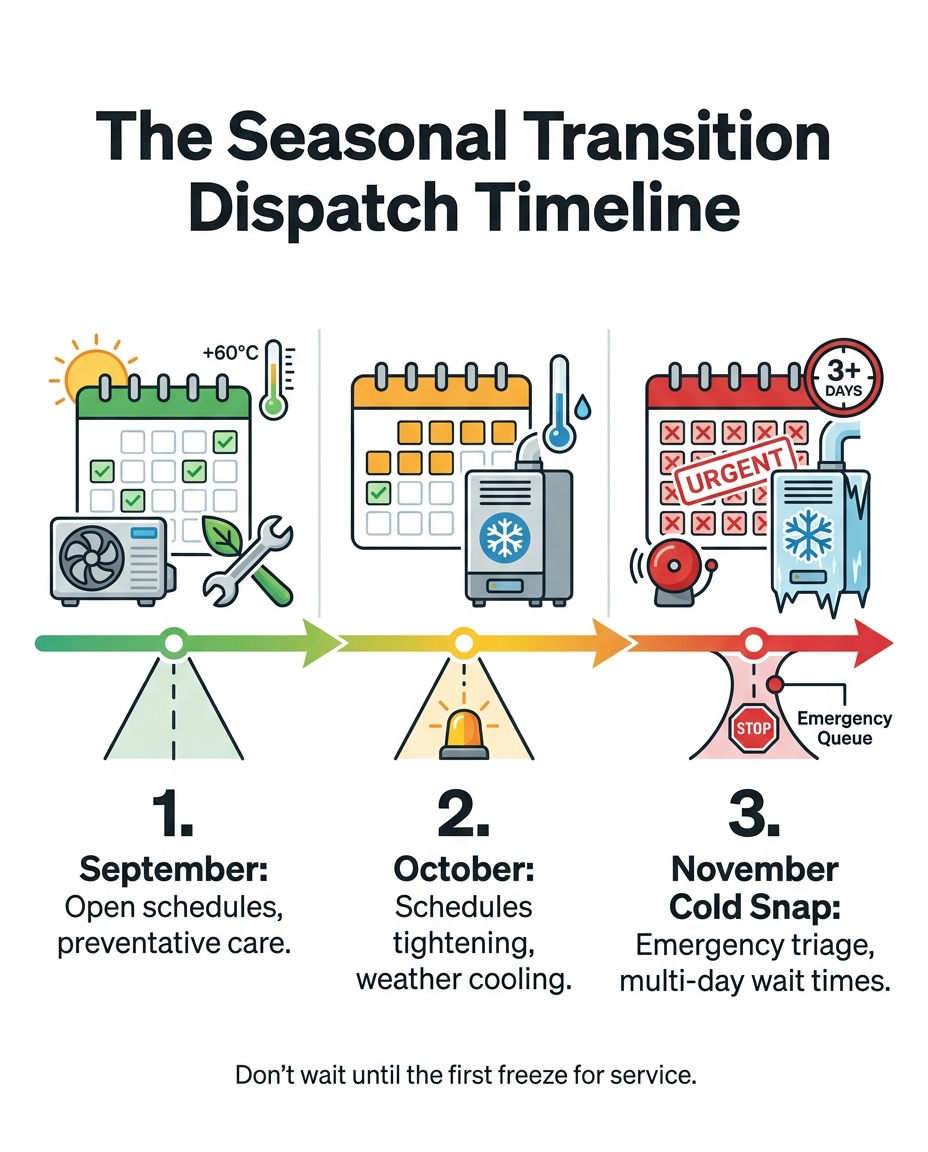
To visually demonstrate the advantage of acting early, here is the chronological breakdown of a typical fall transition:
1. The Early Fall Phase (September): This is the optimal window. Dispatch schedules are wide open. Technicians have the time to perform deep, thorough inspections. If a part needs to be ordered, there is plenty of time for shipping without leaving your family in the cold.
2. The Late Fall Phase (October): Weather begins to turn, and the most proactive homeowners start making calls. Availability decreases significantly. Schedules tighten, and you may have to wait a few days to get a time slot that fits your personal schedule.
3. The Freeze Phase (November): The first major cold snap arrives. The system reaches maximum capacity. Emergency triage protocols take over, resulting in prolonged wait times for anyone who is not already on a priority list.
By mapping this out, the strategic advantage becomes obvious. Securing time with highly trained Mountain View HVAC technicians during the early fall phase guarantees your system is ready before the triage protocols ever begin.
Bypassing the Queue: The Priority Dispatch Advantage
Even with the best intentions, life gets busy, and sometimes maintenance gets delayed. However, there is a structural advantage built into the HVAC industry designed specifically to protect proactive homeowners during chaotic weather events: priority dispatch.
When a November cold snap hits and the dispatch board lights up with hundreds of emergency calls, priority dispatch systems automatically reorganize the queue. This mechanism identifies proactive plan members and moves them directly to the front of the line, bypassing the massive backlog of non-members waiting for service.
The contrast in experience is stark. A typical non-member calling during a regional freeze might be told they have to wait three to four days for a technician to become available. A member, however, receives expedited routing, ensuring their home is serviced as quickly as physically possible. Working with Plum HVAC means your proactive choices are rewarded; our priority dispatch for maintenance plan members is the smartest way to avoid the chaotic late-fall rush.
This is the ultimate peace of mind against seasonal unpredictability. By securing premium maintenance plan coverage, you are not just buying a tune-up; you are buying a permanent fast-pass for those critical days when everyone else in the region is scrambling for help.
What Happens During a Comprehensive Pre-Winter Tune-Up
The urgency to book early is driven by the sheer depth of the work required to truly prepare a furnace for winter. A professional tune-up is far more than just swapping out an air filter and turning the thermostat on. It is a rigorous, multi-point inspection designed to catch microscopic failures before they cause mid-season breakdowns.
During the September early fall transition, an annual HVAC maintenance plan visit gives the technician the time needed to execute every step of this critical process without rushing to the next emergency call.
Safety First: The Critical Checks
Your furnace relies on controlled combustion to heat your home, making safety inspections the most vital part of the visit.
• Carbon monoxide safety checks: Technicians inspect the heat exchanger for hairline cracks. Even a microscopic fracture can allow dangerous combustion gases to leak into your home's breathing air.
• Ensuring proper venting: The flue pipe must be completely clear of debris, bird nests, or blockages to safely exhaust gases outdoors.
• Testing all limit switches: Every safety control is manually triggered to ensure the furnace will automatically shut down if it overheats or detects a dangerous condition.
Efficiency and Performance
Once the system is verified as safe, the focus shifts to preventing breakdowns and lowering your energy waste.
• Optimizing burner performance: Burners are cleaned and adjusted to ensure a crisp, blue flame, which maximizes heat output and minimizes fuel waste.
• Checking electrical draws: Technicians use multimeters to measure the exact voltage and amperage of the blower motor and inducer fan, catching failing components before they trip your breakers.
• Calibration of thermostats: Startup cycles are tested to ensure the thermostat communicates perfectly with the control board, providing accurate, even heating throughout the home.
Common Questions About Pre-Winter Heating Service
Why is it important to schedule HVAC maintenance in early fall?
Booking in early fall guarantees you secure a convenient appointment before the regional dispatch boards fill up. During the September early fall transition, technicians have open schedules to perform thorough inspections and order any necessary parts. Waiting until winter means risking a breakdown when demand is at its absolute highest.
How long does it take to get an HVAC technician during a cold snap?
During a sudden freeze, wait times for non-members can easily stretch to multiple days. HVAC companies must prioritize emergency "no-heat" calls for vulnerable households over routine service. If you are not on a priority dispatch list, you will be placed at the back of a rapidly growing queue.
What happens if I skip furnace maintenance?
Skipping maintenance drastically increases the risk of a sudden mechanical failure, especially on the first cold night of the year. Dust buildup on flame sensors and strain on untested electrical components frequently cause safety lockouts. Additionally, neglecting safety checks leaves you vulnerable to undetected carbon monoxide leaks from cracked heat exchangers.
How often does a heating system need to be serviced?
Every heating system requires a comprehensive professional tune-up exactly once a year, ideally in the fall before heavy usage begins. Annual service is required by most manufacturers to keep equipment warranties valid. Regular cleaning and calibration consistently extend the overall lifespan of the unit.
Can I test my heater myself before calling a professional?
You should absolutely turn your thermostat to "heat" in early September to verify that warm air blows through your vents. However, this basic functional test does not replace a professional tune-up. Only a licensed technician has the tools to inspect heat exchangers, test electrical draws, and clean delicate ignition sensors safely.
Secure Your Spot Before the Temperatures Drop
The logic is simple: the best time to prepare for winter is before the weather forces you to. By taking action while the dispatch boards are still manageable, you secure your family's comfort without the stress of competing with thousands of other homeowners during a November cold snap.
Do not let a mild afternoon trick you into delaying critical mechanical care. Take control of your seasonal transition today. Reach out to secure your spot on the schedule, ensuring your heating system is clean, calibrated, and ready to deliver reliable warmth the moment you actually need it.
hear what our satisfied clients have to say

.svg)
Service areas
.avif)