

Why September is the Ideal Window for a Pre-Heating Season Tune-Up in the Bay Area
The Hidden Risks of Waiting for the First Cold Morning
As summer begins to fade, you might be wondering why September is the Ideal Window for a Pre-Heating Season Tune-Up in the Bay Area, especially when afternoon temperatures still require air conditioning. The transition into early fall often carries a deceptive warmth. It feels entirely too hot during the day to even consider your home’s heating system. However, this mindset creates a significant vulnerability for your household comfort and safety. The most concrete problem homeowners face during this seasonal shift is the sudden need to turn on an idle furnace for the very first time during an unexpected cold snap, completely without prior safety verification. When a furnace sits dormant for months, internal components collect dust, electrical connections can loosen, and unseen wear from the previous winter remains unaddressed.
To make sure your home is ready for the transition, our comprehensive heating services provide the safety and reliability you need.
The decision point arrives right now, during the mild September shoulder season. You have the choice to schedule proactive maintenance on your own timeline, or wait for an inevitable breakdown when technicians are overwhelmed with emergency calls. Taking action during this brief window ensures that your system is professionally evaluated before the true cold weather sets in. Comprehensive heating services performed during this specific timeframe are designed to prevent emergency failures. By addressing minor wear and tear before the system is placed under heavy load, you protect your equipment from severe damage and protect your family from the hazards of a malfunctioning furnace.
Navigating the Bay Area's Unique 'Indian Summer' Microclimates
The regional weather patterns in Northern California make the transition period uniquely stressful on residential HVAC systems. The Bay Area is famous for its "Indian Summer" phenomenon, a specific meteorological pattern that occurs just as the calendar turns to fall. During this time, daytime high temperatures routinely remain in the upper 80s, baking the outside of your home, while overnight lows can suddenly plummet into the low 50s or high 40s. These rapid, dramatic temperature swings force your climate control system to work in completely opposite directions within a single 24-hour period.
This is where Plum HVAC's deep expertise in Bay Area microclimates becomes essential, allowing for tailored maintenance that addresses both air quality during smoke season and core heating reliability. A localized approach to maintenance is absolutely necessary for homes dealing with these rapid temperature swings. Generic, one-size-fits-all maintenance checklists often fail to account for the heavy mechanical burden placed on systems that must cool a home at 3:00 PM and heat it by 4:00 AM.
The Strain of Rapid Mode Switching
When thermostats rapidly call for air conditioning in the afternoon and heat by dawn, the mechanical wear and tear on your system accelerates. The blower motor, which is responsible for distributing both cooled and heated air throughout your ductwork, ends up operating almost continuously under constantly changing demands. This heavy usage during the September shoulder season can expose weak capacitors, failing bearings, or stressed belts that might have otherwise survived a milder transition.
• Afternoon (2 PM - 5 PM) — Typical Indian Summer Temperature: 82°F - 88°F — HVAC System Demand: High Cooling Load — Mechanical Stress Point: Compressor and Condenser Fan
• Evening (6 PM - 10 PM) — Typical Indian Summer Temperature: 65°F - 70°F — HVAC System Demand: System Idle or Fan Only — Mechanical Stress Point: Blower Motor Continuous Operation
• Early Morning (2 AM - 6 AM) — Typical Indian Summer Temperature: 48°F - 54°F — HVAC System Demand: Moderate to High Heating Load — Mechanical Stress Point: Furnace Ignition and Heat Exchanger
As the table illustrates, the shifting demands place immense pressure on shared components like the blower motor. A tune-up in Mountain View or the surrounding communities must specifically evaluate these shared components to ensure they can handle the whiplash of Indian Summer weather.
The Overlap of Wildfire Smoke and Heating Preparation
Early fall is historically the peak for regional wildfire smoke in Northern California. This climate-specific reality creates an urgent need for filter assessment before the heating season officially starts. As smoke blankets the region, heavy particulate matter—including ash, soot, and microscopic debris—is pulled into your home's return vents. Your air filter works overtime to capture these pollutants, which severely clogs the filter media much faster than normal household dust.
Understanding the wildfire smoke impacts on your HVAC filter is critical for protecting your furnace. Starting a furnace with a smoke-clogged filter introduces a cascade of performance and safety issues. The dense layer of trapped particulates acts like a solid wall, restricting the necessary airflow your furnace needs to operate safely. Connecting filter replacement to both indoor air quality and furnace longevity is a primary focus of early fall maintenance.
Airflow Restrictions and System Overheating
Blocked airflow forces the heat exchanger to retain too much heat. The heat exchanger is the metal component that safely transfers heat from the combustion gas into your home's air supply. When restricted airflow prevents cooler air from blowing over the heat exchanger, the metal overheats rapidly. This excessive heat triggers the furnace's high-limit safety switches, which are designed to shut the system down to prevent a fire or a cracked heat exchanger.
The cascading effects of a smoke-clogged filter include:
• Short-cycling: The furnace turns on, overheats in minutes, shuts down for safety, and then turns back on once it cools, repeating the cycle endlessly.
• Increased energy consumption: The blower motor strains against the blocked filter, drawing significantly more electricity to force air through the dense ash.
• Premature component failure: Constant overheating weakens the metal of the heat exchanger, leading to microscopic stress fractures over time.
• Compromised air quality: A fully saturated filter can no longer trap new pollutants, allowing fine smoke particulates to bypass the filter and circulate through your living spaces.
By scheduling maintenance during the September shoulder season, a professional can remove the heavily soiled summer filter, clean the blower compartment of any bypassed ash, and install a fresh filter perfectly timed for winter heating.
Safety First: Why Idle Furnaces Need Verification
Focusing on the safety hazards of starting an idle furnace without a professional check is the most important reason to act early. According to Department of Energy (DOE) data, dirty filters and neglected maintenance are leading causes of HVAC system failure. Furthermore, National Fire Protection Association (NFPA) warnings consistently highlight that heating equipment remains a leading cause of home fires in the United States. These statistics underscore the reality that a furnace is a controlled combustion appliance operating inside your home, and it requires professional verification after months of inactivity.
During the long summer months, several things happen to dormant furnace components. Dust accumulation settles thickly over the burners, flame sensors, and ignitors. Electrical connections expand and contract with the summer heat, potentially loosening wires that control vital safety mechanisms. A thorough furnace inspection mitigates these dormant-season risks by verifying that every safety switch, gas valve, and exhaust flue is operating exactly as the manufacturer intended.
Combustion and Electrical Hazards
The danger of cracked heat exchangers leaking carbon monoxide cannot be overstated. Carbon monoxide is an odorless, colorless gas produced during the heating process. A healthy heat exchanger keeps this gas safely contained and vents it outside. However, if the metal has cracked due to age or overheating, that toxic gas can leak directly into the air circulating through your home. Because carbon monoxide is undetectable without specialized equipment, a professional safety check during the September shoulder season is a critical protective measure.
Additionally, dust buildup on burners causes delayed ignition or small flare-ups on the first startup. When the thermostat calls for heat, gas flows into the burners. If dust blocks the ignitor, the gas can pool for a few seconds before finally catching a spark, resulting in a miniature explosion inside the cabinet. This "roll-out" can damage wiring and create a serious fire hazard. Professional cleaning ensures smooth, safe ignition on that very first cold morning.
Beating the Late-Fall Emergency Service Rush
Treating early fall as a strategic booking window rather than just a generic seasonal recommendation gives you a significant advantage. There is a predictable, massive surge in emergency calls that occurs on the exact morning temperatures first drop below 50 degrees. Across the region, thousands of homeowners turn their thermostats to "heat" simultaneously. Inevitably, a large percentage of those dormant systems will fail to ignite, blow cold air, or shut down entirely.
By the time the sun rises on that first cold day, local HVAC dispatch boards are completely overwhelmed. Wait times for a technician can stretch from a few hours to several days. For Mountain View homeowners, booking early guarantees technician availability and flexible scheduling. You get to choose an appointment time that works for your calendar, rather than taking time off work to wait for an emergency window.
Furthermore, proactive scheduling allows time for any necessary part replacements before the cold weather sets in permanently. If an inspection reveals a failing inducer motor or a weak capacitor, the part can be ordered and installed while the weather is still mild. You avoid the stress of sitting in a freezing house waiting for a supply house to deliver a replacement component. Ultimately, early booking provides the peace of mind that comes with knowing the system is fully ready on demand.
What a Professional Pre-Season Tune-Up Includes
A true pre-season tune-up goes far beyond simply changing the filter and turning the system on. It is a comprehensive, step-by-step evaluation of the mechanical, electrical, and combustion systems. When performed during the September shoulder season, this deep-dive inspection ensures every component is calibrated for maximum efficiency and safety.
A professional furnace maintenance checklist includes:
• Testing and calibrating the thermostat: Ensuring the thermostat accurately reads the room temperature and correctly communicates with both the heating and cooling sequences.
• Inspecting and cleaning the blower motor and wheel: Removing dust and debris to ensure proper airflow, measuring the motor's amperage, and checking the condition of the blower belt if applicable.
• Evaluating the heat exchanger: Using specialized inspection cameras to check for microscopic cracks, rust, or signs of metal fatigue that could lead to carbon monoxide leaks.
• Checking all electrical connections: Tightening loose wires, inspecting the control board for burn marks, and measuring voltage and current on all motors to prevent electrical failures.
• Assessing and replacing the air filter: Removing the summer filter, which is often heavily compromised after smoke exposure, and installing a fresh, appropriately rated filter for the winter season.
• Cleaning and adjusting the burner assembly: Removing soot and dust from the burners to ensure a clean, efficient blue flame and prevent delayed ignition.
• Testing safety controls: Verifying that the high-limit switch, pressure switches, and flame rollout switches all function correctly and will shut the system down in an emergency.

Common Questions About Fall Furnace Maintenance
Why is fall the best time for a furnace tune-up?
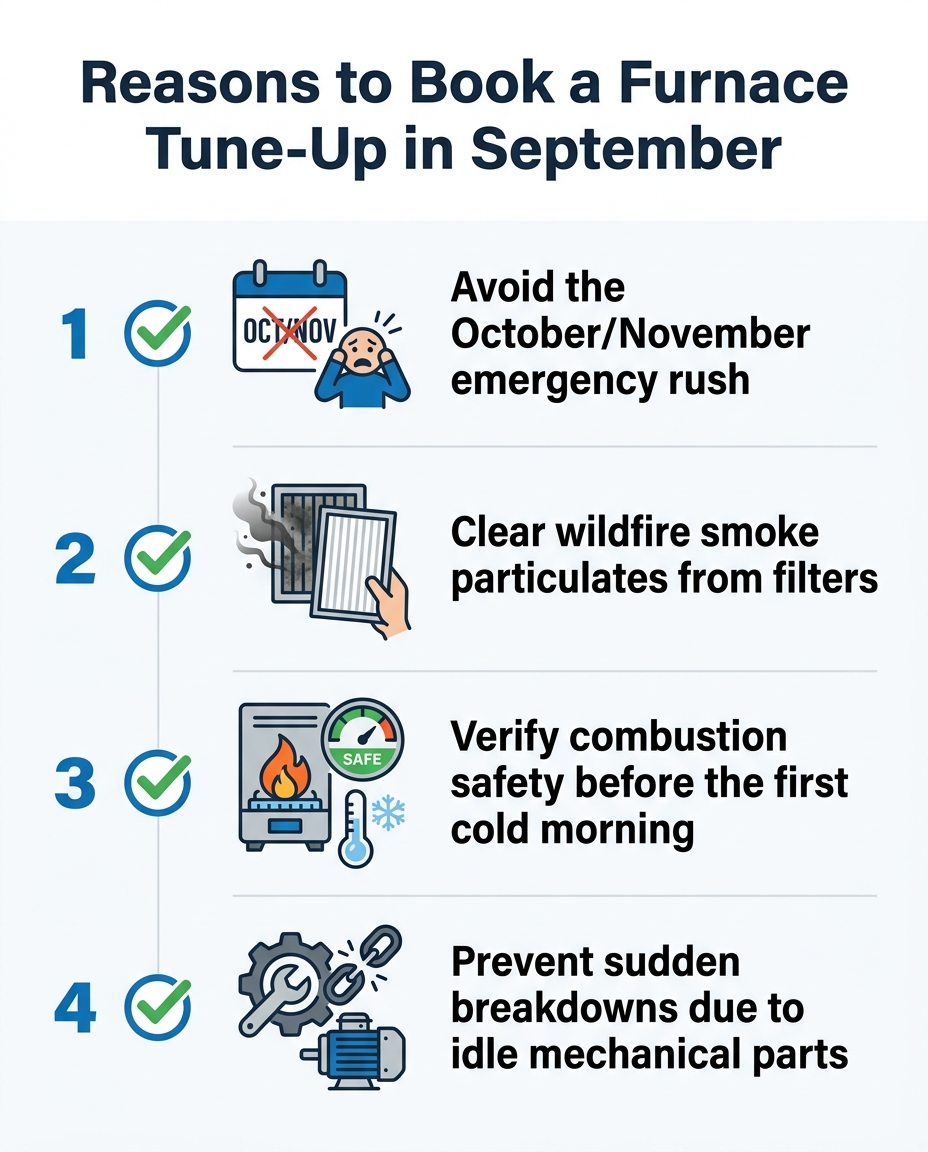
Fall offers a critical window of mild weather where your HVAC system isn't under heavy demand for either heating or cooling. Scheduling during the September shoulder season ensures technicians are readily available before the winter emergency rush begins. It also allows time to order and replace any failing parts without leaving your home without heat during freezing temperatures.
What happens if I skip furnace maintenance before winter?
Skipping maintenance drastically increases the risk of sudden breakdowns, higher energy bills, and safety hazards. Dust buildup on idle components can cause delayed ignition or sensor failures, while a neglected, clogged filter will restrict airflow and overheat the system. Over time, avoiding annual checks can void your manufacturer warranty and shorten the overall lifespan of the equipment.
How does wildfire smoke affect my HVAC system's heating performance?
Wildfire smoke introduces heavy, dense particulate matter into your return air ducts, which clogs your air filter much faster than normal household dust. If you start your furnace with a smoke-clogged filter, the restricted airflow forces the heat exchanger to overheat, triggering safety shutdowns. Replacing this compromised filter in early fall is essential for both system efficiency and indoor air quality.
Do I really need a furnace tune-up every single year?
Yes, annual maintenance is strongly recommended by equipment manufacturers and safety organizations alike. A furnace is a complex machine that burns fuel inside your home; annual inspections verify that combustion gases like carbon monoxide are venting safely outdoors. Regular tune-ups also keep the system running efficiently, which minimizes unnecessary wear and tear on moving parts.
How long does a pre-season furnace inspection typically take?
A thorough, professional furnace tune-up generally takes between one to two hours to complete. This timeframe allows the technician to carefully clean the burners, inspect the heat exchanger, test all electrical safety switches, and verify system calibration. If the system has been heavily neglected or requires deep cleaning due to smoke exposure, the process may take slightly longer.
Secure Your Comfort Before the First Cold Morning Strikes: Why September is the Ideal Window for a Pre-Heating Season Tune-Up in the Bay Area
Early fall remains the most logical time for safety and reliability checks on your residential heating system. By taking action now, you secure the dual benefit of clearing out harsh summer smoke particulates while prepping the internal mechanics for winter heat. Waiting for the first freezing morning only guarantees stress, potential safety hazards, and long wait times for emergency repairs.
To keep your Mountain View home consistently comfortable, the best approach is proactive care. We strongly encourage readers to enroll in a routine maintenance plan to keep their systems protected year-round. Taking care of your furnace during the September shoulder season ensures that when you finally switch that thermostat to "heat," you are met with safe, warm, and reliable airflow.
hear what our satisfied clients have to say

.svg)
Service areas
.avif)