

Recognizing the Signs of End-of-Season AC Fatigue Before Labor Day
The Hidden Risks of Late Summer Cooling Demands
The late-August/Labor Day transition is quickly approaching, and recognizing the signs of end-of-season AC fatigue before Labor Day is critical for keeping your home comfortable. Your air conditioner has been running constantly through July and August, bearing the brunt of the heavy summer workload. Now, as the holiday weekend nears, you might start noticing subtle drops in performance. At Plum HVAC, we see many homeowners brush off these small changes as normal summer wear and tear. However, in our years of servicing local systems, we've learned that ignoring these early warning signs right before peak late-summer heatwaves can leave you sweating through a long, uncomfortable weekend. Evaluating your system's health right now is the smartest way to avoid a sudden breakdown when you need cooling the most.
When you need reliable air conditioning services, our team knows that scheduling proactive AC maintenance in Mountain View is the best way to protect your system.
By the time late August rolls around, your cooling system has logged hundreds of hours of operation. This continuous workload takes a mechanical toll on moving parts, electrical components, and the overall efficiency of the unit. The risks of ignoring this accumulated stress are significant. A system that is slightly fatigued today can easily turn into a completely failed system tomorrow, especially when outdoor temperatures suddenly spike.
Common hidden risks of late summer AC operation include:
• Compromised electrical components: Capacitors and contactors degrade after months of continuous high-voltage operation.
• Clogged airflow pathways: Summer dust and debris build up on filters and coils, severely restricting the system's ability to breathe.
• Lubrication breakdown: Motor bearings lose their lubrication over time, leading to excess friction and overheating.
• Refrigerant stress: Minor leaks that started in June can compound by August, leaving your system starved for the exact chemical it needs to remove heat from your home.
Addressing these hidden risks before the holiday weekend ensures your system is prepared for whatever the late summer climate brings.
Why September is the Ultimate Test for Your Air Conditioner
Many people assume that once August ends, the cooling season is effectively over. If you live in Mountain View, you already know this is far from the truth. Our technicians at Plum HVAC regularly respond to emergency calls during sudden, severe September heat spikes, which put maximum load on already stressed HVAC systems. While coastal fog might cool down neighboring areas, the valley often traps heat, creating intense temperature swings that force your air conditioner to work overtime.
Operating an already fatigued system during these sudden temperature spikes creates a perfect storm for mechanical failure. When the outdoor temperature jumps from a mild 75 degrees in the morning to a blistering 95 degrees by mid-afternoon, your air conditioner has to ramp up its cooling capacity instantly. If the system is already worn down from July and August, it lacks the reserve capacity needed to handle this extreme demand.
One of the primary culprits behind this reduced capacity is the accumulation of summer debris. Over the past few months, your outdoor condenser unit has been sucking in pollen, dirt, lawn clippings, and airborne dust. This debris coats the condenser coils, creating an insulating layer that prevents the system from releasing heat into the outdoor air. When heat cannot escape, the entire cooling cycle slows down, destroying your system's efficiency.
The upcoming holiday weekend represents a critical threshold for securing system reliability. If your air conditioner is struggling to shed heat because of dirty coils or worn components, a September heatwave will push it past its breaking point. Preparing your system now is the only way to ensure it survives the hottest days of the year.
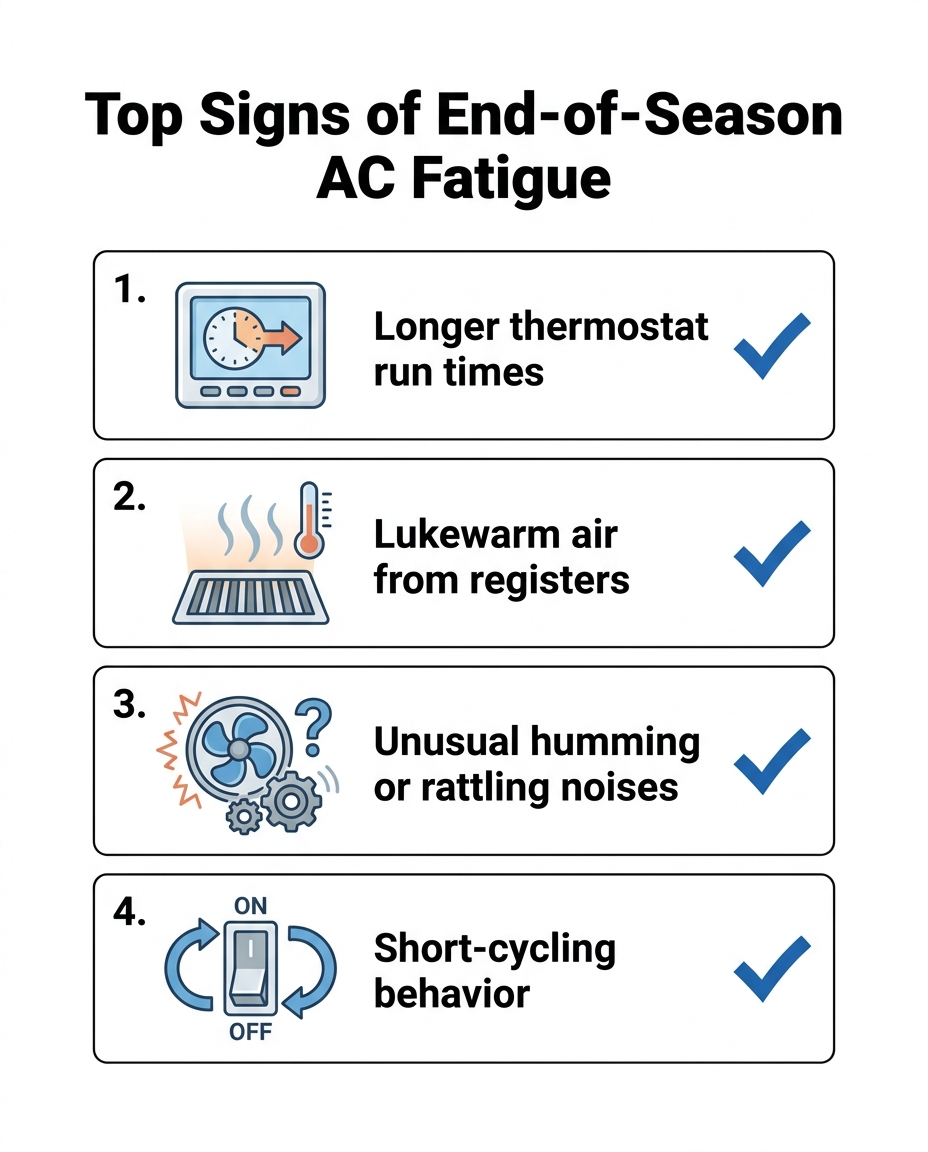
Warning Sign 1: Deciphering Extended Cooling Cycles
The Problem: You might notice that your air conditioner is running almost continuously. Longer thermostat run times are a classic indicator that your system is struggling to keep up with the cooling demand. While it is normal for an AC to run more frequently during the hottest part of the day, a system that never seems to shut off is experiencing a significant drop in capacity.
The Cause: An abnormally long cooling cycle occurs when the system cannot remove heat from your home fast enough to satisfy the thermostat setting. As mentioned earlier, this is frequently caused by restricted airflow or dirty coils. When the heat transfer process is compromised, the air conditioner has to run for 45 minutes to achieve the same temperature drop that used to take 15 minutes. This places exponential stress on the compressor motor, forcing it to operate at high temperatures for extended periods without a break.
The Solution: We highly recommend monitoring your cycle lengths during the hottest parts of the day. If the system runs for more than 20 to 30 minutes at a time without shutting off, it requires professional attention. One of our licensed technicians can measure the system's output, clean the necessary components, and restore the proper heat transfer rate.
The Impact of Dirty Coils on Efficiency
The condenser coils in your outdoor unit rely on direct contact with the air to dissipate the heat removed from your home. When summer debris insulates these coils, the resulting drop in heat transfer capability is dramatic. The refrigerant inside the coils stays hot, meaning it cannot absorb as much heat when it cycles back inside your house. This inefficiency is exactly why the system is forced to work overtime. Restoring bare-metal contact between the coils and the outside air is vital for efficient operation.
Warning Sign 2: Lukewarm Air from Your Registers
Another subtle symptom our team frequently encounters during the late-August/Labor Day transition is a change in the temperature of the air coming from your vents. If you hold your hand up to a register and notice a subtle shift from crisp, cold air to mildly cool or lukewarm air, your system is signaling a deep underlying issue.
This symptom often goes unnoticed until the outdoor temperature spikes. On a mild day, mildly cool air might eventually bring the house down to the desired temperature. However, when a September heatwave hits, lukewarm air simply cannot combat the intense heat infiltrating your home. Potential causes for this issue include a struggling compressor that isn't pressurizing the refrigerant correctly, a slow refrigerant leak that has depleted the system's charge, or severely restricted airflow that prevents the indoor coil from absorbing heat.
The most common reaction to lukewarm air is to walk over to the thermostat and lower the temperature setting even further. You must avoid doing this. Lowering the thermostat does not make the air coming out of the vents any colder; it only commands the system to run longer. If the system is already blowing lukewarm air because of a mechanical or refrigerant issue, forcing it to run continuously will only exacerbate the strain and accelerate a complete breakdown.
Warning Sign 3: Unusual Noises and Mechanical Stress
Air conditioners are designed to operate with a consistent, relatively quiet hum. In our experience servicing units throughout Mountain View, we've seen how months of continuous operation and constant vibration can loosen internal components and cause moving parts to wear down. New or unusual noises are a clear indicator that the system is struggling to keep up and that mechanical fatigue has set in.
Listen for these specific warning signs:
• Rattling or clanking: This usually indicates that a component has vibrated loose. It could be a loose fan blade, a loose panel, or even a failing motor mount. If left unaddressed, the loose part can cause catastrophic damage to surrounding components.
• Grinding or squealing: These harsh noises almost always point to a problem with the fan motor bearings. When the lubrication breaks down after heavy summer use, metal grinds against metal. This excess friction causes the motor to overheat and eventually burn out entirely.
• Loud buzzing or humming: While a soft hum is normal, a loud, aggressive buzz often indicates an electrical issue. This could be a failing capacitor, a sticking contactor relay, or a compressor that is struggling to start. Electrical components are highly susceptible to fatigue after months of high-voltage operation.
• Hissing or bubbling: This sound, typically heard near the indoor unit or the refrigerant lines, is a strong indicator of a pressurized refrigerant leak.
If you hear any of these noises, it is crucial to turn the system off and have our team evaluate it before the mechanical stress causes irreparable damage.
Warning Sign 4: The Danger of Short-Cycling
The Problem: While longer thermostat run times indicate a lack of capacity, the opposite problem—short-cycling—is equally dangerous. Short-cycling occurs when the air conditioner turns on, runs for just a few minutes, and then abruptly shuts off, only to turn back on again a few minutes later. This rapid on-and-off behavior prevents the system from properly cooling or dehumidifying your home.
The Cause: Short-cycling is a critical fatigue symptom that places severe stress on the compressor motor. Every time an air conditioner starts up, it requires a massive surge of electricity (known as inrush current). This startup phase is the hardest work the compressor does. When a system short-cycles, it forces the compressor to endure this intense startup stress dozens of times an hour. Causes range from an overheating compressor shutting itself down on a thermal overload safety switch, to a failing electrical capacitor, to a severely clogged air filter causing the indoor coil to freeze.
The Solution: If your system is short-cycling, turn it off immediately at the thermostat. Allowing it to continue this behavior will destroy the compressor motor, which is one of the primary reasons why late August is the most common time for AC compressor failures. A professional diagnostic from our HVAC technicians is required to identify the root cause of the short-cycling and safely restore normal operation.

Distinguishing Between Normal Summer Wear and Critical Fatigue
As we approach the late-August/Labor Day transition, it can be difficult for homeowners to decide if their system needs immediate intervention or just standard upkeep. Is that slight drop in performance just normal summer wear, or is it a sign of critical fatigue?
Minor efficiency drops—such as the system taking a few extra minutes to cool the house on a 95-degree day—can often be attributed to normal wear. A fresh air filter and a quick rinse of the outdoor unit might be all that is needed. However, critical symptoms like lukewarm air, aggressive grinding noises, and short-cycling are never normal. Assuming a struggling system will just "make it through" the rest of the season is a massive risk.
• Airflow Temperature — Normal Summer Wear: Crisp, cold air, but takes slightly longer to cool the room. — Critical AC Fatigue: Lukewarm or mildly cool air coming from the vents.
• System Noises — Normal Summer Wear: Standard operating hum, perhaps slightly louder fan noise. — Critical AC Fatigue: Grinding, squealing, loud buzzing, or metal-on-metal rattling.
• Cycle Length — Normal Summer Wear: Runs longer during peak afternoon heat, but eventually shuts off. — Critical AC Fatigue: Never shuts off, or rapidly turns on and off every 3-5 minutes.
This is where Plum HVAC's proactive maintenance approach and deep understanding of Silicon Valley climate strains become invaluable. By having our experts catch subtle AC fatigue before it turns into an expensive holiday weekend emergency, you gain the peace of mind that your home will remain comfortable regardless of the weather. The value of a professional diagnostic lies in confirming system health and ensuring that minor wear hasn't escalated into a major mechanical threat. If you are noticing signs of fatigue, securing Palo Alto AC maintenance is a proactive step toward protecting your investment.
Securing Your System Before the Holiday Weekend
Emphasizing the urgency of addressing these symptoms before the long weekend cannot be overstated. When a system breaks down in Mountain View over Labor Day weekend, our dispatchers see firsthand the logistical challenges of securing emergency repairs. Supply houses are closed, meaning specific replacement parts might not be available until Tuesday. Furthermore, emergency service schedules fill up rapidly as unprepared systems fail under the holiday heat.
If you notice any of the fatigue signs discussed in this article, we strongly recommend scheduling an evaluation immediately. Do not wait for the system to stop producing cold air entirely. A timely inspection allows our professionals to clean the coils, test the electrical components, verify the refrigerant charge, and tighten any loose parts.
This straightforward intervention can restore your system's efficiency, lower your energy consumption, and, most importantly, prevent a catastrophic failure. Reiterate the importance of being prepared for the hottest days of the year by ensuring your AC maintenance in Milpitas or your local area is up to date before the holiday begins.
Frequently Asked Questions About Late-Summer AC Performance
Why is my AC running constantly but not cooling?
When an air conditioner runs constantly without lowering the indoor temperature, it usually indicates a severe loss of cooling capacity. This is frequently caused by a thick layer of dirt on the condenser coils, a clogged indoor air filter, or a low refrigerant charge. Because the system cannot remove heat effectively, the thermostat never registers that the target temperature has been reached, forcing the unit to run continuously. Having a professional clean the coils and check the refrigerant levels is the best way to resolve longer thermostat run times.
How do I know if my AC compressor is failing?
A failing compressor often gives warning signs before it completely breaks down. You might hear loud, unusual noises such as grinding, clanking, or a hard buzzing sound when the system tries to start. Additionally, if the system is short-cycling (turning on and off rapidly) or blowing warm air despite running, the compressor is likely struggling. Because the compressor is the heart of the system, these symptoms require immediate professional diagnosis.
What are the signs of a struggling air conditioner?
A struggling air conditioner will exhibit several distinct fatigue symptoms. The most common signs include weak airflow from the registers, air that feels lukewarm instead of crisp and cold, and unusually long cooling cycles. You may also notice a sudden spike in your energy usage as the system works harder to achieve the same level of comfort. Addressing these signs early prevents minor strain from turning into major mechanical damage.
Should I get my AC serviced at the end of summer?
Yes, late-summer servicing is highly recommended, especially in regions that experience severe September heatwaves. An end-of-season inspection addresses the wear and tear accumulated during July and August, cleaning out summer debris and testing stressed electrical components. This proactive care ensures the system has the capacity to handle late-season temperature spikes without breaking down.
Why do AC units often fail around the Labor Day weekend?
At Plum HVAC, we see a massive spike in emergency calls over Labor Day weekend because local systems have been running under maximum load for months, leading to deep mechanical fatigue. Components like capacitors and motor bearings are worn down, and coils are often choked with summer dust. When a late-summer heatwave hits during the holiday weekend, this accumulated stress pushes the fatigued system past its breaking point, resulting in a total failure.
How does late summer dust impact AC efficiency?
Late summer dust, pollen, and yard debris coat the outdoor condenser coils, acting as a thick insulating blanket. This insulation prevents the hot refrigerant inside the coils from releasing its heat into the outdoor air. As a result, the system's heat transfer process is severely compromised, forcing the air conditioner to run longer, consume more electricity, and endure excessive mechanical strain just to cool your home.
Prevent a Holiday Breakdown with Proactive Care
Recognizing the signs of end-of-season AC fatigue is the first step in protecting your home's comfort. Whether you are dealing with longer thermostat run times, lukewarm air, or strange noises, addressing these issues now ensures your system can handle the impending September heatwaves. The late-August/Labor Day transition is the perfect time to evaluate your system's health and clear away the accumulated wear and tear of the summer months.
Don't wait for a total breakdown to ruin your long weekend. By having our team at Plum HVAC perform a professional evaluation before the holiday, you can restore your system's efficiency and prevent a catastrophic failure. Take action today to secure your cooling system, so you can enjoy a comfortable, stress-free late summer season.
hear what our satisfied clients have to say

.svg)
Service areas
.avif)