

The Mechanics of AC Refrigerant Leaks and Why Topping It Off is a Red Flag
When Your AC Blows Warm in Late Summer: The Top-Off Temptation
Your thermostat is set to 72 degrees, but the vents are pushing out lukewarm air right when the afternoon heat is peaking. Understanding The Mechanics of AC Refrigerant Leaks and Why Topping It Off is a Red Flag is critical before you make a frantic call for a quick fix. You are hot, frustrated, and likely assuming that your cooling system simply ran out of juice and needs a quick recharge to survive the rest of the season. This is the exact moment we see many homeowners face a pivotal choice: pay for a cheap, temporary top-off or hire a professional to properly diagnose the root cause.
When our team provides comprehensive Air Conditioning Services, we look past the surface symptoms to solve the actual mechanical failure. We constantly remind our customers that treating an air conditioner like a vehicle that just needs an occasional oil change is a fundamental misunderstanding of how HVAC technology works. Especially here in Mountain View CA, where we see late summer heat waves push systems to their absolute limits, ignoring the underlying issue is a gamble. A quick recharge might give you a few days of cold air, but it leaves a gaping mechanical vulnerability right in the middle of your equipment.
The Closed-Loop Reality: Debunking the Refrigerant Myth
The Problem: Every summer, the search pattern for an "AC freon recharge" spikes as homeowners look for a fast, inexpensive way to get their air conditioning running cold again. The widespread belief is that air conditioners naturally consume, burn off, or use up their refrigerant over time, much like a car consumes gasoline or slowly burns through engine oil.
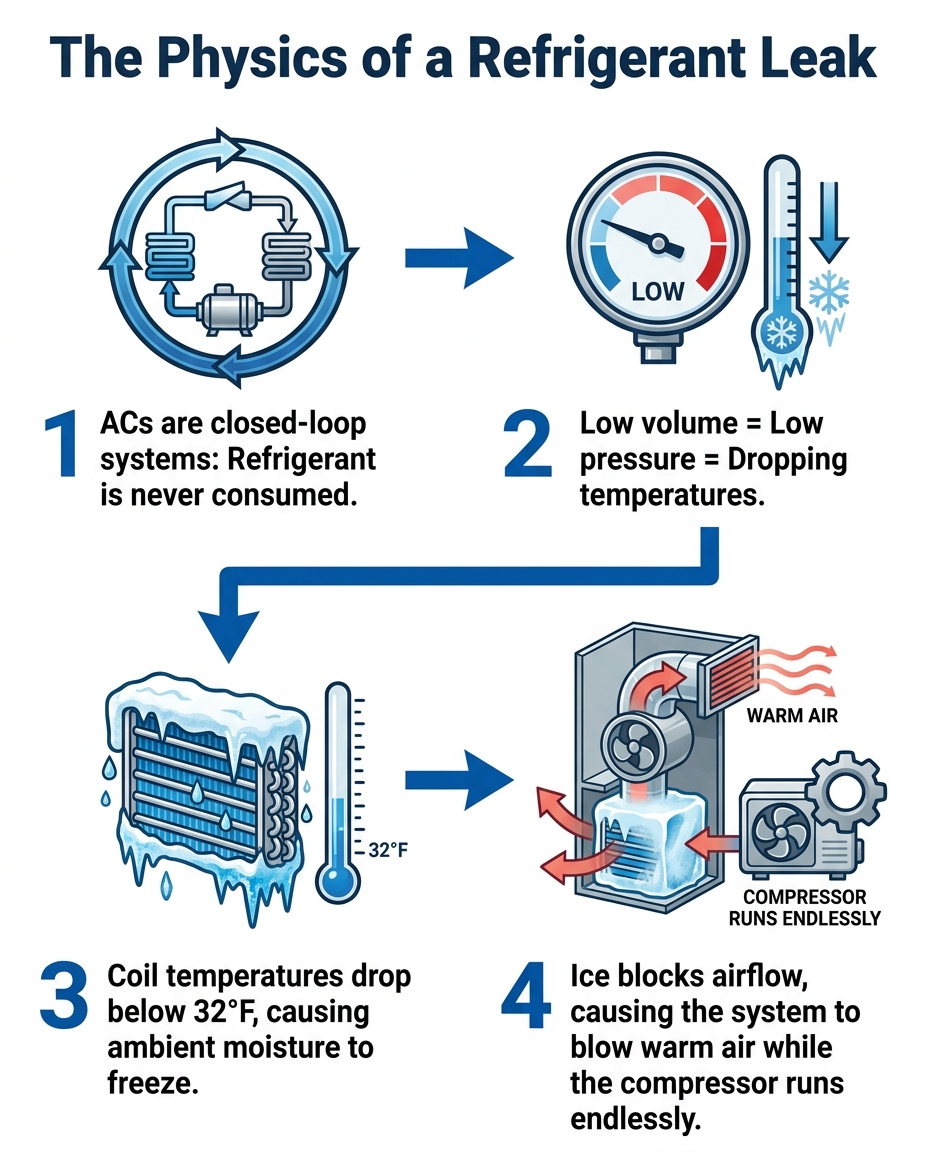
The Cause: This misconception stems from applying automotive logic to a completely different type of machinery. Central air conditioners operate as hermetically sealed, closed-loop systems. The refrigerant inside is not a fuel source that gets burned to create cold air; it is a heat-transfer fluid that continuously cycles between a liquid and a gas state. Because the system is entirely sealed at the factory, the volume of refrigerant inside should remain exactly the same on day one as it does ten years later.
The Solution: The mechanical reality we encounter on service calls every day is simple: if your system is low on charge, there is an absolute certainty of a physical breach, crack, or hole in the copper lines or coils. Booking proper AC maintenance in Mountain View ensures that our technicians measure the exact factory-specified volume of refrigerant to confirm system integrity, rather than blindly adding more fluid to a leaking loop.
Why the 'Car Oil' Analogy Fails
To fully grasp why a top-off is problematic, we often ask our customers to contrast how different machines handle their internal fluids. An internal combustion engine relies on controlled explosions, extreme friction, and venting exhaust, which naturally degrades and consumes oil over time. An HVAC system does none of these things.
• Fluid Purpose — Car Engine (Oil/Fuel): Combustion and friction reduction — HVAC System (Refrigerant): Phase-change heat transfer
• System Design — Car Engine (Oil/Fuel): Open (exhausts gases, burns fuel) — HVAC System (Refrigerant): Hermetically sealed closed-loop
• Natural Depletion — Car Engine (Oil/Fuel): Expected and normal over time — HVAC System (Refrigerant): Physically impossible without a leak
• Maintenance Action — Car Engine (Oil/Fuel): Routine top-offs and fluid changes — HVAC System (Refrigerant): Locating and patching the physical breach
When you understand that the loop is completely sealed, it becomes obvious why asking a technician to "just add a little more" is equivalent to pouring water into a bucket with a hole in the bottom. The fluid isn't degrading; it is escaping.
The Physics of Low Pressure and Frozen Evaporator Coils
When refrigerant begins leaking out of the system, a counterintuitive mechanical reaction occurs. You might expect the system to simply blow slightly less cold air, but the reality involves a drastic drop in internal pressure that actually causes the system to freeze solid. Inside your indoor unit sits the evaporator coil, where the warm air from your home blows across the chilled copper tubing.
The relationship between refrigerant volume, pressure, and temperature is deeply intertwined. As the refrigerant leaks out, the pressure inside the copper lines drops significantly. According to the laws of thermodynamics, a drop in pressure forces a corresponding drop in temperature. Paradoxically, losing refrigerant causes the remaining fluid inside the coil to plummet well below freezing.
In our experience, Mountain View's intense late August afternoon heat waves rapidly expose the weakness of a leaking system. Our technicians frequently arrive at homes to find systems forced to run constantly to combat the high indoor temperatures. As the super-cooled evaporator coil sits below 32 degrees Fahrenheit, the ambient humidity in your home's air condenses on the metal fins and immediately freezes. This creates a solid block of ice that chokes off all airflow. The chain reaction forces the compressor to run continuously without actually delivering any cooling to the living space, accelerating the wear and tear during late August / end-of-season cooling cycles when you need relief the most.

Why 'Just Topping It Off' is a Diagnostic Red Flag
The Problem: When an air conditioner starts struggling, some technicians will immediately offer to perform an "AC freon recharge" without ever mentioning the word "leak." This creates a dangerous financial trap for the homeowner, who ends up paying for expensive refrigerant to be injected directly into a compromised system.
The Cause: Depending on the size of the microscopic hole in the copper, a top-off might last a few months, or it might leak out entirely in a matter of days. Furthermore, the Environmental Protection Agency (EPA) strictly regulates the handling of these chemicals under Section 608 guidelines. Intentionally venting harmful refrigerants into the atmosphere—or knowingly filling a system with a massive leak—violates the core principles of environmental safety and professional HVAC standards.
The Solution: An honest diagnostic requires locating the exact source of the leak, providing a clear quote for the patch or coil replacement, and permanently sealing the loop. At Plum HVAC, our team focuses on long-term solutions and honest diagnostics rather than quick 'top-offs' that leave homeowners stranded again next season. If a technician is willing to add refrigerant without searching for the hole, it is a glaring red flag regarding their diagnostic ethics.
The Hidden Dangers of Running a Leaking System
Ignoring a leak and relying on band-aid recharges does much more than just waste money on lost refrigerant; it causes severe, long-term mechanical damage to the most expensive component in your system: the compressor. Located in the outdoor unit, the compressor is the heart of the air conditioner, responsible for pumping the refrigerant through the lines.
What most homeowners do not realize is that refrigerant also acts as a carrier for specialized, highly refined oil. This oil circulates throughout the closed loop to keep the compressor's internal moving parts lubricated. When you have a leak, you aren't just losing cooling capacity—you are actively starving the compressor of vital lubrication. Running the system in this state causes massive friction, excessive heat, and eventual mechanical seizure.
Additionally, a system running on low charge is highly susceptible to a phenomenon called liquid slugging. Because the pressures are incorrect, liquid refrigerant can flow backward into the compressor, which is only designed to compress vapor. Liquid cannot be compressed, and this hydraulic impact can literally shatter the internal valves. This is exactly why late August AC compressor failures happen so frequently in the neighborhoods we service. We see firsthand how repeated top-offs during late August / end-of-season cooling cycles often culminate in catastrophic compressor failure, turning a repairable leak into a full system replacement.
Professional Leak Detection: How the Loop is Actually Repaired
Finding a microscopic pinhole leak in hundreds of feet of copper tubing is not a guessing game, nor is it a DIY project. Handling pressurized refrigerants and brazing copper lines requires professional licensing, specialized recovery equipment, and EPA certification. When our Plum HVAC technicians handle a repair here in Mountain View CA, we follow a strict, methodical sequence to ensure the loop is perfectly sealed and restored to factory specifications.
1. Electronic Halogen Sniffing: Our technicians first use highly sensitive electronic wands that detect the specific chemical signature of refrigerants in the air. By running this wand along the coils and weld joints, they can pinpoint the general area of the breach.
2. UV Dye Injection and Ultrasonic Detection: For incredibly small or hidden leaks, a specialized UV-reactive dye can be introduced into the system. As it circulates and escapes, it leaves a glowing trace visible under a blacklight. Ultrasonic detectors may also be used to "listen" for the high-frequency hiss of escaping gas.
3. Nitrogen Isolation Pressure Testing: Once the remaining refrigerant is safely recovered into a sealed tank, the system is pressurized with dry nitrogen. Nitrogen is an inert gas that allows the technician to confirm the integrity of the copper lines. If the pressure holds steady, the system is sealed; if it drops, the leak is still active.
4. Brazing and Deep Vacuuming: The technician repairs the hole using an oxy-acetylene torch to braze the copper, or replaces the compromised coil entirely. Afterward, a vacuum pump is attached to pull the system down to a deep vacuum (measured in microns). This removes all microscopic moisture and non-condensable gases from the lines.
5. Weighing in the Factory Charge: Finally, the exact, factory-specified weight of fresh refrigerant is added back into the system using a digital scale, ensuring flawless pressure dynamics.
Skipping any of these steps compromises the entire system. This is why scheduling proper Palo Alto AC maintenance and repair is non-negotiable when dealing with sealed loops.
Making the Right End-of-Season Investment
As the summer winds down, the temptation to just "get through September" with a cheap recharge is incredibly strong. However, making the right end-of-season investment requires looking at the long-term health of your equipment. Limping through late August / end-of-season cooling with a compromised system is a massive gamble that risks destroying your compressor right before the weather finally breaks.
The long-term ROI of a proper repair: Fixing the leak properly now prevents catastrophic damage and ensures the system is ready for the inevitable heat waves of the following year. A sealed, properly charged system operates at peak efficiency, which immediately lowers your monthly utility bills and significantly extends the overall lifespan of the equipment. We also advise homeowners to check for any generic utility incentive programs or energy rebates that might apply to upgrading aging, leaky equipment.
We always advise that the best way to avoid being blindsided by a major leak is through proactive care. Enrolling in our HVAC Maintenance Plan ensures that a Plum HVAC professional is inspecting your coils, checking your pressures, and catching microscopic vulnerabilities long before they cause a sudden shutdown. When your system is truly sealed and accurately charged, you get to enjoy consistent, reliable comfort without ever having to worry about the "top-off" trap again.
Frequently Asked Questions
Is it normal for an AC to lose refrigerant over time?
No, it is never normal for an air conditioner to lose refrigerant. The system is built as a hermetically sealed, closed loop that circulates the same fluid continuously. If the refrigerant level is low, it means there is a physical hole or crack in the copper lines or coils that must be repaired.
Can you just add Freon to an AC unit without fixing the leak?
While a technician physically can add refrigerant to a leaking system, doing so is highly discouraged and often considered a diagnostic red flag. Adding refrigerant without patching the hole is a temporary band-aid that wastes money and allows the harmful chemical to continue leaking into the environment. A proper repair always requires finding and sealing the breach first.
What happens if you run an AC with low refrigerant?
Running an air conditioner with low refrigerant causes the internal pressure to drop, which forces the temperature of the evaporator coil to fall below freezing. This leads to severe ice buildup that blocks airflow and stops the system from cooling your home. Furthermore, it starves the compressor of vital lubricating oil, which can lead to catastrophic mechanical failure.
How long does an AC recharge last if there is a leak?
The lifespan of a recharge depends entirely on the size of the physical hole in the system. A microscopic pinhole might hold the new refrigerant for a few months, while a larger crack could drain the entire system in a matter of days. Because it is impossible to predict, paying for a top-off without a repair is a significant financial risk.
Why does a refrigerant leak cause the AC coil to freeze?
A leak causes the coil to freeze due to the direct relationship between pressure and temperature in thermodynamics. As refrigerant escapes, the pressure inside the copper tubing drops, causing the remaining fluid to become super-cooled. The ambient humidity in your home's air then condenses on this freezing metal and quickly turns into a solid block of ice.
How do HVAC professionals find hidden refrigerant leaks?
Professionals use specialized, highly sensitive tools to locate leaks that are invisible to the naked eye. They rely on electronic halogen sniffers that detect the chemical signature of the gas, UV dyes that glow under blacklight, and ultrasonic tools that listen for high-frequency hissing. Once found, they use high-pressure nitrogen testing to verify the integrity of the repair.
As you transition into the back-to-school routine, dealing with an air conditioner that blows warm air is frustrating, but understanding the mechanics behind the breakdown puts you in control. Refusing the quick "top-off" and insisting on a thorough, professional leak repair is the only way to protect your equipment from permanent damage. By treating the root cause rather than just the symptom, you ensure your system remains reliable, efficient, and ready to handle whatever the late summer heat throws your way.
hear what our satisfied clients have to say

.svg)
Service areas
.avif)