

Why Your AC Smells Musty During Late Summer Afternoons
That Sudden Mildew Odor When the Thermostat Clicks On
August heat waves in the Bay Area bring intense temperatures, and when you rely on your cooling unit to keep your home comfortable, the last thing you want is a foul odor filling the room. Here at Plum HVAC, our technicians field dozens of calls every August from homeowners dealing with this exact issue. If you are wondering why your AC smells musty during late summer afternoons, you are experiencing one of the most common end-of-season cooling issues for homeowners in Mountain View CA. You walk inside, the thermostat clicks on, and suddenly the house smells like a damp locker room or dirty gym socks. This immediate discomfort is a clear sign that something is actively growing inside your equipment.
Understanding what is happening inside your air conditioning systems is the first step toward a permanent solution. That sudden mildew odor is not just stale air trapped in your ductwork; it is a symptom of a biological issue residing deep within the air handler. As cooling demands peak during the back-to-school transition, the internal components of your system remain constantly damp. Acknowledging that this is a highly common, predictable symptom allows you to move past temporary fixes and address the root cause of the contamination.
The Mechanics of Dirty Sock Syndrome in Your System
To understand the source of the odor, it helps to look at the exact science of how your cooling equipment operates. The HVAC industry refers to this specific biological contamination as "Dirty Sock Syndrome." It occurs when microbial and bacterial growth takes hold on the indoor evaporator coil. During the August late-summer cooling season, your system works overtime, creating the perfect storm for this biological buildup.
How Condensation Forms on the Coil
Your air conditioner does not just cool the air; it naturally extracts heavy moisture from your indoor environment. The heat exchange process involves pulling warm, humid air across a series of highly refrigerated metal tubes and fins known as the evaporator coil. When warm air meets cold metal, moisture instantly beads up on the surface.
• Continuous moisture generation: A typical residential system can remove several gallons of water from the air every single day during heavy operation.
• Constant dampness: Because the coil is constantly sweating, it remains coated in a thin layer of condensation as long as the compressor is running.
• Dust accumulation: Even with a good filter, microscopic organic dust particles bypass the media and stick to the wet metal surfaces.
The Ideal Environment for Microbial Growth
The inside of an air handler is completely dark, constantly damp, and supplied with a steady stream of organic dust. This combination creates the absolute perfect habitat for biological pollutants. Bacteria and microbes naturally settle onto the wet evaporator fins and begin to metabolize the organic matter trapped in the condensation. As these bacterial colonies feed and multiply, they release volatile organic compounds (VOCs) as a byproduct. When the blower fan pushes fresh air over this microbial buildup, those VOCs are carried directly through the ductwork, resulting in that distinct musty smell.
Why the Odor Peaks in Late Summer
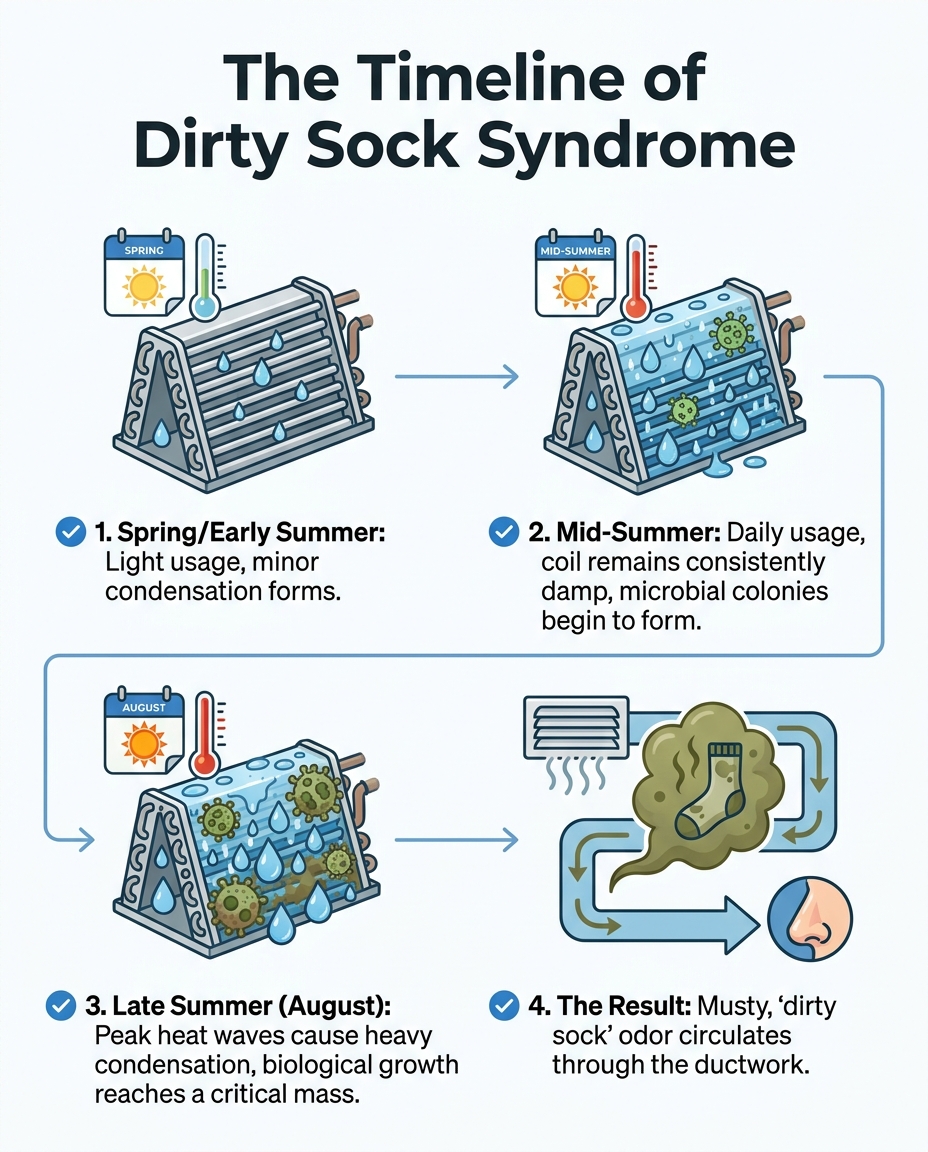
In our years of servicing cooling systems across the Bay Area, we've noticed a distinct pattern: many homeowners in Mountain View CA wonder why their system smelled fine in June but suddenly developed a terrible odor in August. The answer lies in the cumulative seasonal effect of continuous operation. The late-summer odor is simply the tipping point of months of unchecked microbial accumulation.
Cumulative Moisture Buildup
During the spring and early summer months, your air conditioner likely runs on an occasional basis. The coil gets wet, but it has plenty of time to dry out completely between cycles. However, as the season progresses, layers of biological growth slowly begin to compound. By the time the August late-summer cooling season arrives, the microbial colony has established a strong foothold on the aluminum fins. The biofilm becomes thick enough that it can no longer be ignored, and the off-gassing becomes noticeable every time the fan engages.
The Impact of Shorter Drying Cycles
Bay Area microclimates and late-summer heat waves demand heavy, continuous cooling cycles. When temperatures soar, your system is forced to run longer and more frequently to maintain the set temperature on the thermostat. Back-to-back cooling cycles leave absolutely no time for the indoor unit to properly evaporate residual moisture. The evaporator coil never fully dries out. This constant state of dampness accelerates the bacterial growth exponentially, turning a minor microbial presence into a full-blown case of dirty sock syndrome practically overnight.

Evaporator Coils vs. Clogged Drain Lines: Where Is the Smell Coming From?
Accurate diagnosis is required because the cleaning methods for different HVAC components are entirely different. In our field experience, while the evaporator coil is the primary culprit for Dirty Sock Syndrome, our team frequently finds that the condensate drain system can also harbor intense odors during the August late-summer cooling season. Differentiating between the two most common sources of musty AC odors helps clarify why professional intervention is necessary.
Evaporator Coil Contamination
When the smell originates from the coil, the contamination is spread across the delicate fins and surface area of the heat exchanger. This requires specialized foaming cleaners designed specifically to penetrate the tight microscopic spaces between the aluminum plates without causing corrosion.
Backed-Up Condensate Drain Pans
Alternatively, a clogged condensate drain line causes water to back up and stagnate in the drain pan located beneath the coil. Blockages occur when dust, biological sludge, and algae grow inside the PVC drainage pipe. When water sits in the pan for days, it develops a swampy, stagnant odor that is slightly different from the sharp, dirty gym sock smell of a contaminated coil.
• Type of Odor — Evaporator Coil (Dirty Sock Syndrome): Sharp, musty, dirty gym socks or intense mildew. — Clogged Condensate Drain Line: Swampy, stagnant water, or rotten egg smell.
• Timing of Odor — Evaporator Coil (Dirty Sock Syndrome): Hits immediately when the blower fan turns on. — Clogged Condensate Drain Line: Constant ambient smell near the indoor unit.
• Location of Growth — Evaporator Coil (Dirty Sock Syndrome): Directly on the aluminum fins in the air stream. — Clogged Condensate Drain Line: Sitting in the plastic drain pan or PVC pipe.
• Required Solution — Evaporator Coil (Dirty Sock Syndrome): Chemical foaming sanitation and careful rinsing. — Clogged Condensate Drain Line: Clearing the blockage and treating the standing water.
The Danger of Masking Odors Instead of Removing Biological Growth
It is incredibly tempting to seek out a quick fix when your house smells unpleasant. However, attempting to mask a biological issue is one of the biggest mistakes we see homeowners in Mountain View CA make. Temporary fixes fail to solve the underlying problem and can actually worsen your indoor air quality.
Air Fresheners Only Hide the Symptom
Using plug-in air fresheners, scented sprays, or essential oils near your intake vents will only temporarily mask the smell. Masking scents interact poorly with biological odors, often creating a sickeningly sweet mildew smell that is even more offensive. More importantly, the microbial colony continues to grow, metabolize, and release spores even if you cannot smell it temporarily. Adding artificial fragrances simply introduces more volatile organic compounds (VOCs) into your indoor air without addressing the bacterial source.
When Upgrading Filters Isn't Enough
A common misconception is that a better filter will stop the smell. While understanding how wildfire smoke affects your AC filter is critical for managing dust and ash, standard filters cannot stop biological growth that is already living on the coil. Filters clean the air before it hits the heat exchanger. They do absolutely nothing to sanitize the equipment downstream. In fact, installing highly restrictive air filters can actually reduce critical airflow across the coil, causing it to stay wet longer and making the moisture problems significantly worse. Physical removal and professional sanitation are the only permanent solutions to biological growth.
Why Coil Cleaning Requires Professional Expertise
If you are dealing with a contaminated system during the August late-summer cooling season, you might assume you can simply wipe the components down yourself. However, modern evaporator coils are highly sensitive, complex pieces of engineering tucked away inside sealed air handler cabinetry. Accessing and sanitizing these components is not a DIY project.
The Fragility of Evaporator Fins
The aluminum fins on an evaporator coil are paper-thin and extremely fragile. They are spaced millimeters apart to maximize heat transfer. If you attempt to clean them with household brushes, rags, or vacuums, the fins will easily bend and crush. Bent fins permanently restrict critical airflow, severely reducing system efficiency and potentially causing the compressor to overheat. Our team at Plum HVAC has seen countless crushed fins from well-intentioned DIY attempts. We offer trusted local expertise in diagnosing the exact location of the biological growth and safely accessing sensitive components without causing damage to the delicate metal.
Safe Chemical Application Standards
Standard household cleaners, bleach, and acidic solutions should never be introduced to an HVAC system. These chemicals will rapidly corrode the aluminum and copper components, leading to catastrophic refrigerant leaks. Professional technicians use EPA-approved, coil-safe foaming agents that expand deep into the fin pack to lift biological growth to the surface. Proper chemical rinsing and verifying correct drainage are mandatory steps to ensure the system is thoroughly sanitized and safe to operate. Professional diagnostics remain the safest way to guarantee the odor is eliminated without compromising the integrity of your equipment.
Frequently Asked Questions About Musty AC Odors
When dealing with unusual smells, homeowners in Mountain View CA often start looking into indoor air quality solutions to keep their families comfortable. Below are the most common questions regarding biological growth and late-summer system odors.
Why does my AC smell like mildew when I first turn it on?
The immediate mildew smell is caused by a blast of air passing over a damp, biologically contaminated evaporator coil. When the system sits idle, moisture and bacteria fester in the dark cabinet. The moment the blower fan engages, it pushes the accumulated volatile organic compounds directly into your ductwork and living spaces.
Is it safe to run my AC if it smells musty?
Running an AC that smells musty is generally not recommended for extended periods due to indoor air quality concerns. The odor indicates the active presence of biological pollutants, bacteria, and potential mold spores. Circulating these contaminants throughout your home can aggravate allergies, asthma, and respiratory sensitivities.
How do you fix dirty sock syndrome in an air conditioner?
Fixing dirty sock syndrome requires a professional coil cleaning process using specialized, non-corrosive foaming chemicals. A technician must safely open the air handler, apply the expanding foam to neutralize the biological growth, and meticulously rinse the coil. In severe, recurring cases, installing a UV germicidal light over the coil may be recommended to prevent future growth.
Can a dirty air filter cause a musty smell?
A dirty air filter itself rarely causes a distinctly musty or mildew-like smell, though it can make the air feel stale. However, a clogged filter restricts airflow, which prevents the evaporator coil from drying out properly between cycles. This excess moisture creates the environment where musty odors and biological growth thrive.
Why did the musty smell suddenly appear in August?
The sudden appearance of the smell in late summer is due to the cumulative moisture effect over the preceding months. After weeks of heavy daily usage during peak heat waves, the coil remains consistently wet, allowing microbial colonies to reach a critical mass. The odor becomes noticeable once the biological buildup is large enough to off-gas heavily.
Will turning the fan from 'auto' to 'on' dry out the coil?
Turning the fan to the "on" position can sometimes help dry the coil, but it often backfires by re-evaporating moisture back into the home. When the compressor shuts off but the fan keeps running, the air pulls humidity straight off the wet coil and distributes it through the vents. This can actually increase indoor humidity and spread the musty odor more rapidly.
Eliminate the Odor with Professional Coil Diagnostics
A musty smell coming from your vents is a clear indicator of biological growth that requires physical removal. Masking the odor with sprays or upgrading a filter will not solve the underlying moisture and microbial issue that peaks during the August late-summer cooling season. To truly restore your indoor air quality, the contamination must be safely neutralized and rinsed away by a trained technician. Do not let dirty sock syndrome dictate your home's comfort. Our team at Plum HVAC is ready to help. Schedule an expert evaluation for AC maintenance in Mountain View to get a thorough coil and drain line inspection, ensuring your system runs cleanly and efficiently.
hear what our satisfied clients have to say

.svg)
Service areas
.avif)