
How Wildfire Smoke Season Changes Your Air Conditioner Filter Replacement Schedule
When Wildfire Smoke Overwhelms Your Standard HVAC Defense
You know the frustrating feeling: your air conditioner is running nonstop to fight off the late-summer heat, but the house still feels warm, and a faint, stale campfire smell lingers in the hallway. Figuring out exactly how wildfire smoke season changes your air conditioner filter replacement schedule is the key to protecting both your home's air and your cooling equipment. At Plum HVAC, our technicians see the aftermath of this every late summer: during an active smoke event, the standard rules of home maintenance get thrown completely out the window.
The concrete problem most homeowners face is that standard HVAC filters clog rapidly with fine ash. What usually takes months to accumulate can happen in a matter of days. When that happens, you are faced with a critical decision point: you must know exactly when to abandon the standard 90-day replacement schedule, and you have to decide if upgrading to a higher MERV rating is actually safe for your specific system. August heatwaves often coincide directly with these heavy smoke events, forcing your AC unit to run continuously while breathing in heavily compromised air.
To establish a solid baseline for your home's indoor air quality, you have to look beyond the calendar. Relying on a standard schedule when the air outside is thick with PM2.5 particulate matter and ash is a guaranteed way to suffocate your HVAC system.
The Hidden Threat of Microscopic Particulate Matter on Airflow
The problem: When the sky turns an eerie orange and the air quality index plummets, many homeowners assume their standard fiberglass filter will catch the incoming debris. However, standard filters are designed to trap large particles like pet hair, lint, and common household dust. They are completely outmatched by the microscopic nature of wildfire smoke.
The cause: Smoke is primarily composed of PM2.5 particulate matter and ash. These particles are incredibly small—less than 2.5 micrometers in diameter, which is about 30 times smaller than a single human hair. Unlike dry household dust, which sits loosely on the filter media, smoke ash is often sticky and dense. It rapidly coats and seals the permeable fibers of a standard filter, creating an almost impenetrable wall.
The solution: Understanding this microscopic threat allows you to adjust your expectations. Once that impenetrable wall of ash forms, the immediate impact on your system's airflow is severe. The blower motor has to work twice as hard to pull the same amount of air through the choked filter, leading to reduced cooling capacity, increased energy consumption, and unnecessary wear and tear on the internal components.
Why Ash Clogs Filters Faster Than Dust
To truly understand why your filter lifespan plummets during a fire, it helps to contrast the physical properties of typical household debris with the harsh reality of wildfire fallout. The rapid accumulation rate during a localized smoke event changes the physics of how your filter breathes.
• Particle Size — Household Dust & Dander: Large and varied (10 to 100+ micrometers) — Wildfire Ash (PM2.5): Microscopic (Under 2.5 micrometers)
• Texture — Household Dust & Dander: Dry, loose, and fluffy — Wildfire Ash (PM2.5): Dense, fine, and often sticky or oily
• Accumulation Rate — Household Dust & Dander: Gradual build-up over 30 to 90 days — Wildfire Ash (PM2.5): Rapid saturation, sometimes within 48 to 72 hours
• Airflow Impact — Household Dust & Dander: Slowly reduces efficiency over months — Wildfire Ash (PM2.5): Creates a sudden, hard seal that starves the blower motor
Because ash packs together so tightly, it eliminates the microscopic gaps in the filter media that normally allow air to pass through. This is why a filter that looks only slightly gray with ash can actually be far more restrictive than a filter covered in a thick layer of dog hair.
Why the 90-Day Replacement Rule Fails During Peak Fire Season
If you look at the packaging of almost any standard HVAC filter, you will see a prominent recommendation to "change your filter every 3 months." This standard manufacturer advice is based on laboratory testing under normal air conditions. It assumes a typical home environment with average levels of dust, normal seasonal pollen, and a standard amount of pet dander. It completely fails to account for the extreme environmental stress of the August late-summer wildfire season.
During a severe localized smoke event, extreme air quality index (AQI) spikes can compress months of typical filter wear into just a few days. The specific late-summer window when Northern California experiences its heaviest localized ash fallout creates a worst-case scenario for your cooling system. The weather is intensely hot, meaning the air conditioner is running for longer cycles, pulling massive volumes of contaminated air across the filter media hour after hour.
In our years of repairing AC units across Mountain View, we've seen firsthand how ignoring the visual cues and blindly trusting a calendar while your AC system suffocates is incredibly dangerous. Running the system with a severely clogged filter is one of the leading causes of the frozen evaporator coils our team thaws out every August. When airflow drops, the cooling coil cannot absorb enough heat from the house. The condensation on the coil freezes into a block of solid ice, which completely stops the cooling process and can cause liquid refrigerant to flow backward into the compressor, potentially destroying it.

The Danger of Blindly Upgrading to High-MERV Filters
The problem: When smoke fills the sky, a common reaction is to rush to the hardware store and buy the most expensive, highest-rated filter on the shelf. While trapping smoke is important, our team frequently responds to late-summer service calls where a homeowner threw a dense filter into an older system without understanding the mechanics, causing immediate mechanical failures.
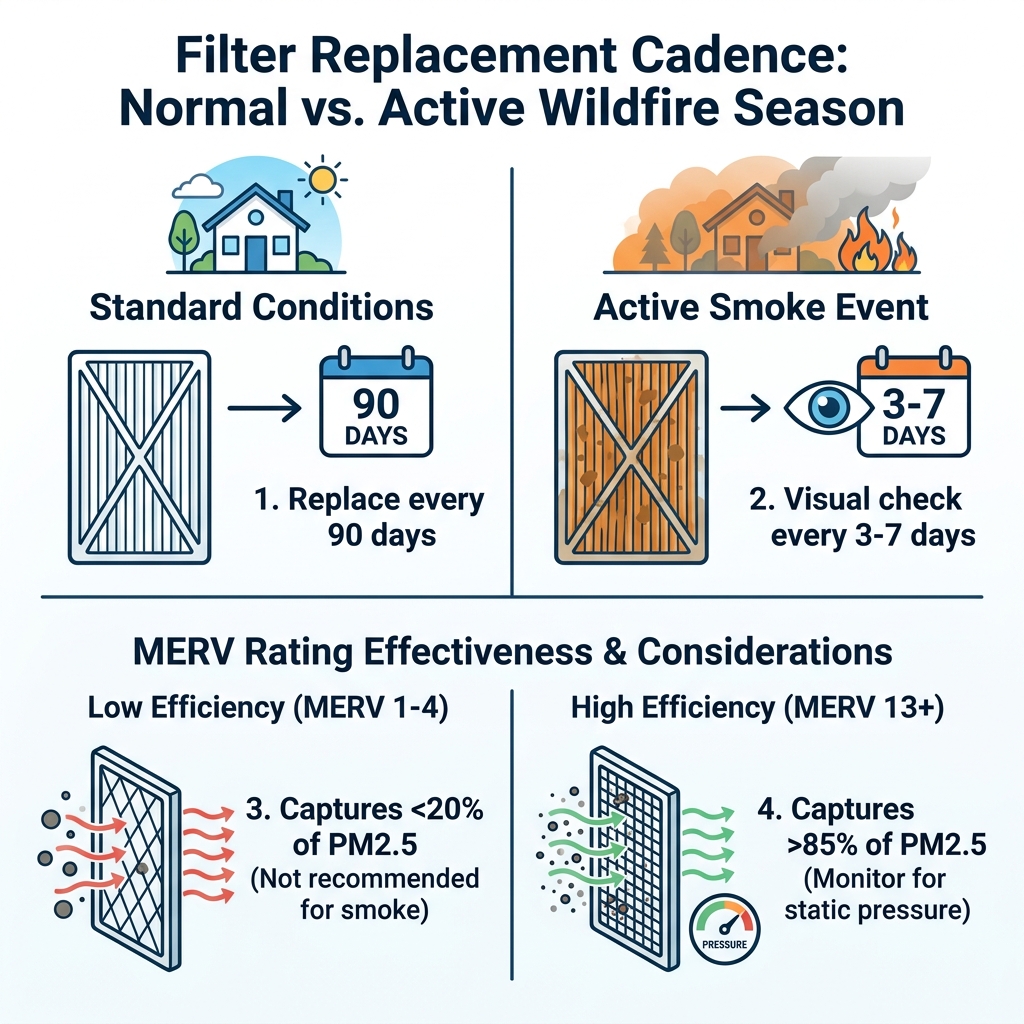
The cause: Filters are rated using the Minimum Efficiency Reporting Value (MERV) scale. While MERV 13 or higher is generally recommended for capturing fine smoke particles, these highly efficient filters present a massive hurdle for your equipment. This introduces the concept of static pressure. Static pressure is the resistance to airflow within your ductwork. Dense, high-MERV filters restrict airflow heavily even when they are brand new, simply because the weave of the fabric is so tight.
The solution: You have to respect the dual threat facing your equipment during the August late-summer wildfire season. You have an older blower motor struggling against a dense, restrictive filter, compounded by the extreme strain of peak cooling demand. If you suffocate the motor, it will overheat and shut down on a thermal limit switch, or burn out entirely. Finding the right balance between trapping ash and maintaining healthy system airflow is vital. If your system cannot handle a MERV 13 filter, we recommend running a less restrictive MERV 8 filter and supplementing your indoor air quality with standalone room purifiers, rather than destroying your primary air conditioning systems.
How Top-Tier HVAC Brands Handle Increased Airflow Strain
Not all air conditioners react to a clogged filter in the same way. The way your specific system handles the increased static pressure of a high-efficiency filter depends entirely on the technology inside the air handler. Modern, high-efficiency systems use variable-speed blower motors (often called ECM motors). Unlike older, single-stage motors that only have one speed (on or off), a variable-speed motor can sense resistance.
When a variable-speed motor detects that a filter is loading up with ash and restricting airflow, it will automatically ramp up its RPMs to push harder and maintain the required volume of air. This is a fantastic feature for maintaining comfort, but it means the motor is working significantly harder and consuming more electricity. Older single-stage motors (PSC motors) do not have this ability; when they face a clogged filter, the airflow simply drops off a cliff, leading directly to the frozen coils mentioned earlier.
This is why system design matters just as much as filter selection when defending your home against smoke in Mountain View and greater Bay Area. Different major manufacturers engineer their systems with varying tolerances for high static pressure. If you are curious about how different units stack up when it comes to blower motor durability and advanced airflow features, comparing top residential HVAC brands can provide deeper insight into which systems are best equipped to handle heavy filtration demands.
A Practical Visual-Check Cadence for Active Smoke Events
Since the calendar is useless during a fire, you need a reliable, time-agnostic method for determining exactly when your filter has reached its limit. Shifting to a proactive, visual inspection routine is the only way to protect your equipment from the rapid accumulation of PM2.5 particulate matter and ash.
1. Shift to a weekly (or daily) inspection schedule: As soon as you smell smoke outside or see the AQI climb into the unhealthy range, pull your filter out once a week. If the smoke is dense enough to block out the sun, check it every single day. It only takes thirty seconds, but it can save your blower motor.
2. Perform the "light test" for saturation: You do not need special tools to know if a filter is ruined. Hold the filter up to a bright light bulb or a sunny window. If you can clearly see light shining through the media, it still has life left. If the ash has formed a solid crust and you cannot see light through the pleats, it is completely saturated and must be replaced immediately.
3. Keep a stockpile of appropriate filters on hand: Do not wait until the sky turns orange to buy filters. Hardware stores frequently sell out of common filter sizes within hours of a major fire breaking out. Keep a minimum of three spare filters in your closet before the season begins so you are never forced to run your AC without protection.
4. Focus strictly on simple slide-outs: Your responsibility as a homeowner stops at the filter slot. Slide the old filter out, note the airflow direction arrows on the cardboard frame, and slide the new one in. Never attempt DIY internal AC dismantling to clean blower wheels or coils yourself, as this requires specialized tools and handling high-voltage components.
Comprehensive Indoor Air Quality Strategies for Local Homes
Relying solely on a standard 1-inch filter to protect your entire home during a major smoke event is an uphill battle. To truly fortify your home, you need to look at comprehensive solutions that go beyond the basic filter slot. Upgrading to a media cabinet is one of the most effective strategies. These cabinets house thick, 4-inch or 5-inch pleated filters. Because they have exponentially more surface area than a 1-inch filter, they can trap massive amounts of ash without causing a dangerous drop in static pressure.
Additionally, whole-home air scrubbers and active purification systems can be installed directly into your ductwork to neutralize odors and capture the microscopic particles that slip past physical filters. However, even the best filters are useless if your ductwork is compromised. Sealing your ductwork is vital to prevent smoke infiltration from unconditioned spaces like attics or crawlspaces. If your return ducts have leaks, your system will actively suck smoke from the attic and blow it directly into your living room, completely bypassing the filter.
As the team at Plum HVAC, we have deep expertise in safeguarding Mountain View homes against region-specific microclimates and localized ash fallout. We understand exactly how the late-summer coastal winds push smoke into the valley. Once the smoke clears, scheduling a professional inspection to clean the evaporator coils and check the motor health is highly recommended. Ash often bypasses the filter housing entirely, settling on the damp indoor coil where it turns into a corrosive sludge. Staying on top of this through a routine maintenance plan ensures your system recovers fully. Keep in mind that general utility incentive programs or energy-efficiency rebates may apply to certain high-efficiency IAQ upgrades, so it is always worth checking current local guidelines when planning improvements.
Frequently Asked Questions About AC Filters and Wildfire Smoke
How often should I change my AC filter during a wildfire?
During an active wildfire, you should check your filter visually every 3 to 7 days, and replace it as soon as it fails the light test. The standard 90-day rule does not apply when the air is thick with ash. Depending on the severity of the smoke and how often your air conditioner runs, a brand-new filter can become completely clogged in less than a week.
What MERV rating is best for wildfire smoke?
A MERV 13 filter is generally considered the best choice for capturing the microscopic PM2.5 particles found in wildfire smoke. However, you must ensure your specific HVAC system can handle the increased airflow resistance of a MERV 13 filter. If your system is older or struggles with static pressure, using a lower MERV rating and supplementing with standalone room purifiers is a safer strategy for your equipment.
Can wildfire smoke ruin an air conditioner?
Yes, wildfire smoke can severely damage an air conditioner if the system is neglected. The fine ash quickly clogs the air filter, which suffocates the blower motor and often leads to frozen evaporator coils. Additionally, if ash bypasses the filter and coats the internal components, it can cause the system to overheat, short-cycle, and eventually suffer a complete mechanical breakdown.
Does running the AC filter out wildfire smoke from outside?
Most standard residential air conditioners do not bring in fresh air from the outside; they recirculate the existing air inside your home. Running your AC will filter the indoor air as it passes through the return filter. However, if your home has drafty windows, poor insulation, or leaky ductwork in the attic, smoke will inevitably seep indoors, making your HVAC filter your primary line of defense.
How can I tell if my AC filter is clogged with ash?
The easiest way to tell if your filter is clogged is to perform a simple light test. Remove the filter and hold it up to a bright light source. If you cannot see light shining through the pleated material, the filter is fully saturated with ash and dust. You may also notice weak airflow coming from your vents or a lingering smoky odor inside the house.
Should I run my AC fan continuously during a smoke event?
Running your AC fan continuously (setting the thermostat fan switch from "Auto" to "On") can help constantly cycle the indoor air through your filter, improving indoor air quality. However, you must be extremely diligent about checking the filter every few days. If the filter becomes clogged with ash, running the fan continuously will rapidly burn out the blower motor.
Protect Your Home's Air and HVAC System This Smoke Season
Navigating the August late-summer wildfire season requires a proactive approach to your home comfort. By adopting a clear, adjusted timeline for visual filter checks and choosing a safe MERV rating that your system can handle, you can keep your indoor air clean without putting undue stress on your equipment. Remember that protecting your indoor air quality should never come at the cost of suffocating the AC unit and causing a premature breakdown.
If you are unsure whether your current filter setup is safe, or if your system has been struggling to keep up with the demands of the season, professional support can make all the difference. Having your system inspected, your coils cleaned of lingering ash, and your blower motor tested ensures you are ready for whatever the weather brings to Mountain View and greater Bay Area. Take the time to safeguard your equipment by scheduling your AC maintenance in Mountain View today, and breathe a little easier knowing your home is fully protected.
hear what our satisfied clients have to say

.svg)
Service areas
.avif)