

How Variable Refrigerant Flow Systems Handle Fall Temperature Swings
Conquering the 'Morning Heat, Afternoon AC' Dilemma
As the September early fall transition arrives in the Bay Area, understanding how variable refrigerant flow systems handle fall temperature swings becomes the key to true indoor comfort. You wake up to a brisk 50-degree morning where the floors feel like ice and the house desperately needs warmth, only to find that same house sweltering by mid-afternoon when the sun beats down on your windows. This daily swing forces homeowners into a constant, frustrating battle with their thermostats, manually switching from heating to cooling and back again just to maintain a baseline level of comfort.
If you are tired of this daily temperature tug-of-war, upgrading from standard heat pump systems to advanced HVAC zoning systems powered by VRF technology provides a permanent, automated solution.
The daily thermostat battle: Traditional central air systems treat your entire house as a single box. When you turn on the heat to take the chill off your morning routine, the system blindly pushes warm air into every room. By the time the afternoon sun hits, the house is already holding onto that morning heat, compounding the uncomfortable afternoon temperatures. You find yourself shedding layers by 2:00 PM and rushing to switch the thermostat over to cooling mode.
Variable Refrigerant Flow (VRF) technology represents a fundamental shift in how we condition residential spaces. Instead of forcing you to choose between a freezing living room or an overheated upstairs bedroom, VRF operates dynamically. It assesses the precise thermal needs of each individual zone in your house and delivers exactly the right amount of conditioning to that specific area. By integrating seamlessly with modern zoning controls, these advanced systems eliminate the need to ever manually intervene with your thermostat during volatile transitional seasons.
Understanding the Diurnal Temperature Challenge
The core of the problem lies in the specific microclimate patterns we experience locally. Mountain View / Bay Area microclimates are famous for their dramatic diurnal temperature swings—a meteorological term for the difference between a day's high and low temperatures. During the early fall, it is entirely common to experience a heavy, insulating marine layer fog in the morning that keeps temperatures hovering in the low 50s, followed by a rapid burn-off that gives way to intense, direct afternoon sunlight pushing temperatures into the 80s.
How solar heat gain complicates comfort: As the day progresses, the sun's position radically changes the thermal load on your home.
• East-facing rooms: Heat up quickly in the morning but cool down significantly by late afternoon.
• South and West-facing rooms: Take the brunt of the intense afternoon solar heat gain, often turning living spaces and home offices into saunas.
• Interior and North-facing rooms: Remain heavily shaded and perpetually cool throughout the entire day.
When you rely on standard, single-zone reliable heating solutions, your system cannot account for these localized differences. If the central thermostat is located in a shaded hallway, it will continue calling for heat long after the sun-drenched living room has become uncomfortably warm. Conversely, if the thermostat is in the hot living room, it will shut off the heat prematurely, leaving the rest of the house freezing. This architectural reality makes managing fall temperature swings nearly impossible without a system capable of addressing different zones independently.
Beyond Traditional HVAC: The Mechanics of VRF Technology
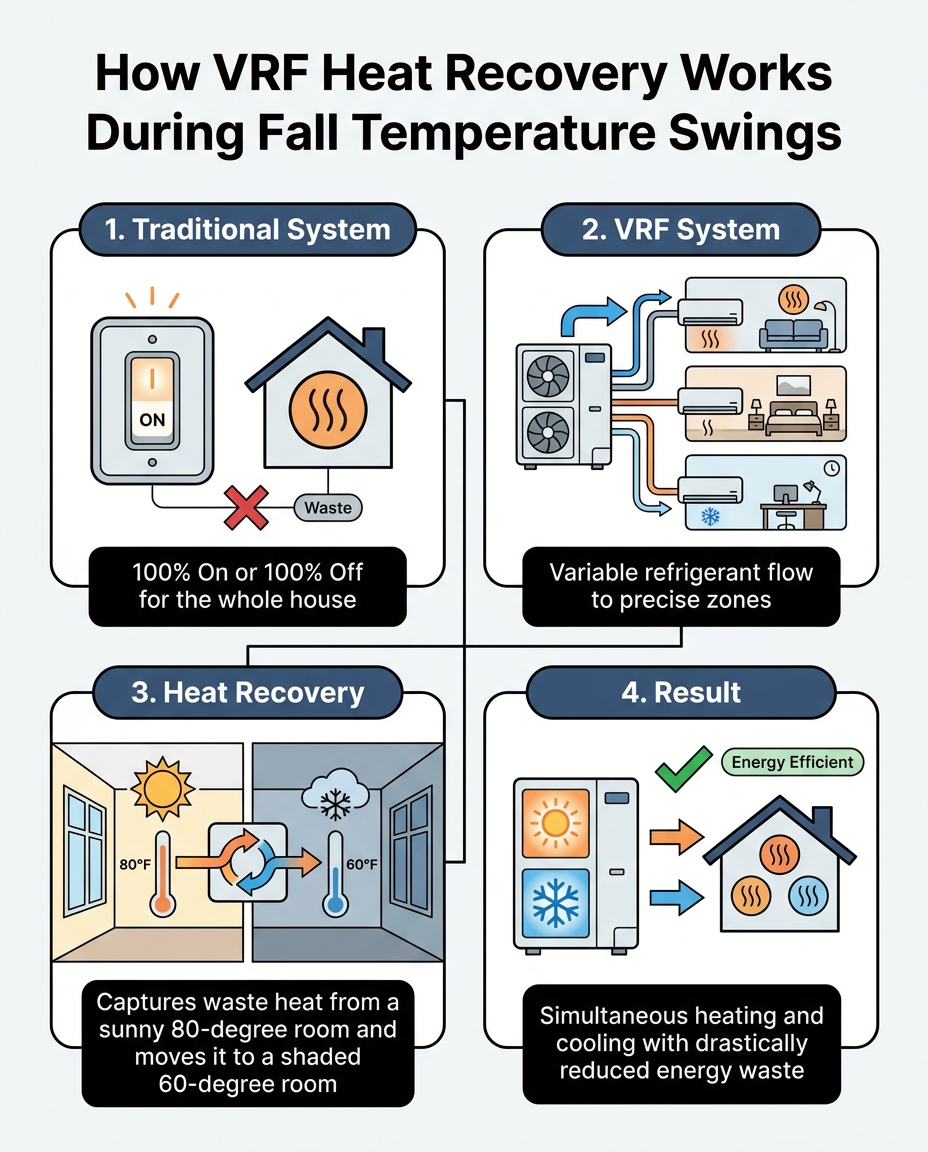
To understand how Variable Refrigerant Flow systems handle fall temperature swings, it helps to look at the mechanical differences between traditional equipment and modern inverter-driven technology. A standard air conditioner or heat pump uses a fixed-speed compressor. When it turns on, it runs at 100% capacity until the target temperature is reached, and then it shuts off completely. It is a blunt instrument—much like driving a car by only using the floorboard accelerator or the emergency brake.
VRF technology changes this dynamic entirely. Originally pioneered by Daikin in 1982 under the name Variable Refrigerant Volume (VRV), this technology utilizes advanced inverter compressors. An inverter compressor acts like a dimmer switch, smoothly ramping up or down to match the exact heating or cooling load required by the home at any given moment. By continuously varying the flow of refrigerant, the system delivers precise climate control without the loud, inefficient on-and-off cycling of traditional units.
The precision of variable flow: When a VRF system operates, it communicates with multiple indoor air handlers distributed throughout the home. If only one room needs a slight temperature adjustment, the outdoor compressor modulates its speed to send just a trickle of refrigerant to that specific zone. For homeowners interested in comparing Daikin systems to traditional AC, this variable capacity is the defining feature that allows for whisper-quiet operation and pinpoint temperature accuracy, even as the outdoor weather shifts dramatically hour by hour.
Heat Recovery: Moving Heat Instead of Just Making It
The most remarkable feature of premium VRF technology—and the exact reason it excels during the September early fall transition—is a capability known as heat recovery. Standard VRF systems can provide highly efficient heating or cooling to different zones, but they must operate in a single mode at a time. Heat recovery VRF systems, however, can simultaneously heat and cool different rooms within the exact same house at the exact same time.
This sounds like magic, but it is purely advanced thermodynamics. Instead of generating new heat from scratch, a heat recovery system captures waste heat from a room that requires cooling and physically pipes that heat into a room that requires warming. If your south-facing home office is baking in the 3:00 PM sun, the indoor unit in that room absorbs the thermal energy. Rather than venting that captured heat outside, the system redirects it to the shaded, chilly north-facing bedroom that is calling for warmth. This synergistic process makes these systems, including high-end ductless mini-split options that utilize VRF technology, incredibly efficient.
The Three-Pipe System Advantage
The secret to simultaneous heating and cooling lies in the specialized piping infrastructure used by heat recovery models. While standard systems use two pipes, heat recovery VRF systems utilize a sophisticated three-pipe design.
1. The Hot Gas Line: Carries high-pressure, high-temperature refrigerant vapor to zones that require active heating.
2. The Liquid Line: Transports condensed, medium-pressure liquid refrigerant to zones that require active cooling.
3. The Suction Line: Returns low-pressure refrigerant gas back to the main outdoor compressor to restart the cycle.
The role of the branch selector box: Between the outdoor compressor and the indoor units sits a critical component called the branch selector box. Think of this as the intelligent traffic cop of your HVAC system. It reads the real-time demands from every thermostat in the house and rapidly routes the appropriate state of refrigerant (hot gas for heating, cold liquid for cooling) to the exact indoor unit that needs it. This continuous, silent redirection of energy is how the system perfectly balances the house during wild fall temperature swings.

Why Standard Split Systems Struggle in the Fall
To truly appreciate the value of a VRF system, it is helpful to contrast it directly with the limitations of standard central split systems during transitional weather. Traditional HVAC systems are fundamentally binary. Because they can only operate in one mode at a time, they force a scenario where satisfying the central thermostat inadvertently makes the rest of the house uncomfortable.
The thermostat war: In a multi-story home during early fall, heat naturally rises. The upstairs bedrooms become stuffy, while the downstairs living room remains frigid. If you turn on the AC to cool the upstairs, the downstairs becomes an icebox. If you turn on the furnace to warm the downstairs, the upstairs becomes a sauna. This architectural imbalance cannot be solved by a system that pushes the same temperature air everywhere simultaneously.
• Operation Mode — Traditional Central Split System: Binary (100% ON or 100% OFF) — VRF System with Heat Recovery: Variable (Ramps from 10% to 100% as needed)
• Simultaneous Conditioning — Traditional Central Split System: Impossible (Heating OR Cooling only) — VRF System with Heat Recovery: Yes (Heats and cools different zones at once)
• Energy Transfer — Traditional Central Split System: Vents waste heat outside — VRF System with Heat Recovery: Moves waste heat to cold rooms
• Temperature Swings — Traditional Central Split System: Noticeable fluctuations up to 4 degrees — VRF System with Heat Recovery: Maintains precise temperature within 0.5 degrees
• Wear and Tear — Traditional Central Split System: High (Constant hard starts and short-cycling) — VRF System with Heat Recovery: Low (Continuous, gentle operation)
Furthermore, mild transitional weather is notoriously hard on traditional equipment due to a phenomenon called short-cycling. When the outdoor temperature is a mild 65 degrees, a massive central air conditioner is vastly oversized for the actual cooling load. It turns on, blasts cold air, satisfies the thermostat in five minutes, and abruptly shuts off. Ten minutes later, it repeats the process. This constant starting and stopping dramatically increases wear and tear on mechanical components and spikes your electrical usage.
Advanced Climate Control for Silicon Valley Homes
Modern homes with open floor plans, expansive glass facades, and specialized architectural features require a more sophisticated approach to climate control. A state-of-the-art VRF system is the premier, high-tech upgrade for homeowners who expect precise, effortless comfort without compromise.
Seamless smart home integration: Today's VRF systems integrate flawlessly with advanced smart home ecosystems. Because the indoor units operate continuously at low speeds, they provide whisper-quiet performance. You never hear the loud "clunk" of a compressor kicking on or the rush of forced air through metal ductwork. Instead, the system quietly maintains the exact set temperature in every room, constantly circulating and filtering the air to improve indoor air quality during the fall transition.
Plum HVAC brings specialized expertise in designing and servicing these advanced, high-efficiency climate control systems tailored specifically for modern Silicon Valley homes. Properly designing a VRF system requires complex engineering. Load calculations must account for the specific solar orientation of the house, the quality of the insulation, and the localized weather patterns of the Bay Area. When engineered correctly, the system operates invisibly in the background, adapting to the shifting weather before you ever feel a change in room temperature.
Energy Efficiency and Long-Term Value
Beyond the immediate comfort benefits, VRF technology offers exceptional long-term value through drastic reductions in energy consumption. The efficiency gains are twofold: the variable-speed inverter compressor uses far less electricity than a fixed-speed motor, and the heat recovery process recycles thermal energy that would otherwise be wasted.
The power of partial loads: Because VRF systems rarely need to run at maximum capacity, they spend most of the fall season operating at partial loads. Running a compressor at 30% capacity uses significantly less than 30% of the electricity required to run it at full blast. By sharing heat between zones and operating at low speeds, these systems drastically reduce electrical consumption. This reduction in load is highly beneficial to the electrical grid, especially during peak afternoon hours when solar heat gain is at its worst.
Additionally, upgrading to high-efficiency heat pump technology often qualifies homeowners for various federal tax credits or local utility incentive programs designed to encourage energy conservation. While specific program details and availability change frequently, investing in a VRF system is widely recognized as a major step toward home electrification and decarbonization. We advise readers to consult with their utility provider or a tax professional to verify which current incentive programs may apply to their installation.
Frequently Asked Questions
Can VRF heat and cool at the same time?
Yes, specifically if it is a heat recovery VRF system. These advanced units use a three-pipe design and branch selector boxes to route hot refrigerant gas to rooms that need heating, while simultaneously sending liquid refrigerant to rooms that require cooling. This allows different zones in the exact same building to be heated and cooled concurrently.
How does a VRF heat recovery system work?
It works by capturing waste thermal energy and moving it where it is needed. When an indoor unit cools a hot, sun-baked room, it absorbs heat from the air. Instead of venting that heat outside, the system's branch selector box redirects that thermal energy to another indoor unit in a different room that is currently calling for heat.
What is the difference between VRV and VRF?
There is no mechanical difference between the two terms; they refer to the exact same technology. Daikin invented the technology in 1982 and trademarked the term VRV (Variable Refrigerant Volume). When other manufacturers later developed their own versions of the technology, they used the generic term VRF (Variable Refrigerant Flow).
Is VRF technology a good fit for homes with large windows and sun exposure?
It is an exceptional fit for homes with significant solar heat gain. Large windows cause specific rooms to heat up rapidly in the afternoon while the rest of the house remains cool. A VRF system can provide targeted cooling directly to those sun-exposed rooms without freezing out the shaded interior spaces.
How does a VRF system eliminate hot and cold spots during transitional seasons?
It eliminates temperature imbalances by providing individualized zone control combined with continuous, variable-speed operation. Instead of blasting air intermittently like a traditional system, a VRF system constantly measures the temperature in each zone and gently adjusts the refrigerant flow to perfectly match the room's specific thermal load.
The Ultimate Solution for Fall Comfort
Understanding how variable refrigerant flow systems handle fall temperature swings is the first step toward reclaiming your indoor comfort. You no longer have to accept the daily frustration of waking up in a freezing bedroom only to sweat through the afternoon in your home office. By intelligently moving heat rather than just generating it, VRF technology provides a seamless, automated climate experience. If you are ready to eliminate temperature swings without constant manual thermostat adjustments, now is the perfect time to explore how a custom-designed zoning system can transform your living space.
hear what our satisfied clients have to say

.svg)
Service areas
.avif)