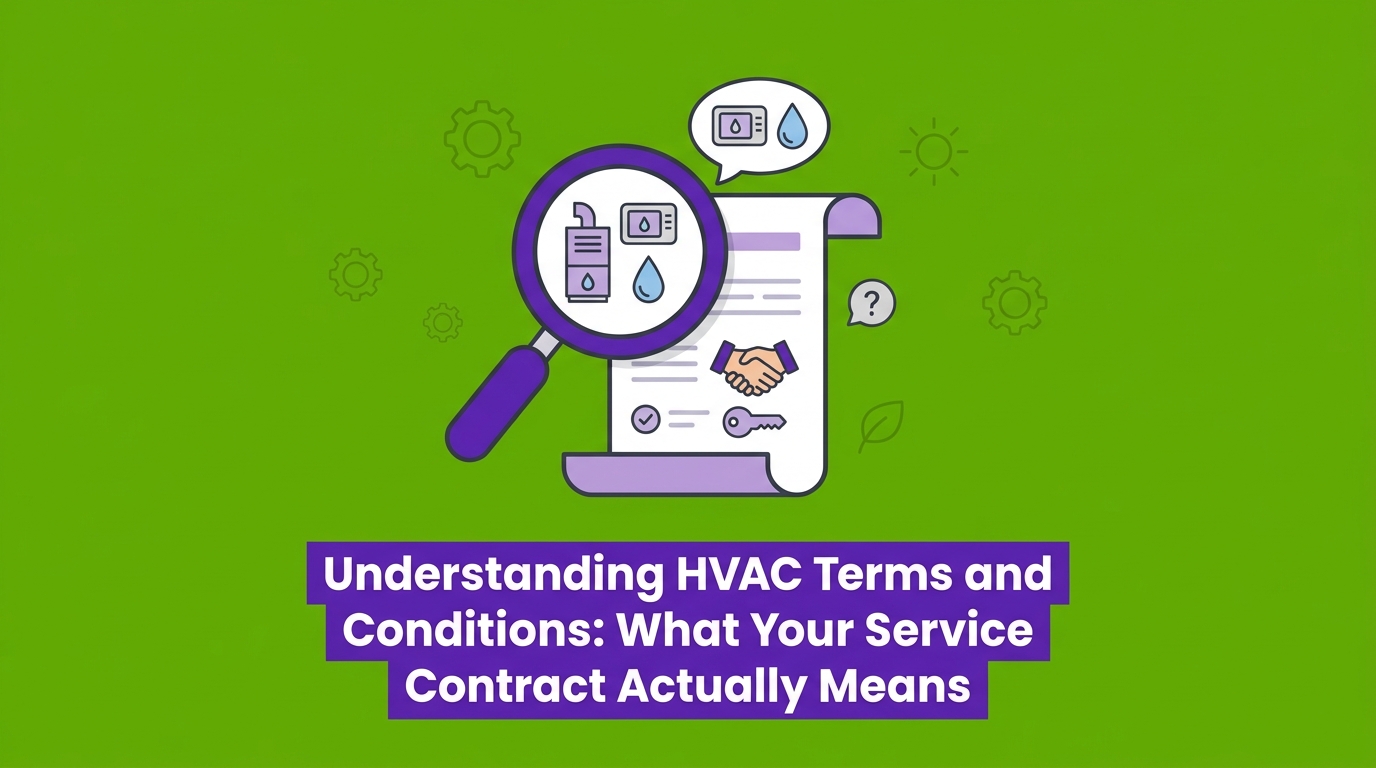
Understanding HVAC Terms and Conditions: What Your Service Contract Actually Means
Decoding the Fine Print Before the Cold Hits
Your furnace is making a strange rattling noise, and as you pull out your paperwork, you quickly realize that understanding HVAC terms and conditions: what your service contract actually means is much harder than it should be. You are staring at a dense, multi-page maintenance agreement, trying to prep your home for the changing seasons, but the legal jargon is making your head spin. In our years of serving Mountain View homeowners, we've seen countless families find themselves in this exact position during their September pre-heating tune-up, wondering if the document they are about to sign actually protects their equipment or just locks them into a rigid payment schedule.
Signing a contract without understanding the exclusions, priority service clauses, and mutual obligations is a significant risk. You might assume a certain repair is fully covered, only to discover later that your specific agreement only covers the technician's time, not the physical parts. Translating this legalese into a clear, mutual roadmap for system reliability is essential for your peace of mind and your home's comfort.
Ready to secure your home's comfort? Explore our comprehensive HVAC services or lock in your system's reliability today with our professional HVAC maintenance plan.
The Anatomy of a Standard Maintenance Agreement
Before you can evaluate the specific clauses in your paperwork, you need to understand what an HVAC service contract actually is. A formal agreement is very different from a basic tune-up receipt or a simple checklist left behind by a technician. A legally binding service agreement acts as a protective measure for long-term equipment health, outlining exactly how your system will be cared for over the next year.
At Plum HVAC, our team believes in complete transparency. Having maintained countless systems across the Bay Area, we know a good agreement should prioritize plain-English communication so you know exactly what is covered, without needing a law degree to figure it out. When a company hides behind confusing jargon, it usually means the homeowner is the one taking on the risk. A well-structured document will clearly define the coverage dates, the exact frequency of service visits, and the explicitly stated obligations for both the provider and the homeowner.
Identifying Core Coverage Areas
The most important part of reading your agreement is differentiating between preventative checks and reactive repairs. Preventative checks are the scheduled tasks designed to keep your system running efficiently, while reactive repairs happen when something unexpectedly breaks down.
• The baseline scope of work: This section lists exactly what the technician will do during a routine visit, such as testing safety switches, measuring electrical draw, and cleaning specific components.
• Coverage dates and terms: This defines when your contract begins and ends, and whether it automatically renews at the end of the term.
• Service frequency: Most standard agreements specify two visits per year—one for cooling and one for heating.
• System specifics: The contract should explicitly list the make, model, and serial numbers of the equipment covered. A contract covers specific machines, not the entire house.
• Records a single, past event. — Formal Service Agreement: Outlines future obligations and ongoing coverage.
• No priority status for future breakdowns. — Formal Service Agreement: Usually includes priority dispatching for emergencies.
• Only covers the work performed that day. — Formal Service Agreement: Often includes ongoing discounts on future repairs.
• No impact on maintaining manufacturer warranties. — Formal Service Agreement: Provides the continuous documentation warranties require.
Parts vs. Labor Exclusions: What You Actually Pay For
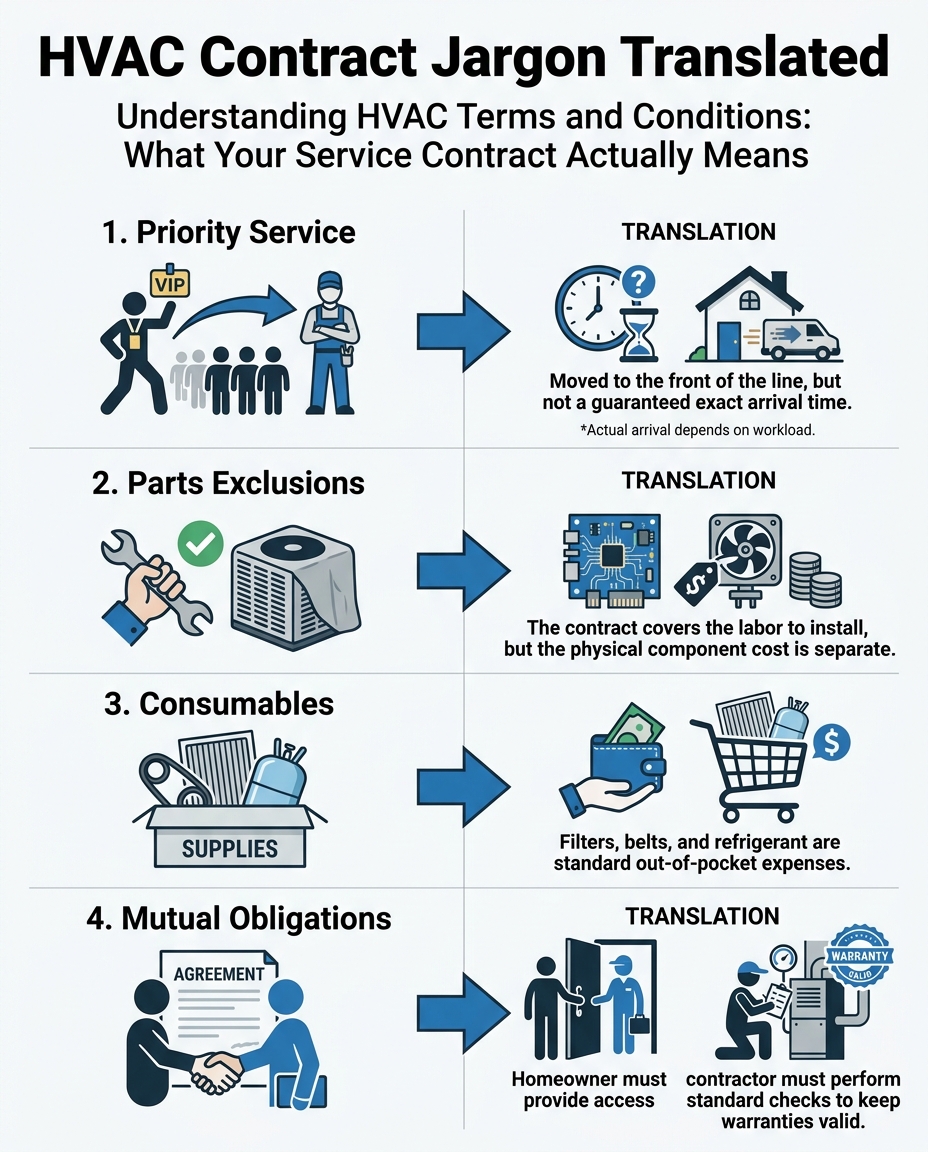
The problem: A pattern we see often when the first fall chill hits is a homeowner waking up to a freezing house, calling their HVAC provider, and having a technician replace a failed blower motor. Because they have a maintenance agreement, they expect the repair to be fully covered. Instead, they are handed an invoice for the physical motor, leaving them frustrated and confused about what their contract actually does.
The cause: This frustration almost always stems from a misunderstanding of parts exclusions and labor coverage. In the HVAC industry, the physical components (the parts) and the human effort required to install them (the labor) are treated as two entirely separate categories. Our technicians frequently spend time explaining that most standard maintenance agreements cover the labor for routine preventative maintenance, but they explicitly exclude the cost of new parts when something breaks. Even if your equipment is relatively new and the part itself is covered under a manufacturer's warranty, that manufacturer does not pay the local technician for the hours spent diagnosing and installing it. Therefore, your service contract dictates how that labor time is billed.
The solution: The key to avoiding surprise bills is reading your provider's standard terms and conditions carefully before signing. Look for the exact definitions of what is excluded from the base contract fee. Understanding these boundaries allows you to budget correctly for inevitable wear and tear.
Navigating Consumable Replacements
Beyond major parts like motors and compressors, you must also understand how your contract handles "consumables." Consumables are items that are designed to be used up and replaced regularly as part of normal operation.
• Air filters: Unless explicitly stated otherwise, providing and replacing standard or specialized media filters is almost always the homeowner's financial responsibility.
• Refrigerant: If your system develops a leak, the cost of the new refrigerant required to recharge the system is treated as a consumable exclusion.
• Belts and UV bulbs: Mechanical belts that wear down and ultraviolet bulbs used for indoor air quality lose their effectiveness over time and require out-of-pocket replacement.
Why are these treated differently? In our experience, their lifespan depends heavily on your specific home environment. A house with four shedding pets will go through air filters much faster than a pet-free home. Standardizing these costs inside a base contract fee is impossible, which is why they are billed separately when needed.
Priority Service vs. Guaranteed Response Times
When you live in the Mountain View / Bay Area, the weather can be unpredictable. Our dispatch team knows firsthand that the transition from warm, dry summers to mild, wet winters often brings sudden, unexpected cold snaps. When the temperature drops drastically overnight, every heating system in the region has to work overtime. Inevitably, many of those systems fail, flooding local dispatch queues with desperate calls for help.
This is where the "priority service" clause in your contract becomes incredibly valuable, but it is also widely misunderstood. Priority service means that as a contract holder, your emergency call is moved ahead of non-contract customers in the dispatch queue. If fifty people call for a broken furnace on a Tuesday morning, the customers with active maintenance agreements are scheduled first.
However, priority service is not the same as a "guaranteed response time." Guaranteed response times—where a company legally obligates itself to arrive within a specific window, like four hours—are exceedingly rare in residential contracts. Weather emergencies, traffic logistics, and the unpredictable nature of complex repairs make exact guarantees nearly impossible to fulfill safely.
Defining a Covered Emergency
To fully grasp your priority status, you need to know what contract language considers a true emergency versus a standard service call. While you might have utilized this benefit for your Mountain View AC maintenance during a summer heatwave, the rules apply equally to winter heating failures.
• Complete system failure: A total loss of heating during winter weather is universally classified as an emergency, triggering your priority status.
• Partial functionality: If your system is running but making a strange noise, or if one room is slightly cooler than the rest, this is usually classified as a standard service call, which may be scheduled during normal business hours.
• After-hours and holidays: Check the fine print to see how dispatch fees are handled outside of normal business hours. Some premium contracts waive after-hours fees entirely, while standard contracts simply guarantee that a technician will be dispatched, but standard overtime rates will still apply.
The Warranty Connection: Understanding Mutual Obligations
In our experience navigating manufacturer policies, one of the least understood benefits of an HVAC service contract is how it interacts with your equipment's original warranty. When you purchase a new furnace or air conditioner, the manufacturer provides a warranty covering major components for a set number of years. However, that warranty is not unconditional.
If you read the fine print of any major manufacturer's warranty, you will find a clause requiring proof of annual professional maintenance. Manufacturers know that a neglected system will fail prematurely. If a blower motor burns out because it was suffocating behind a clogged filter and a filthy blower wheel, the manufacturer can—and often will—deny the warranty claim, citing homeowner negligence.
This creates a mutual obligation. The manufacturer is obligated to provide replacement parts, but only if you fulfill your obligation to maintain the equipment. An active service agreement automatically fulfills this requirement. When your technician arrives for your September pre-heating tune-up, they are doing more than just cleaning sensors; they are actively protecting your legal right to claim warranty coverage if something goes wrong later.
Documentation and Proof of Service
Keeping detailed records of your fall and spring tune-ups is legally necessary. If a major component fails, the first thing the manufacturer's representative will ask for is the service history.
1. Automated tracking: A formalized service agreement automatically tracks this compliance for you. The HVAC company keeps a digital log of every visit, every measurement taken, and every cleaning performed.
2. Detailed invoicing: Your contract ensures you receive detailed paperwork showing exactly what was checked, proving to the manufacturer that the system was professionally evaluated.
3. Safe working environment: The fine print of your contract also outlines your physical obligations. You must provide clear, safe access to the equipment. If a technician cannot safely reach the furnace because the attic access is blocked or unsafe, the service cannot be performed, which puts your warranty status at risk.
For more details on how these documents interact, you can learn about deciphering HVAC manufacturer warranties to ensure you never accidentally void your coverage.
Transferability and Cancellation Clauses
Homeowners often hesitate to sign a multi-year or annual maintenance agreement because they are unsure of their future plans. What happens if you decide to sell your house? What if you are unhappy with the service and want to change providers? This is where transferability and cancellation clauses come into play.
A "transferability clause" dictates whether the contract can be reassigned to a new owner if you sell your property. We often advise our clients that an active, transferable maintenance contract is actually a minor selling feature for a home. It shows prospective buyers that the mechanical systems have been professionally maintained and provides them with immediate coverage during their first few months in the house. The fine print will usually require you to notify the HVAC company in writing within a certain timeframe (often 30 days) of the home sale to execute the transfer.
Cancellation policies are equally important to review. Standard contracts usually require written notice to cancel, often 30 days before the contract's renewal date.
• Transferring to a Buyer — Typical Requirements in the Fine Print: Written notice required, usually within 30 days of closing. The new owner assumes the remaining term.
• Canceling Mid-Term — Typical Requirements in the Fine Print: May incur an early termination fee, or require you to pay back any discounts received during the active term.
• Automatic Renewals — Typical Requirements in the Fine Print: Contract renews automatically unless written notice is provided 30 to 60 days prior to the anniversary date.
Always check for automatic renewal clauses. While auto-renewals are convenient and ensure your system never experiences a lapse in coverage, you should always know exactly how and when you can opt out if your situation changes.
Signing Your Fall Maintenance Agreement With Confidence
Understanding standard clauses like priority service, parts exclusions, and mutual obligations removes the fear of the unknown. When you know exactly what your contract covers—and just as importantly, what it does not cover—you can make informed decisions about your home's comfort.
Living in the Mountain View / Bay Area means dealing with unpredictable weather shifts. As your local HVAC experts, we know you need a system that is ready to perform when the first cold snap hits. A clear, plain-English contract is the sign of a trustworthy HVAC partner who wants to build a long-term relationship based on mutual respect and transparent communication.
Do not wait until your system is struggling to keep up. Review your options, ask questions about the fine print, and secure your system's reliability before the heavy heating season begins.
Frequently Asked Questions
What does an HVAC service agreement actually cover?
An HVAC service agreement covers the labor and expertise required to perform preventative maintenance on your system. It typically includes one or two scheduled visits per year to clean components, test safety mechanisms, and measure system efficiency. It does not usually cover the cost of new parts if something breaks, but it often provides a discount on those repairs.
What is the difference between parts and labor coverage in an HVAC contract?
Parts coverage refers to the physical components of your system, like a motor or a circuit board, which are usually covered by the manufacturer's warranty. Labor coverage refers to the technician's time and expertise to diagnose the problem and install the new part. Standard maintenance contracts generally cover preventative labor, but exclude the labor and parts for unexpected breakdowns unless specifically stated.
How does a maintenance contract affect my manufacturer warranty?
A maintenance contract is often the best way to keep your manufacturer warranty valid. Most equipment manufacturers include clauses in their warranties that require proof of annual, professional maintenance. An active service agreement automatically generates the documentation and service history needed to prove you have not neglected the system.
Are consumable items like air filters included in standard maintenance agreements?
No, consumables are almost always excluded from the base cost of a standard maintenance agreement. Items like air filters, humidifier pads, UV bulbs, and replacement refrigerant are considered out-of-pocket expenses. Because the lifespan of these items varies wildly depending on your home environment, they are billed separately when replacement is necessary.
Can you negotiate the terms and conditions of an HVAC contract?
While the core legal terms and safety obligations are usually standard across the industry, some elements can be customized. You can often negotiate the frequency of visits, the number of systems covered, or choose between different tiers of coverage (such as basic maintenance versus a premium plan that waives after-hours dispatch fees). However, liability and warranty compliance clauses are non-negotiable.
What legally constitutes an HVAC emergency under a priority service agreement?
An emergency is typically defined as a complete loss of primary heating or cooling during extreme weather conditions that pose a risk to the home or its occupants. A total furnace failure during a winter freeze qualifies as an emergency, moving you to the front of the dispatch queue. Minor issues, like a noisy fan or a slightly inaccurate thermostat, are usually treated as standard service calls.
hear what our satisfied clients have to say

.svg)
Service areas
.avif)