
Deciphering HVAC Manufacturer Warranties Before Approving a Major Repair
Facing a Sudden AC Breakdown? Why You Should Pause Before Approving Repairs
Your cooling system is blowing warm air, the house is sweltering, and a technician just handed you a major repair quote. Deciphering HVAC manufacturer warranties before approving a major repair is likely the last thing you want to do during a July peak summer heat wave, but it is the most critical step you can take to protect your finances. In our years of restoring comfort to Mountain View homes, our team at Plum HVAC has seen countless residents nearly pay out-of-pocket for covered components simply out of heat-induced desperation. When temperatures spike rapidly in the afternoon, the extreme discomfort often pushes homeowners to make rushed decisions. You just want the cool air flowing again, so it is incredibly tempting to sign the first repair estimate you see.
Mountain View and the surrounding areas feature a distinct microclimate where sudden afternoon temperature spikes can turn a slightly warm house into an uncomfortable oven within a matter of hours. This localized weather pattern creates a sense of panic when a system fails. However, blindly approving a major repair quote out of desperation is a common mistake that can cost you dearly. If a major component like a compressor or an evaporator coil has failed, there is a strong chance that the manufacturer is still legally obligated to provide a replacement part at no cost to you.
Taking just a few minutes to pause, breathe, and verify your equipment's coverage status can prevent you from paying out-of-pocket for components that are already protected. It is also a powerful reminder of why keeping up with seasonal tune-ups is so important, as professional upkeep is exactly what keeps these agreements valid over the long haul.
Whether you are researching new air conditioning systems or you want to protect your current equipment with a routine HVAC maintenance plan, knowing exactly where you stand with your warranty coverage is the foundation of smart homeownership.
How to Quickly Check Your HVAC Warranty Status
You do not have to wait for the contractor to leave or dig through dusty filing cabinets to find out if your cooling system is covered. You can look up your warranty status right from your smartphone while the technician is still at your Mountain View CA home. Manufacturers have made this process entirely digital, allowing you to confirm your coverage window in just a few minutes.
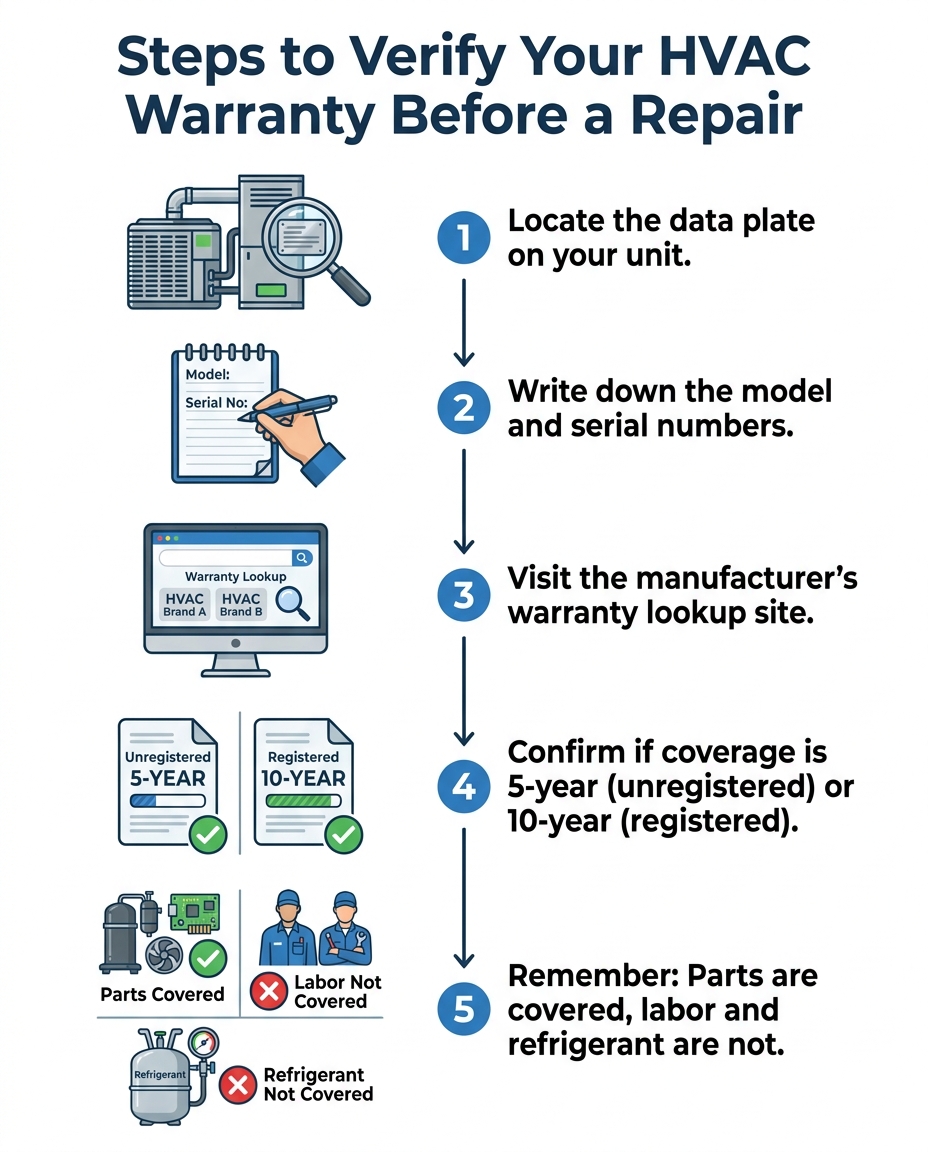
Our technicians always recommend following these quick steps to verify your status before you sign any repair approvals:
1. Locate the equipment data plate: Walk outside to your exterior condenser cabinet. Look for a silver, white, or black sticker mounted on the side of the unit, typically near where the copper refrigerant lines connect to the machine. If you are checking an indoor component, look on the front panel of the air handler or furnace.
2. Identify the model and serial number: The data plate contains a lot of technical specifications, but you only need two pieces of information. Look for the lines labeled "M/N" (Model Number) and "S/N" (Serial Number). The serial number is usually a long string of letters and numbers that acts as your equipment's unique fingerprint.
3. Take a clear photograph: Because these stickers sit outside in the harsh sun, the text can be quite small and sometimes faded. Snap a picture with your smartphone so you can zoom in and read the characters clearly without crouching next to the unit.
4. Navigate to the official lookup tool: Open your web browser and search for your specific equipment brand followed by the phrase "warranty lookup" (for example, "Carrier warranty lookup" or "Trane warranty lookup"). Ensure you are clicking on the manufacturer's official corporate website, not a third-party vendor.
5. Enter your credentials: Type your serial number into the search bar on the manufacturer's portal. The system will instantly generate a report showing your installation date, your registration status, and exactly how many years of coverage remain on your specific unit.
Once you have this information on your screen, you can have a much more informed conversation with the technician standing in your driveway.

Parts vs. Labor: Understanding What Your Manufacturer Warranty Actually Covers
A pattern we see often during our July peak summer dispatch calls is the utter frustration homeowners feel upon discovering that their "fully covered" air conditioner still comes with a repair bill. This confusion stems from a fundamental misunderstanding of how the HVAC industry structures its guarantees. There is a strict dividing line between the physical components manufactured in a factory and the human effort required to install them.
Standard manufacturer warranties cover the physical replacement parts. If a compressor seizes up or an evaporator coil develops a factory defect, the company that built the machine will ship a new part to your local supply house for free. However, they do not cover the labor, the diagnostic fees, or the shipping costs. During peak season heat, the specialized labor required to safely remove a broken compressor, braze a new one into place, pull a vacuum on the system, and test the electrical draw is highly technical. This specialized labor is billed separately by your local contractor.
To make matters clearer, here is a breakdown of how costs are typically distributed during a major repair:
• Physical Parts (Compressors, Coils, Motors) — Manufacturer Parts Warranty: Covered (Usually 5 to 10 years) — Contractor Labor Warranty: Not Covered
• Technician Time & Specialized Labor — Manufacturer Parts Warranty: Not Covered — Contractor Labor Warranty: Covered (Usually 1 to 2 years)
• Consumables (Refrigerant, Filters) — Manufacturer Parts Warranty: Not Covered — Contractor Labor Warranty: Rarely Covered
• Diagnostic & Dispatch Fees — Manufacturer Parts Warranty: Not Covered — Contractor Labor Warranty: Varies by Contractor
It is also vital to understand that refrigerant is legally classified as a consumable material, much like the oil in your car. Even if a covered evaporator coil develops a leak due to a manufacturing defect, the manufacturer will only supply the bare metal coil. The cost to replace the lost refrigerant falls entirely to the homeowner, which can significantly impact the final repair bill.
The 5-Year vs. 10-Year Coverage Trap: Why Registration Matters
When you look up your serial number, you might be shocked to see that your coverage expired after just five years, even though the sales brochure promised ten. This is the registration trap. Across the industry, unregistered equipment typically defaults to a standard 5-year parts warranty.
To unlock the full 10-year coverage, manufacturers require the equipment to be registered in their database within 60 to 90 days of the original installation. If you recently purchased a home, you should immediately check the registration status of your cooling system. While some brands allow coverage to transfer to a new owner, that transfer usually must be documented within a strict window after closing, or the system reverts back to the default 5-year term.
Common Pitfalls That Can Void Your HVAC Manufacturer Warranty
Even if your serial number lookup confirms you are well within your coverage window, a manufacturer can still deny your claim. Warranties are legally binding agreements that require the homeowner to uphold their end of the bargain. If you neglect the system, the manufacturer will not pay for the consequences. We constantly remind our maintenance members that prevention is the most reliable way to keep coverage active.
Here are the most common pitfalls that can instantly void your remaining coverage in Mountain View CA:
Skipping Annual Professional Maintenance
Manufacturers explicitly require proof of consistent, documented professional upkeep. If your compressor fails, the manufacturer has the right to ask your contractor to submit the last few years of maintenance invoices before they approve the replacement part. Skipping your annual tune-ups gives manufacturers clear grounds to deny a claim. A dirty, neglected system forces internal components to work twice as hard, leading to premature mechanical failure that the factory is not responsible for.
Using Unauthorized Third-Party Parts
When a minor component like a capacitor or a contactor fails, it must be replaced with an authorized OEM (Original Equipment Manufacturer) part or an approved equivalent. If an uncertified handyman installs a cheap, incompatible aftermarket part to save a few dollars, and that part subsequently causes the main compressor to short out, the manufacturer will void the warranty on the entire system.
Hiring Uncertified Technicians
Cooling systems are complex networks of high-voltage electricity and pressurized chemicals. Manufacturers require that all repairs and installations be performed by licensed, certified HVAC professionals. Attempting a DIY repair or hiring an unlicensed neighborhood handyman to tinker with the internal wiring will immediately invalidate your coverage.
To protect your investment and ensure your claims are always honored, prioritizing air conditioning maintenance in Mountain View is non-negotiable. Consistent professional care creates the paper trail you need to prove your system was treated properly.
How a Transparent HVAC Technician Helps You Verify Coverage
Dealing with a sudden failure during a July peak summer heat wave is stressful enough without feeling like you have to become a warranty expert on the fly. This is exactly where the caliber of your chosen contractor makes all the difference. A reputable technician serves as your advocate, not just an order-taker.
An honest technician will never rush you into a major financial decision without first checking the equipment's age and serial number. At Plum HVAC, our team routinely uncovers active warranties that homeowners didn't even realize they had. Our commitment to honest, transparent diagnostics means we actively assist you in looking up your warranty status on the manufacturer's portal right from your driveway. We want to ensure you never pay out-of-pocket for a part that the factory owes you.
Transparent diagnostics mean clearly separating the estimate into distinct categories. A trustworthy contractor will show you exactly what the covered part would cost if you had to buy it, and then clearly outline the required labor, the necessary refrigerant, and the diagnostic fees. This level of clarity removes the anxiety from the process and allows you to see exactly where your money is going.
Reviewing these options carefully is crucial, not just for today's repair, but for tomorrow's investments. Understanding how different brands handle parts and labor claims is incredibly helpful when comparing warranties across top residential HVAC brands for future system replacements. When you know how a company treats you during a breakdown, you know exactly what to look for when buying a new system.
Frequently Asked Questions About HVAC Warranties
How do I check my HVAC warranty status?
You can verify your status by finding the model and serial number on the unit's exterior data plate. Once you have those numbers, enter them into the manufacturer's official warranty lookup tool on their corporate website. This portal will instantly tell you if your equipment is still covered and whether it is registered.
Does an HVAC manufacturer warranty cover labor?
No, standard manufacturer warranties only cover the physical parts that fail due to a factory defect. The specialized labor required to diagnose the problem, remove the broken part, and install the new component is typically covered separately by the installing contractor, usually lasting 1 to 2 years after installation.
What does a 10-year HVAC warranty actually cover?
A standard 10-year agreement covers major internal mechanical components, such as the compressor, the evaporator coil, and the blower motor. It strictly covers the cost of the bare metal parts and does not cover diagnostic fees, consumable materials like refrigerant, or the technician's time.
Are HVAC warranties transferable to a new homeowner?
Many modern agreements are transferable to a new buyer, but they often come with strict conditions. If the transfer is not formally registered within a specific window—usually 60 to 90 days of closing—the coverage often reverts from a 10-year term down to a 5-year term starting from the original installation date.
Why isn't refrigerant covered under my parts warranty?
Refrigerant is legally classified as a consumable material rather than a manufactured mechanical part. Even if a fully covered evaporator coil develops a leak and requires replacement, the cost to replace the lost refrigerant falls entirely to the homeowner.
What voids an HVAC manufacturer warranty?
The most common reasons for a denied claim include a lack of documented annual maintenance, using uncertified technicians for repairs, and installing incompatible third-party replacement parts. Manufacturers require proof that the system was professionally maintained before they will honor a claim for a major component failure in Mountain View CA.
Make Informed Repair Decisions for Your Cooling System
Knowing your exact coverage status is the ultimate shield against overpaying during a sudden breakdown. When you pause to decipher your warranty, you take control of the situation, transforming a stressful emergency into a manageable, informed decision. Understanding the distinct difference between parts and labor empowers you to review repair quotes with confidence, ensuring you only pay for the services you actually need.
The peace of mind that comes with clear, transparent explanations is invaluable, especially for homeowners in Mountain View CA facing intense summer weather. Do not let the urgency of a warm house push you into a blind approval. Reach out to a local expert who will prioritize transparent diagnostics, help you verify your coverage, and provide honest repair estimates that respect your time and your budget.
hear what our satisfied clients have to say

.svg)
Service areas
.avif)