

A Technician's Framework for Evaluating Heating Brand Reliability
Beyond the Brochure: The Real Drivers of Heating Reliability
A high AFUE efficiency rating does not guarantee a reliable furnace that will run flawlessly through the winter, yet this is the most common myth homeowners believe when they start researching A Technician's Framework for Evaluating Heating Brand Reliability. The truth is that efficiency and reliability are two completely different metrics. Efficiency measures how much fuel your system converts into usable heat, while reliability measures how consistently the mechanical components operate under stress without failing. When you rely solely on manufacturer brochures, you are only getting the marketing perspective.
As the September pre-heating season approaches, the window for making a proactive, well-researched replacement decision begins to close. Navigating glossy marketing materials can make every brand look like the perfect choice. However, field technicians see a very different reality once these systems are installed and running. They evaluate brands based on mechanical durability, part accessibility, and real-world failure rates rather than smart features and aesthetic cabinet designs. By understanding how the professionals evaluate equipment, you can make a significantly more informed decision for your home.
If you are planning an upgrade this fall, exploring professional heating services and learning about your options for furnace installation and replacement is the best first step.
Marketing Metrics vs. Mechanical Reality
When you open a consumer brochure for a new heating system, the prominent features usually highlight ultra-quiet operation, sleek cabinet designs, and seamless smart thermostat compatibility. While these features certainly enhance your daily comfort, they have very little to do with preventing a mechanical breakdown at two in the morning. Marketing metrics are designed to sell units on the showroom floor, whereas mechanical reality dictates how long the system will last in your basement or attic.
Technicians evaluate Residential furnaces and heat pumps by looking at the core components that do the heavy lifting. The true test of a system's quality lies in the durability of its primary and secondary heat exchangers, the heavy-duty construction of its blower motors, and the resilience of its draft inducers. These are the parts that endure extreme temperature fluctuations and constant vibration.
A typical pattern we see in the field is that the most heavily marketed brands aren't always the ones with the lowest failure rates. Some manufacturers pour their budgets into advertising and proprietary smart features, while quietly cutting corners on the thickness of their heat exchanger metal or the quality of their internal wiring harnesses. When evaluating a system, professionals look past the touchscreen thermostat and focus on the mechanical integrity of the parts that actually generate and distribute heat.
• Heat Exchanger Quality: The thickness and material (such as tubular stainless steel) dictate how well the unit resists cracking from thermal fatigue.
• Blower Motor Durability: Heavy-duty bearings and robust electrical components prevent premature motor burnout.
• Control Board Resilience: Well-protected circuit boards are less susceptible to moisture and dust-related short circuits.
• Draft Inducer Construction: High-quality inducer assemblies handle exhaust gases safely without rattling or failing early.
The Critical Impact of Universal vs. Proprietary Components
One of the most significant factors in long-term heating reliability is whether a system relies heavily on proprietary parts or if it can accept universal HVAC components. Universal parts are standardized components—like certain ignitors, capacitors, contactors, and standard blower motors—that are manufactured to fit a wide variety of brands. Proprietary components are highly specialized parts designed to work only with one specific brand or even one specific model line.
When comparing top residential HVAC brands, field technician experience consistently shows shorter repair downtimes for universally compatible systems. If a universal capacitor fails on a freezing Tuesday night, a technician likely has three of them sitting on their truck. The system is repaired immediately, and your home is warm again within the hour.
Conversely, if a proprietary control board or specialized communicating motor fails, that part must often be ordered directly from the manufacturer. This can lead to extended mid-winter repair delays, leaving your family without heat while you wait for a shipping truck. When interviewing contractors for your fall replacement, ask them directly how heavily their recommended brand relies on proprietary parts for basic operation.
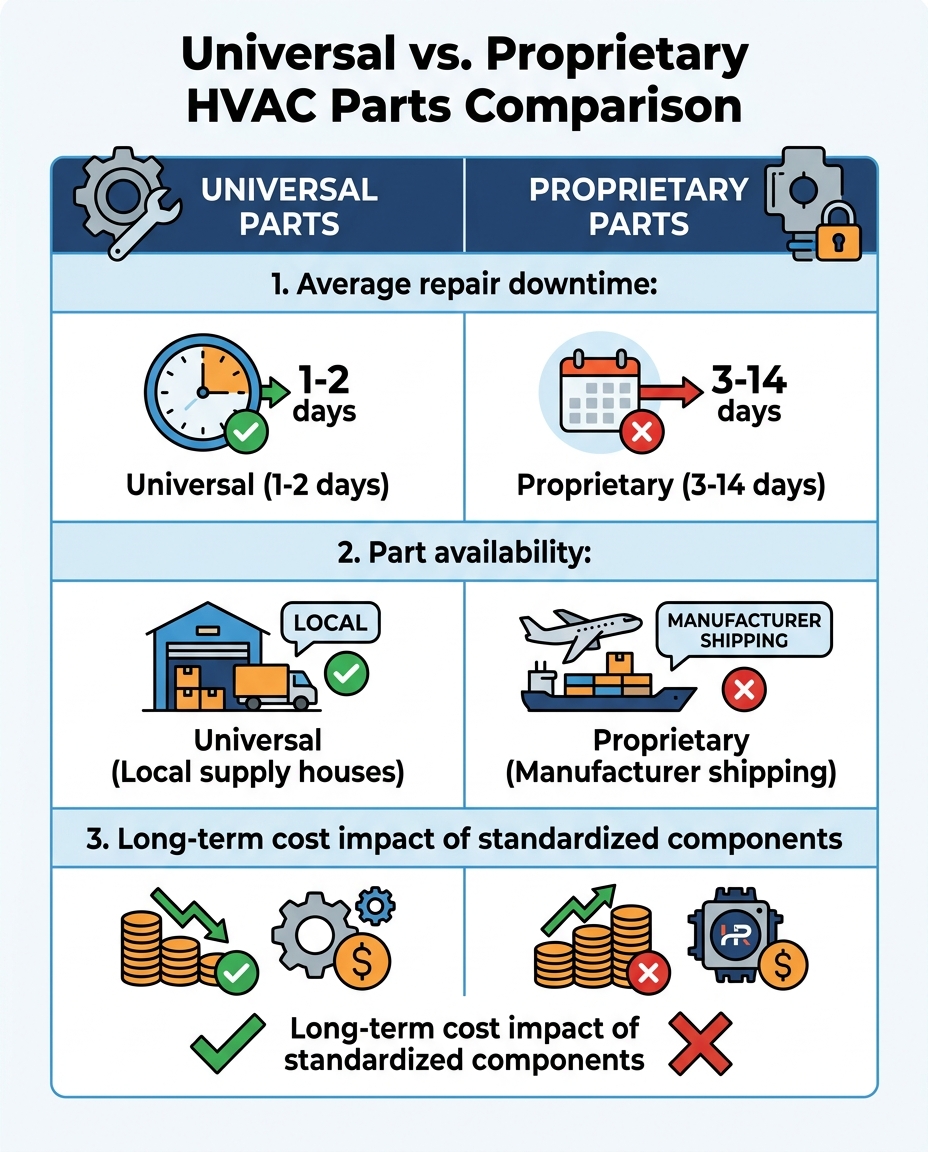

• Immediate Availability — Universal Components: High (stocked on standard service trucks) — Proprietary Components: Low (often requires special ordering)
• Repair Downtime — Universal Components: Usually repaired the same day — Proprietary Components: Can take several days to weeks
• Long-Term Cost — Universal Components: Generally lower due to market competition — Proprietary Components: Often higher due to manufacturer monopoly
• Technician Preference — Universal Components: Highly preferred for fast, reliable service — Proprietary Components: Viewed as a liability for winter emergencies
Cabinet Layout: How Internal Engineering Affects Repair Time
A brand's overall reliability is deeply tied to how easily a technician can access its internal components. Homeowners rarely look inside the metal cabinet of a furnace or heat pump air handler, but the internal engineering layout is a primary metric for industry professionals. A system that is easy to service will generally receive better, more thorough routine maintenance over its lifespan.
Some brands design their cabinets with the service technician in mind. In these systems, the control board swings out easily, the blower motor slides out on a built-in track, and the flame sensor is located right at the front of the burner assembly. This clean engineering reduces the labor time required for basic diagnostic work and routine cleaning.
Other brands feature cramped, convoluted layouts where technicians must remove the exhaust flue, unbolt a gas manifold, and navigate a web of wiring just to reach a basic sensor. This poor engineering increases labor time, which translates directly to higher repair bills for the homeowner. Furthermore, when systems are incredibly difficult to work on, minor preventative maintenance tasks are more likely to be rushed or skipped, leading to major mechanical failures down the road.
The Maintenance Accessibility Factor
The accessibility of internal parts directly dictates the quality of your annual tune-ups. When evaluating different brands, technicians prioritize systems that make preventative care straightforward.
1. Sensor Cleaning: Sensors and boards located behind complex paneling are harder to clean. A dirty flame sensor is a leading cause of nuisance furnace lockouts. If it takes twenty minutes just to reach the sensor, the labor costs for your tune-up increase.
2. Proactive Replacement: Accessible components encourage proactive part replacement before catastrophic failure. If a technician can easily test and access a weak capacitor, they can replace it on the spot. If it is buried behind the blower assembly, it might be left until it completely fails.
3. Visual Inspections: A clean layout allows technicians to visually inspect the heat exchanger for dangerous cracks or rust quickly and accurately, ensuring your home remains safe.
Why Proper Sizing Outperforms Maximum Heating Power
One of the most dangerous misconceptions in heating replacement is the idea that bigger is always better. Homeowners often request the highest BTU output available, assuming it will provide faster, more reliable heat. In reality, sheer heating power is useless—and actively detrimental—if the system is not properly sized for the specific thermal load of your home.
When a furnace or heat pump is oversized, it blasts the home with a massive amount of hot air, satisfying the thermostat almost immediately. The system then shuts off. A few minutes later, the house cools down, and the system turns back on. This rapid starting and stopping is called "short-cycling." Mechanically, starting up is the most stressful phase of operation for any HVAC system. Constant short-cycling wears out ignitors, stresses blower motors, and causes the heat exchanger to rapidly expand and contract, leading to premature metal fatigue and cracking.
In Mountain View, the winter climate features mild averages punctuated by sudden chilly snaps. This specific regional weather pattern makes avoiding short-cycling the true key to system longevity. A massive, oversized furnace will short-cycle constantly during the mild weeks, wearing itself out before the real cold snaps even arrive. The most reliable systems are those that provide steady, even, responsive heating rather than aggressive blasts of maximum power.
Even the highest-rated brand on the market will fail years ahead of schedule if it is improperly sized. This is why thorough technicians perform detailed heat load calculations before recommending heat pump systems or gas furnaces. Proper sizing ensures the unit runs in long, efficient cycles, which protects the mechanical parts from unnecessary wear and tear.
Local Supply Chains: The Hidden Metric for Fast Repairs
When consumer magazines publish their annual lists of top-rated equipment, they rarely factor in the logistics of regional supply chains. However, how HVAC brands are ranked by local technicians depends heavily on the robustness of the manufacturer's local distributor network. This is the hidden metric that dictates how fast your system can be fixed during a mid-winter breakdown.
A highly rated national brand might be a terrible choice for your specific neighborhood if their nearest parts warehouse is three states away. If a proprietary blower motor fails and the local supply houses do not carry that brand, you are entirely dependent on freight shipping. During a severe winter storm, freight shipping can be delayed for days, leaving your home completely without heat.
Technicians factor local supply chain availability into their brand recommendations to protect homeowners from these freezing wait times. A brand that maintains a massive distribution center within a thirty-mile radius is inherently more reliable for you than a boutique brand with limited regional support. When you are balancing your upfront investment with long-term peace of mind, evaluating the total value of a system means ensuring the parts are available locally.
Understanding these logistical realities helps you make a smarter purchasing decision. If you are exploring different tiers of equipment to find the right balance of reliability and local support, reviewing HVAC financing options can help you afford a system that offers both high-quality universal components and excellent regional part availability.
Frequently Asked Questions About Heating Brand Reliability
How do technicians rank top HVAC brands?
Technicians rank brands based on mechanical durability, the availability of replacement parts, and how easy the internal cabinet is to service. While consumer reviews often focus on the purchasing experience or smart thermostat compatibility, professionals look at the failure rates of core components like heat exchangers and blower motors. A brand that uses standardized, universal parts and features a clean internal layout will always rank higher among technicians than a complex, proprietary system.
What makes a heating system truly reliable?
True reliability comes from proper system sizing, rigorous installation practices, and high-quality internal components that resist thermal fatigue. A reliable system runs in long, steady cycles rather than short, stressful bursts, which minimizes wear on the motors and ignitors. Furthermore, a reliable system is one that can be easily maintained and quickly repaired using locally available parts.
Why do some furnace brands break down more often than others?
Some brands experience higher breakdown rates because they utilize thinner metals in their heat exchangers or rely heavily on proprietary, complex electronic control boards that are sensitive to dust and moisture. Additionally, brands that are notoriously difficult to service often suffer from neglected maintenance, as technicians cannot easily access the parts that need regular cleaning. Poor internal engineering directly correlates to a higher frequency of mechanical failures.
Is a higher AFUE rating a guarantee of fewer repairs?
No, a higher AFUE rating is absolutely not a guarantee of fewer repairs. AFUE stands for Annual Fuel Utilization Efficiency, which simply measures how much of the fuel is converted into usable heat versus how much is lost as exhaust. A 98% AFUE furnace is incredibly fuel-efficient, but its complex secondary heat exchangers and modulating gas valves actually introduce more components that can potentially fail compared to a simpler, lower-efficiency model.
How does universal part compatibility affect heating repair costs?
Universal part compatibility significantly lowers heating repair costs because the parts are widely available and competitively priced across multiple local supply houses. When a system requires proprietary parts, the manufacturer controls the pricing, and the homeowner must often pay premium rates and expedited shipping fees to get their heat restored. Standardized parts ensure faster, more affordable emergency repairs.
What is the most reliable heating and cooling brand for mild climates?
In mild climates, the most reliable brand is one that offers excellent low-stage modulation and is perfectly sized to avoid short-cycling during moderate weather. Rather than focusing on a single brand name, homeowners should look for equipment paired with a strong local distributor network and an installation contractor who performs meticulous Manual J load calculations. The precise sizing and installation quality matter far more than the logo on the cabinet.
Make an Informed Decision for Your Fall Replacement
True reliability in a heating system goes far beyond the glossy promises of a manufacturer's brochure. It is built on a foundation of universal part compatibility, smart internal cabinet layout, and precise, climate-specific sizing. When you look past the marketing metrics and focus on the mechanical realities, you protect your home from unnecessary winter breakdowns and extended repair delays.
You now have a technician-grade framework to evaluate contractor recommendations confidently. By asking the right questions about local supply chains, proprietary components, and heat load calculations, you can ensure your investment is sound. Do not wait for the seasonal temperature drop to put overwhelming strain on your aging equipment; take action this fall to secure a heating system that will deliver consistent, reliable comfort for years to come.
hear what our satisfied clients have to say

.svg)
Service areas
.avif)