
Evaluating Top HVAC Brands: Heating Options Comparisons for Homeowners
Is It Time to Reevaluate Your Heating System Before Winter?
Are you searching for objective options comparisons for homeowners because you suspect your aging furnace will not survive another season? Are you tired of crossing your fingers every time the thermostat calls for heat? Deciding whether to replace an aging traditional heating system before cold weather strain causes a systemic failure is a significant technical decision. Waiting for a complete breakdown during the coldest week of the year severely limits your choices, forcing a rushed installation rather than a carefully considered upgrade. The October pre-winter heating startup provides the critical window for evaluating aging equipment before the heavy operational demands of winter take their toll.
Before rushing into a replacement, a thorough assessment of top HVAC brands is necessary to understand the current technological landscape. The industry has shifted significantly over the last decade, and replacing like-for-like is no longer the default recommendation for most properties. Instead of a single-brand sales pitch, homeowners need a technical comparison of how modern systems operate, how they use energy, and how they align with regional climate demands.
As you transition away from relying heavily on air conditioning systems and prepare for cooler weather, evaluating the mechanical differences between available heating technologies becomes the priority. Understanding the operational efficiency and long-term viability of top-tier equipment allows you to make an informed, data-driven choice for your property's infrastructure.
Analyzing the Technical Shift: Electric Heat Pump vs. Traditional Gas Furnace
The most fundamental decision in modern residential heating is choosing the underlying technology: an electric heat pump vs. traditional gas furnace. These two systems operate on completely different mechanical principles, which directly impacts their energy consumption, longevity, and performance profile. Understanding these core operational differences is the first step in evaluating which top HVAC brands offer the right solution for your home.
How Modern Heat Pumps Transfer Energy
Unlike older heating methods that consume fuel to create heat, modern heat pumps utilize a refrigeration cycle to transfer ambient thermal energy from the outside air into your living space. Even in cold weather, ambient air contains heat energy. The system's compressor pumps a specialized refrigerant through outdoor coils, where it absorbs this heat, and then moves it indoors to be released through the air handler.
Because they move heat rather than generate it, heat pumps operate at exceptional efficiency levels. This efficiency is measured by the Coefficient of Performance (COP). A COP of 3.0 means that for every unit of electrical energy consumed, the system produces three units of heat energy. Top-tier manufacturers have heavily invested in variable-speed compressor technology, allowing these systems to modulate their output precisely to match the home's real-time heating demands, rather than simply turning on and off at full capacity.
The Mechanics of Gas Combustion Heating
A traditional gas furnace relies on the combustion of fossil fuels to generate heat. Natural gas is ignited within a sealed combustion chamber, heating a metal heat exchanger. The system's blower motor then forces indoor air over this hot metal, transferring the thermal energy into the ductwork. The exhaust gases produced during combustion are safely vented outside through a flue.
The efficiency of a gas furnace is measured by its Annual Fuel Utilization Efficiency (AFUE) rating. An AFUE of 90% means that 90% of the fuel consumed is converted into usable heat, while the remaining 10% escapes as exhaust. While modern condensing furnaces can achieve very high AFUE ratings, older combustion models often struggle with heavy use, suffering from cracked heat exchangers and failing ignition modules. Furthermore, because a gas furnace generates heat through combustion, its maximum efficiency is physically capped below 100%—it can never produce more energy than it consumes.
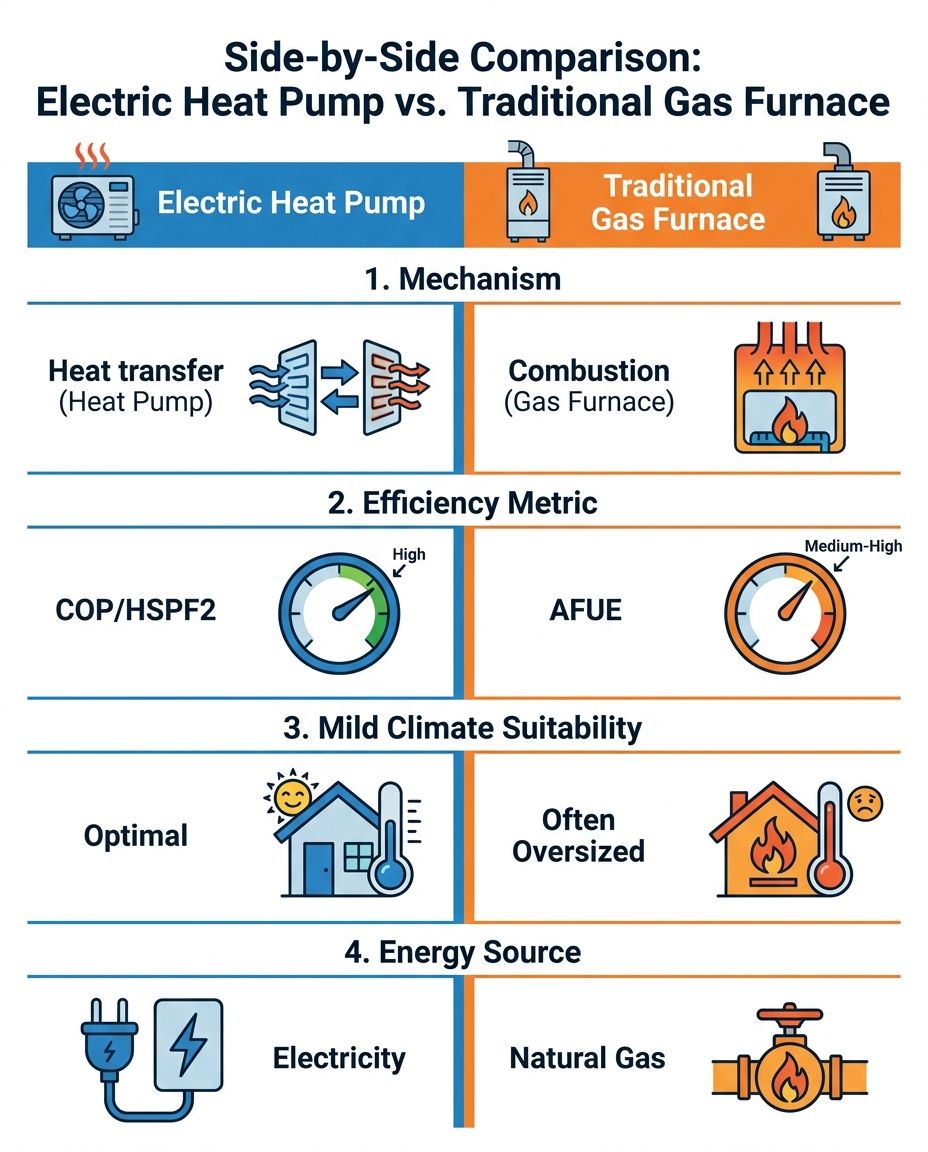
• Primary Mechanism — Electric Heat Pump: Heat transfer via refrigeration cycle — Traditional Gas Furnace: Heat generation via gas combustion
• Efficiency Metric — Electric Heat Pump: COP / HSPF2 (Can exceed 100% efficiency) — Traditional Gas Furnace: AFUE (Capped strictly below 100%)
• Energy Source — Electric Heat Pump: Electricity — Traditional Gas Furnace: Natural Gas or Propane
• Output Modulation — Electric Heat Pump: Highly variable (inverter technology) — Traditional Gas Furnace: Typically single or two-stage operation
When evaluating furnace replacement options, weighing the long-term viability of combustion technology against the rapid advancements in electric heat transfer is critical for future-proofing your home.

System Efficiency and Climate Compatibility in Mild Winters
Equipment performance cannot be evaluated in a vacuum; it must be contextualized within the specific regional climate. National heating advice often heavily favors high-capacity combustion systems designed for extreme, sub-zero blizzards. However, in our years of evaluating local homes, our team at Plum HVAC has found that Mountain View's mild winter temperatures rarely drop below freezing. This makes high-efficiency heat pumps from top-tier brands the superior technical choice over traditional gas furnaces for our specific climate.
The problem of oversizing: A pattern we see often during our October pre-winter heating startup calls is oversized equipment. Installing a massive gas furnace in our moderate climate frequently leads to a mechanical issue known as short-cycling. Because the system produces a massive blast of heat very quickly, it satisfies the thermostat in minutes and shuts down, only to turn back on shortly after. This constant starting and stopping causes severe wear and tear on the blower motor and heat exchanger, drastically reducing the system's lifespan and destroying its operational efficiency.
The advantage of modulation: Conversely, modern electric heat pumps maintain peak operational efficiency year-round in moderate temperature zones. Because they utilize inverter-driven compressors, they can run continuously at a very low speed, gently maintaining the exact temperature of the home without the harsh temperature swings associated with gas furnaces. This continuous, low-power operation is exactly what Department of Energy (DOE) and Energy Star standards recognize when awarding high-efficiency certifications.
When considering heat pump upgrades, homeowners in mild climates benefit immensely from the versatile climate control these systems provide, seamlessly transitioning from summer cooling to efficient winter heating without the need for a secondary fossil fuel source.
Evaluating Manufacturer Warranties Among Top HVAC Brands
A technical evaluation of an electric heat pump vs. traditional gas furnace is incomplete without thoroughly examining the manufacturer's backing. Warranties vary wildly between premium and budget tiers, and the fine print often dictates the true long-term cost of ownership.
When reviewing the guarantees provided by top HVAC brands, homeowners should systematically check the following components:
• Standard Parts vs. Extended Labor: Most manufacturers offer a baseline parts warranty (often 5 to 10 years if registered), but this rarely covers the cost of the technician's labor to diagnose and replace the part. Extended labor warranties are typically handled by the installing dealer or a third-party underwriter.
• Compressor Guarantees: In a heat pump, the compressor is the most critical and expensive component. Premium brands often offer specialized, longer-term coverage specifically for the compressor, sometimes extending to the lifetime of the unit for the original registered homeowner.
• Heat Exchanger Coverage: For gas furnaces, the heat exchanger is the equivalent critical component. Top-tier brands frequently provide 20-year or lifetime limited warranties on the heat exchanger, reflecting their confidence in the metallurgy and design.
• Registration Requirements: The most common pitfall in HVAC warranties is failing to register the equipment. Many top brands explicitly state in their fine print that if the system is not registered within 60 to 90 days of installation, the warranty term is automatically slashed in half.
• Installation Validity: No manufacturer will honor a warranty if the system was installed improperly. Proper airflow calculations, correct refrigerant charging, and adherence to local building codes are mandatory. If a compressor fails due to poor ductwork design, the manufacturer will void the claim.
For a deeper dive into how different manufacturers structure their guarantees, comparing residential HVAC brand features and warranties provides the necessary technical insight to protect your investment.
The Reality of Local Parts Availability and Supply Chains
A brand's national reputation means very little if your system breaks down during a cold snap and the required replacement part is sitting in a warehouse three states away. The reality of local parts availability and regional supply chains is a critical, yet frequently overlooked, factor in equipment selection during the October pre-winter heating startup.
Proprietary vs. Universal Components: High-end, communicating HVAC systems offer incredible efficiency, but they achieve this by using heavily proprietary, brand-specific control boards and sensors. If one of these proprietary components fails, it must be ordered directly from the manufacturer's regional distributor. Conversely, simpler or more universally designed systems often utilize standard contactors, capacitors, and motors that any local supply house carries in stock.
Regional Warehousing Impact: Downtime during peak heating season is directly tied to a brand's warehousing footprint. Brands that maintain massive distribution centers in Northern California can overnight parts to local dealers, while brands relying on East Coast distribution may leave you waiting days for a specialized blower motor.
This is where local, on-the-ground knowledge becomes invaluable. At Plum HVAC, our team offers unbiased technician expertise based on years of field experience in the Silicon Valley area. We know exactly which manufacturers have the most reliable local parts availability and warranty support because we navigate these supply chains daily. We weigh a brand's national marketing claims against the harsh reality of regional supply chain strength, ensuring that the equipment we install in your home can actually be serviced rapidly when Mountain View HVAC services are required.
Navigating Generic Energy Rebates and Tax Incentives
The transition away from fossil fuels is currently being heavily incentivized at both the federal and local levels. Factoring these generic financial incentives into your technical decision can significantly alter the long-term return on investment when comparing an electric heat pump vs. traditional gas furnace.
Federal Tax Credits: General federal tax credits may apply to qualifying high-efficiency heat pump installations under current energy transition initiatives. These credits are designed to offset a portion of the installation cost for systems that meet strict Energy Star efficiency criteria.
Local Utility Rebates: Furthermore, local utility providers in California frequently run rebate programs that incentivize homeowners to cap off their gas lines and transition to fully electric heating. Because heat pumps reduce the overall carbon footprint and utilize the electrical grid more efficiently during off-peak winter hours, utilities are highly motivated to support this technological shift.
Verification is Mandatory: It is important to note that not every piece of equipment qualifies. Homeowners must check the specific Energy Star ratings, SEER2, and HSPF2 numbers of the exact model being proposed. Always verify all current programs, eligibility requirements, and application deadlines with your local utility provider or a qualified tax professional before making a final purchasing decision.
Making a Confident Decision for Your Home's Comfort: Options Comparisons for Homeowners
Selecting the right heating system requires looking past brand names and focusing on mechanical realities. The October pre-winter heating startup is the ideal time to evaluate the technical differences, operational efficiency, and long-term viability of your next system. Whether you lean toward the proven combustion of a gas furnace or the advanced heat transfer of a modern electric heat pump, the best brand is ultimately the one that aligns with your local climate needs, offers robust warranty protections, and maintains a strong local supply chain.
Do not wait for a complete system failure to force your hand. Schedule a professional, unbiased technical evaluation of your current equipment and ductwork. By taking a proactive approach to options comparisons for homeowners, you ensure that your next HVAC investment provides reliable, efficient comfort for decades to come.
Frequently Asked Questions
What is the most reliable HVAC brand?
In our experience serving Mountain View homeowners, the most reliable HVAC brand is the one that is correctly sized and properly installed for your specific home. While top-tier manufacturers offer excellent engineering and robust warranties, even the most expensive equipment will fail prematurely if the ductwork is undersized or the refrigerant charge is incorrect. Reliability is determined 80% by the quality of the installation and 20% by the manufacturing brand.
Should I replace my gas furnace with a heat pump in California?
Replacing a gas furnace with a heat pump is generally a transition our team highly recommends for mild California climates. Because temperatures rarely drop into the extreme negatives, heat pumps can operate at peak efficiency year-round, utilizing the refrigeration cycle to transfer heat rather than burning fossil fuels. This transition also positions your home to take advantage of clean energy grids and local utility incentives aimed at decarbonization.
Which heat pump brand is best for mild climates?
The best heat pump brand for a mild climate is one that features inverter-driven, variable-speed compressor technology. This allows the system to modulate its output, running at very low speeds to maintain consistent indoor temperatures without over-conditioning the space. Brands that prioritize high Coefficient of Performance (COP) ratings at moderate ambient temperatures will provide the best comfort and energy efficiency.
How do proprietary parts affect HVAC repair times during the winter?
Proprietary parts can significantly extend repair times if a local distributor does not have them in stock during a cold snap. While high-end communicating systems require brand-specific control boards and sensors to achieve their efficiency ratings, a failure means waiting for that exact part to ship from a regional warehouse. Universal parts used in simpler systems can often be sourced immediately from any local HVAC supply house.
Do generic federal tax credits apply to all HVAC system replacements?
No, generic federal tax credits do not apply to all HVAC system replacements. These incentives are strictly tied to high-efficiency equipment that meets or exceeds specific Energy Star performance metrics, such as SEER2 and HSPF2 ratings. Homeowners must verify the exact model numbers against current federal and local utility program requirements to ensure eligibility before installation.
hear what our satisfied clients have to say

.svg)
Service areas
.avif)