

The Science Behind Heat Exchanger Cracks and Why We Check Them in the Fall
The Invisible Threat Hiding in Your Dormant Furnace
Before the first major temperature drop of the year arrives, understanding the science behind heat exchanger cracks and why we check them in the fall is the most proactive step you can take for your home's safety. During the early fall pre-heating season, your furnace has likely been sitting dormant for months. When the weather shifts, that idle equipment is suddenly called upon to generate massive amounts of heat on demand. This abrupt transition places immense physical stress on the internal components of your heating system, particularly the heat exchanger, which serves as the primary barrier between combustion gases and your breathable indoor air.
If you are looking to secure your system before the cold weather sets in, scheduling comprehensive Heating Services is the most effective way to identify microscopic wear and tear. Mountain View enjoys relatively mild autumns, which can sometimes lull homeowners into a false sense of security. However, when those mild days transition into crisp, cold winter nights, your furnace is thrust from zero activity into heavy, continuous workloads. This sudden demand exposes any underlying weaknesses that developed during previous winters.
To the untrained eye, a furnace either produces heat or it doesn't. But behind the metal casing, intense thermodynamic reactions are taking place every time the thermostat clicks on. The heat exchanger absorbs the brunt of this extreme thermal stress. Over time, the constant cycling degrades the structural integrity of the metal. Understanding the objective science behind this degradation helps homeowners recognize why proactive, professional evaluations are an absolute necessity before the heavy winter workload begins.
Thermodynamics 101: How Thermal Expansion Causes Metal Fatigue
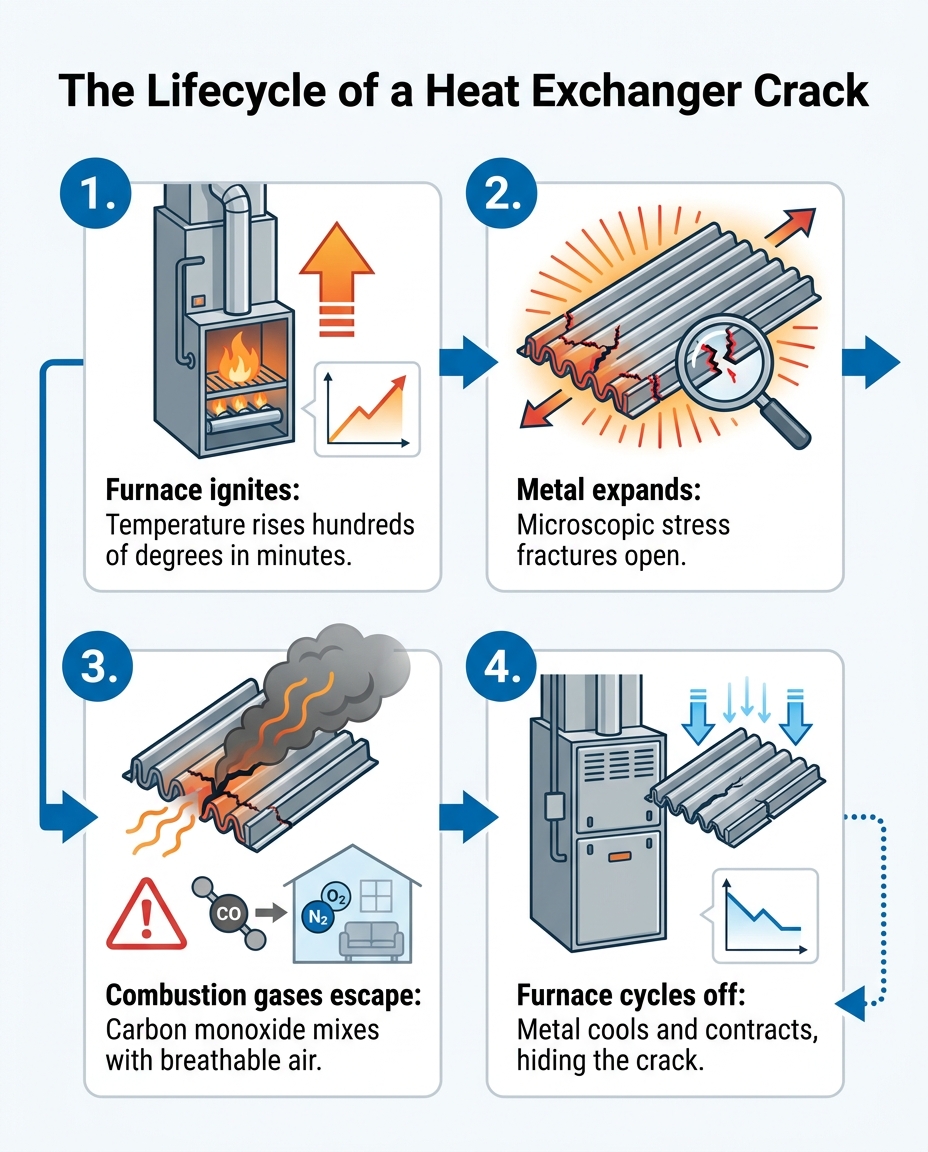
To understand why furnaces eventually fail, you have to look at the physics of how they generate warmth. The heat exchanger is a series of metal tubes or coils. Inside these tubes, volatile combustion gases are burned to create heat. Outside these tubes, your blower motor pushes cold return air across the hot metal. The metal absorbs the heat from the fire inside and transfers it to the air outside, which is then distributed throughout your home. This process requires the metal to endure extreme temperature swings, often heating up by hundreds of degrees within a matter of minutes.
When metal is subjected to rapid heating, its molecules become energized and move further apart, causing the physical structure to expand. Conversely, when the heating cycle ends and the blower continues to run to cool the system down, the metal rapidly contracts. This constant expansion and contraction is known as thermal cycling. Over thousands of cycles, this movement leads to metal fatigue. You can visualize this process by thinking of a metal paperclip: if you bend it back and forth enough times, the metal weakens, becomes brittle, and eventually snaps. The same metallurgical principle applies to your furnace, which is why regular Furnace Services are vital for monitoring this inevitable wear and tear during the early fall pre-heating season.
The Physics of the Heating Cycle
The entire safety of a gas furnace relies on a strict physical boundary. The combustion chamber must remain perfectly sealed off from the blower air. During a standard heating cycle, this barrier undergoes severe mechanical stress:
• Ignition phase: Burners ignite, and the internal temperature of the exchanger spikes dramatically, causing the metal to swell and push outward.
• Blower activation: Cold return air (often around 65 to 70 degrees) is blown forcefully across the exterior of the 400-degree metal, creating a massive temperature gradient across a piece of steel that is only millimeters thick.
• Cooling phase: The burners shut off, but the fan continues to run, rapidly stripping the remaining heat from the metal and forcing it to shrink back to its original size.
This daily punishment inevitably creates microscopic stress fractures. These tiny fissures compromise the physical boundary separating toxic combustion exhaust from the clean, breathable air circulating into your living spaces.

The Deceptive Nature of Microscopic Stress Fractures
One of the most dangerous aspects of metal fatigue is how easily it hides from casual observation. Because of the rules of thermal expansion, heat exchanger cracks often only open fully when the furnace is actively running and the metal is hot. The heat forces the metal to expand, which pulls the edges of a stress fracture apart, creating a physical gap.
When the system cools down at the end of a cycle, the metal contracts. As it shrinks, the edges of the crack are pulled tightly back together. In a cold, dormant furnace, these stress fractures can close so tightly that they become nearly invisible to the naked eye. A homeowner shining a flashlight into the cabinet during the summer will almost never spot a tight, microscopic hairline crack hidden in the curves of the heat exchanger.
This thermodynamic behavior creates a dangerous false sense of security. Homeowners may assume their system is perfectly safe because it looks fine while turned off, completely unaware that the metal separates and leaks exhaust gases every time it heats up. Catching these hidden flaws requires specialized knowledge, specific diagnostic tools, and the right timing. The ideal window for a pre-heating season tune-up is precisely when the weather is still mild, allowing professionals to safely test the system's structural integrity before continuous winter operation begins during the early fall pre-heating season.
The Direct Link Between Metal Fatigue and Carbon Monoxide
When a heat exchanger cracks, the primary danger is the infiltration of combustion byproducts into the home's airstream. A gas furnace produces several exhaust gases as it burns fuel, most notably carbon monoxide (CO). As long as the heat exchanger is intact, these toxic gases are safely routed through the flue pipe and vented outside your roof. But when a breach occurs, the blower fan can push breathable air into the combustion chamber, or drafts can pull exhaust gases out of the crack and into the ductwork.
Carbon monoxide is entirely tasteless, odorless, and colorless. A physical breach in the heat exchanger can slowly pump this gas into your living room without anyone noticing. This is why addressing metal fatigue is directly tied to your home's indoor air quality safety. Relying solely on basic ceiling alarms is often insufficient for catching early-stage leaks, as many standard detectors are designed only to alert occupants to acute, immediately life-threatening levels of CO, rather than chronic, low-level exposure.
Understanding Exposure Thresholds
To truly understand the risk, it is necessary to look at how carbon monoxide is measured. Professionals measure carbon monoxide ppm (parts per million) in the ambient air and within the flue gases. Prolonged exposure to even low levels of CO can cause severe health issues, including chronic headaches, nausea, fatigue, and dizziness.
• 0 - 9 PPM — Typical Source / Effect: Normal baseline for most indoor environments. — Standard Alarm Response: No alarm.
• 10 - 35 PPM — Typical Source / Effect: Trace amounts often caused by early-stage cracks. Can cause minor headaches over long periods. — Standard Alarm Response: Most standard alarms will not sound at this level.
• 70+ PPM — Typical Source / Effect: Dangerous levels causing noticeable physical symptoms (nausea, dizziness) within hours. — Standard Alarm Response: Standard alarms typically sound after 60-240 minutes of continuous exposure.
• 400+ PPM — Typical Source / Effect: Life-threatening levels requiring immediate evacuation. — Standard Alarm Response: Standard alarms sound within 4-15 minutes.
Because trace amounts escaping through microscopic cracks can keep indoor levels hovering in the 15 to 30 ppm range, homeowners can suffer from chronic symptoms without their standard alarms ever going off. This highlights why professional diagnostics, which measure exact carbon monoxide levels down to single digits, are vital for maintaining a safe indoor environment during the heating season.
How Professionals Expose Hidden Heat Exchanger Flaws
Because these cracks are nearly invisible when the metal is cold and tightly contracted, standard visual inspections by an untrained eye are entirely insufficient. Detecting a compromised heat exchanger requires a rigorous, scientific approach using specialized equipment. At Plum HVAC, our commitment to protecting families from carbon monoxide risks means we adhere to strict safety standards and utilize advanced diagnostic methodologies. This level of technical evaluation is not a DIY task; it requires extensive training to interpret the data correctly.
1. High-Resolution Borescope Inspections: Technicians use specialized, flexible cameras called borescopes to navigate the complex curves and deep recesses of the heat exchanger tubes. These cameras illuminate and magnify the metal surfaces, allowing professionals to spot microscopic stress fractures, rust scaling, and metal fatigue that cannot be seen from the access panel.
2. Infrared Thermography: In some cases, infrared cameras are used to observe the heat distribution across the metal. Anomalies in the heat signature can indicate areas where the metal has thinned out or where a crack is disrupting the thermal transfer.
3. Professional Combustion Analysis: Technicians insert a specialized probe into the exhaust flue to measure the exact chemical makeup of the gases leaving the furnace. By analyzing the oxygen, carbon dioxide, and carbon monoxide ppm (parts per million), professionals can detect combustion anomalies that strongly indicate a breach in the system, even if the crack hasn't been visually located yet.
4. Dynamic Flame Observation: Professionals will observe the burner flames precisely when the blower motor engages. If a crack exists, the sudden air pressure from the blower will often push through the fracture and disrupt the flames, causing them to dance, flicker, or change color from a crisp blue to a lazy yellow.
These rigorous methods ensure that even the smallest flaws are exposed before they can pose a threat to homes across Mountain View. Identifying these issues early is the only way to guarantee that the physical boundary protecting your breathable air remains intact.
Why the Pre-Season Window is Critical for Combustion Safety
The timing of a furnace inspection is just as important as the thoroughness of the inspection itself. Testing the system before it is subjected to the constant thermal cycling of heavy winter use prevents catastrophic failures when you need the heat the most. The brief window of mild weather in early fall provides the perfect opportunity to test the system before continuous, high-stress heating cycles are demanded by the climate.
Identifying a compromised heat exchanger early in the early fall pre-heating season provides homeowners with a critical advantage: time. If a severe crack is discovered in September, you have the luxury of carefully weighing repair or replacement options without the intense pressure of a freezing home. You can make an educated, scientifically sound decision rather than a panicked one.
A proactive approach ensures the system operates safely and efficiently from the very first cold night. By securing a comprehensive evaluation through a structured preventative maintenance plan, you ensure that a professional is tracking the metallurgical health of your system year after year. This historical data allows technicians to spot the early warning signs of metal fatigue long before a microscopic crack becomes a dangerous, gaping breach.
Frequently Asked Questions About Heat Exchanger Science
How does a furnace heat exchanger crack?
A furnace heat exchanger cracks due to metal fatigue caused by continuous thermal expansion and contraction. Every time the furnace fires up, the metal heats rapidly and expands; when the cycle ends, it cools and contracts. Over thousands of heating cycles, this constant movement stresses the metal, eventually causing microscopic fissures to form in the weakest areas, much like bending a piece of wire back and forth until it breaks.
Why is a cracked heat exchanger dangerous?
A cracked heat exchanger is highly dangerous because it compromises the physical barrier between toxic combustion exhaust and your home's breathable air. When a crack opens up, dangerous gases like carbon monoxide can spill into the ductwork and be circulated into your living spaces. Because carbon monoxide is invisible and odorless, occupants can be exposed to harmful levels without any immediate warning signs.
How do professionals test a heat exchanger for cracks?
Professionals use a combination of advanced visual tools and scientific measurements to test for cracks. They utilize high-resolution borescopes to visually inspect the deep, hidden curves of the metal for hairline fractures. Additionally, they perform a combustion analysis to measure exact gas levels in the exhaust and observe the burner flame patterns for any disturbances when the blower motor activates, which indicates a pressure leak.
Can you run a furnace with a cracked heat exchanger?
No, you should never run a furnace with a confirmed cracked heat exchanger. Operating a compromised system actively pumps combustion byproducts, including carbon monoxide, into your home's air supply. Once a professional identifies a breach, the system must be shut down immediately to prevent toxic exposure, and the heat exchanger must be replaced, or the entire furnace upgraded.
What role does thermal expansion play in furnace wear and tear?
Thermal expansion is the primary driver of physical wear and tear inside a furnace. The heat exchanger metal is subjected to extreme temperature gradients, causing the molecular structure to swell under heat and shrink when cooled. This thermodynamic reality means that metal fatigue is an inevitable part of a furnace's lifecycle, making proactive inspections necessary to catch the wear before it results in a complete structural failure.
Why are basic carbon monoxide detectors not enough to catch early heat exchanger leaks?
Basic carbon monoxide detectors are designed to sound an alarm only when CO levels reach high, immediately life-threatening concentrations (usually 70 ppm or higher) to prevent false alarms. However, early-stage heat exchanger cracks often leak lower, trace amounts of CO (10 to 30 ppm) that can cause chronic health issues over time. A standard alarm will often ignore these lower levels, which is why professional combustion analysis measuring exact carbon monoxide ppm (parts per million) is required for true safety.
Secure Your Home's Heating Safety Before Winter Arrives
The science of metal fatigue dictates that every aging furnace will eventually experience wear and tear from constant thermal cycling. Microscopic stress fractures are an inevitable result of the extreme temperature swings required to heat your home. However, understanding the thermodynamics behind this process empowers you to make safe, proactive decisions during the early fall pre-heating season.
Don't wait for the first freezing night to find out if your system's structural integrity has been compromised. By scheduling a comprehensive visual and combustion analysis now, you ensure that any hidden flaws are exposed before they pose a risk to your indoor air quality. Protect your household by relying on rigorous scientific evaluation and secure your peace of mind for the winter ahead.
hear what our satisfied clients have to say

.svg)
Service areas
.avif)