

Can I Run My AC and Furnace on the Same Day During Fall Weather Shifts?
Navigating Early Fall Temperature Swings in the Bay Area
September transition microclimates mean chilly mornings are back, leaving many homeowners asking: Can I Run My AC and Furnace on the Same Day During Fall Weather Shifts? It is a common dilemma when you wake up to a brisk 50-degree morning that demands a warm house, only to watch the thermometer climb past 80 degrees by mid-afternoon. This rapid fluctuation forces your residential climate control equipment to pivot quickly, creating potential mechanical stress if not managed correctly.
To keep your home comfortable through every season, learn more about our heating systems and explore our routine HVAC maintenance plan.
Living in the Mountain View / Silicon Valley area means dealing with a very specific weather phenomenon. The day often starts with a dense coastal fog that keeps temperatures low. As the sun rises and that fog burns off, the ambient temperature can spike 30 to 40 degrees in just a few hours. This leaves you shivering over your morning coffee but sweating by the time you finish your afternoon meetings.
If you are manually adjusting your thermostat to keep up with these wild swings, you are not alone. Modern equipment is absolutely designed to handle this kind of daily workload. However, the secret to avoiding unexpected breakdowns lies entirely in how you operate the thermostat. Rapidly mashing buttons to force the house to cool down after the furnace has been running can shock the system. By understanding a few basic rules of operation, you can safely transition between heating and cooling without putting your equipment at risk.
Can You Switch Between Heating and Cooling in the Same Day?
The short answer is yes: you can absolutely run both your furnace and your air conditioner on the exact same day. Modern climate control equipment is engineered for flexibility, and manufacturers anticipate that homeowners will need to change modes during volatile transition seasons.
However, there is a crucial caveat that every homeowner must follow: you must observe a mandatory waiting period between shutting off the heat and turning on the cooling. If you ignore this waiting period and immediately flip the switch from "Heat" to "Cool," you risk causing a system lockout, blowing a fuse, or severely damaging your compressor. This waiting period is tied directly to the 5-minute compressor delay cycle, which is a non-negotiable safety feature built into your equipment.
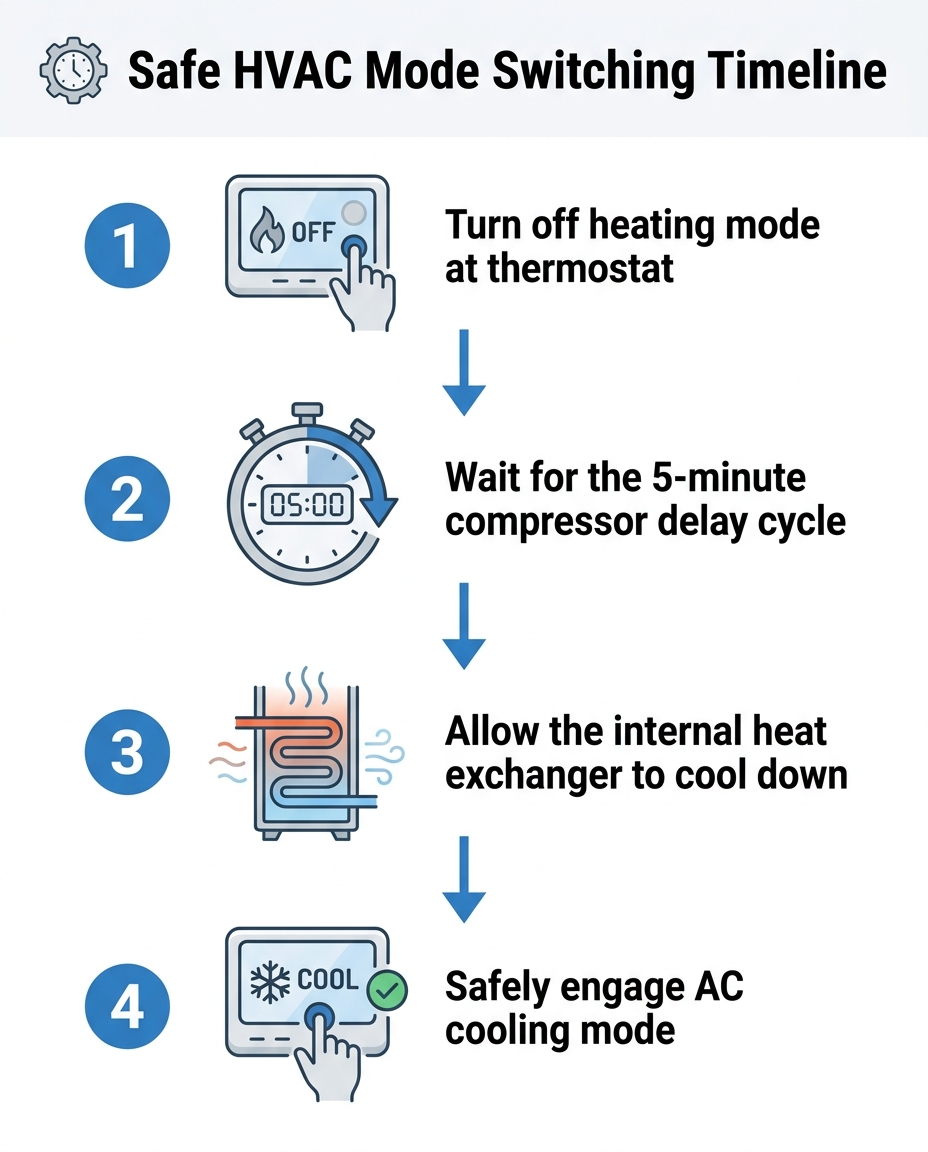
To protect your overall air conditioning performance and ensure your system lives a long, healthy life, follow these safe mode-switching steps:
• Step 1: Turn off the current mode. Switch your thermostat from "Heat" to the "Off" position. Do not go directly to "Cool."
• Step 2: Wait for the fan to stop. Allow the indoor blower motor to finish its cycle and shut down completely. This pushes the last of the warm air out of your ductwork.
• Step 3: Observe the waiting period. Leave the system in the "Off" position for at least five full minutes. This is the most important step in the entire process.
• Step 4: Engage the new mode. Once the five minutes have passed, switch the thermostat to "Cool" and lower the temperature setting to your desired comfort level.
By following this simple sequence, you allow the internal components to reset, cool down, and prepare for a completely different type of operation.
What Happens Inside Your HVAC System When You Switch Modes?
To understand why patience is so important at the thermostat, it helps to know what is actually happening behind the walls and inside your outdoor unit. Your home comfort system relies on extreme temperature differences to do its job. When you switch from heating to cooling too quickly, those extremes collide in a way that causes severe mechanical stress.
When your furnace is running, the internal heat exchanger gets incredibly hot. This is the metal component that safely transfers heat into the air circulating through your home. If you immediately turn on the air conditioner, the system tries to push freezing cold refrigerant through the indoor evaporator coil, which sits right next to that blazing hot heat exchanger. This creates a massive conflict. The heat exchanger needs time to safely cool down to room temperature before the cooling process begins.
Simultaneously, the outdoor unit is dealing with intense pressure changes. The refrigerant inside your system operates under very specific high and low pressures. When the system shuts off, those pressures need time to equalize. If you force the compressor to start against unequalized pressure, it requires a massive surge of electricity. This is known as "locked rotor amps," and it is the primary reason why systems blow fuses or trip circuit breakers during sudden weather shifts. The standard 5-minute compressor delay cycle exists specifically to give these pressures time to balance out.
Whether you have a traditional split system or utilize modern heat pump systems, the internal transition requires a brief pause. Here is a breakdown of what happens during that critical waiting period:
• Heat Exchanger — Status During Heating: Hot and actively transferring heat — Status During the 5-Minute Wait: Gradually cooling to room temperature — Status During Cooling: Inactive and cool
• Refrigerant Lines — Status During Heating: Inactive (in standard furnaces) — Status During the 5-Minute Wait: Pressures are actively equalizing — Status During Cooling: Flowing under high/low pressure
• Blower Motor — Status During Heating: Running to distribute warm air — Status During the 5-Minute Wait: Winding down to a complete stop — Status During Cooling: Running to distribute cool air
• Compressor — Status During Heating: Off (unless using a heat pump) — Status During the 5-Minute Wait: Locked out by safety delay timer — Status During Cooling: Engaged and pumping refrigerant

How to Configure Auto-Changeover Thermostat Settings Safely
If you have upgraded to a smart thermostat in recent years, you likely have access to a feature called "Auto" mode (sometimes referred to as Auto-Changeover). This feature is specifically designed for environments with September transition microclimates, where the house needs warmth in the early morning and active cooling by the afternoon. When configured properly, Auto mode handles the switching for you, completely eliminating the need to manually move the switch from "Heat" to "Cool."
However, Auto mode can actually damage your system if it is not set up correctly. The most critical element of this setting is the "deadband." The deadband is the temperature gap between your heating setpoint and your cooling setpoint. If this gap is too narrow, your system will become confused, rapidly bouncing back and forth between heating and cooling in a destructive loop known as short-cycling.
To safely navigate unpredictable fall weather, you must give the system a wide enough temperature buffer. A gap of 3 to 5 degrees is generally recommended by manufacturers to ensure the furnace and air conditioner do not fight each other for dominance.
Here is how to properly configure your Auto settings for a safe, stress-free transition season:
1. Select the Auto function: Access your thermostat's main menu and change the system mode from "Heat" or "Cool" to "Auto."
2. Set your heating baseline: Choose the lowest temperature you are willing to tolerate before the furnace kicks on. For example, set the heat to 68°F.
3. Set your cooling threshold: Choose the highest temperature you are comfortable with before the air conditioner engages. Following the deadband rule, set the cooling to at least 72°F or 73°F.
4. Verify the deadband gap: Ensure there is a minimum of 4 degrees between your two numbers. The thermostat will now allow the house to naturally drift between 68°F and 72°F without running any equipment at all.
5. Let the thermostat do the work: Once set, step away. The smart thermostat is programmed to automatically enforce the necessary safety delays when crossing from one mode to the other.
Understanding the Built-In Compressor Delay
One of the most common reasons homeowners call for emergency service in the fall is because they believe their thermostat is broken. They switch the system to "Cool," lower the temperature, and nothing happens. The screen might flash "Wait," "Cool On," or display a small hourglass icon. This is not a malfunction. This is the 5-minute compressor delay cycle actively protecting your equipment from catastrophic failure.
As we discussed earlier, your air conditioning compressor is essentially a large, powerful pump that moves refrigerant under high pressure. When the system shuts down, the pressure on one side of the pump is significantly higher than the other. If the thermostat allowed the compressor to restart instantly, the motor would have to fight against that massive wall of unequalized pressure. This draws an enormous amount of electricity, which generates intense heat inside the motor windings. Over time, this specific type of electrical stress will burn out the compressor entirely—leading to one of the most expensive repairs in the industry.
The dangers of button mashing: When homeowners don't hear the system turn on immediately, their first instinct is often to press the buttons again, drop the temperature lower, or flip the system off and back on. Every time you interrupt the cycle, you reset the internal timer. If you try to bypass this delay by cutting power at the breaker panel, you strip away the system's defenses and force it to start under dangerous conditions.
The best thing you can do when you see that flashing icon is simply walk away. The delay is a sign that your thermostat is doing exactly what it was programmed to do: prioritizing the long-term survival of your equipment over instant gratification.
Protecting Your Equipment During Rapid Weather Shifts
While understanding your thermostat is half the battle, the physical condition of your equipment dictates how well it survives the transition season. A well-maintained system handles the mechanical stress of rapid mode-switching far better than a neglected one. When internal components are clean, lubricated, and properly calibrated, the system can pivot from heating to cooling smoothly. When a system is choking on dirt or suffering from worn-out electrical contacts, those same weather shifts can easily trigger a breakdown.
Plum HVAC focuses heavily on proper system configuration and maintenance plans that prevent the mechanical stress associated with rapid short-cycling. We know firsthand that living in the Mountain View / Silicon Valley area requires equipment that is ready for anything. Routine oversight is the absolute best defense against unexpected fall failures.
To ensure your system is prepared for the daily temperature spikes, follow this transition season checklist:
• Inspect and replace air filters: A clogged filter restricts airflow, which causes the heat exchanger to overheat in the morning and the evaporator coil to freeze in the afternoon. Start the fall season with a brand-new, high-quality filter.
• Check your outdoor unit for debris: Summer storms and falling autumn leaves can choke the outdoor condenser. Clear away any vegetation, branches, or debris within two feet of the unit so it can breathe properly when the afternoon heat arrives.
• Verify thermostat battery health: If your smart thermostat relies on backup batteries, fall is the perfect time to replace them. Weak batteries can cause the thermostat to drop its connection or fail to enforce the necessary safety delays.
• Schedule professional maintenance: The most critical step is having a licensed technician inspect the electrical connections, test the safety sensors, and verify that your system is not pulling excessive amperage during startup.
By keeping up with your routine HVAC maintenance plan, you ensure that the built-in safety mechanisms—like the compressor delay and the high-limit switches—are fully operational when you need them most.
Frequently Asked Questions About Fall HVAC Operation
Managing indoor comfort during unpredictable transition seasons generates a lot of questions. From navigating September transition microclimates to understanding why your thermostat is flashing, we have compiled the most common inquiries to help you operate your system safely. For additional seasonal preparation tips, you can also read our guide on how wildfire smoke changes your AC filter schedule.
How long should I wait before switching from heat to AC?
You should wait a minimum of 5 minutes before switching from heating to cooling. This brief pause allows the scorching hot heat exchanger inside your furnace to cool down safely. More importantly, it gives the highly pressurized refrigerant lines time to equalize. If you skip this waiting period, the system will try to start against unequalized pressure, which can trip your circuit breaker or cause permanent damage to the compressor motor.
Can I use auto mode on my thermostat in the fall?
Yes, you can absolutely use auto mode, provided it is configured correctly. Auto mode is incredibly convenient for fall weather shifts, but you must establish a proper "deadband" temperature gap. We recommend setting a gap of at least 3 to 5 degrees between your heating and cooling setpoints (for example, heat at 68°F and cool at 73°F). This buffer prevents the system from rapidly short-cycling back and forth, ensuring the furnace and AC don't fight each other.
Will switching from heat to cool break my AC?
It will not break your AC as long as proper safety delays are observed. Modern residential equipment is specifically engineered to transition between modes safely. However, immediate and aggressive switching—such as flipping the dial directly from "Heat" to "Cool" without pausing in the "Off" position—can cause blown electrical fuses or severe compressor damage. Patience is the key to preventing mechanical failure.
Why does my thermostat have a delay?
The delay is a protective mechanism designed to save your compressor from electrical overload. When an air conditioner shuts off, the refrigerant pressure remains extremely high on one side of the system. The built-in timer forces the system to wait until that pressure balances out. Without this delay, the compressor would require a massive, dangerous surge of electricity to restart, which generates intense heat and quickly burns out the motor windings.
Is it bad to switch from AC to heat in the same day?
It is perfectly fine for modern systems to run both heating and cooling in the same 24-hour period. Homeowners in volatile climates do this constantly during the spring and fall. The process only becomes "bad" for the system if the equipment is poorly maintained or if the user forces the transition without waiting. A healthy, well-maintained system with clean filters will handle these daily pivots without any noticeable strain.
How do coastal fog burn-offs affect my daily HVAC usage?
Coastal fog burn-offs cause rapid 30-40 degree temperature spikes, completely changing your home's thermal load in a matter of hours. This forces your system to pivot operations within a very tight 6 to 8-hour window. You might need the furnace at 7:00 AM to combat the damp, 50-degree fog, but by 2:00 PM, the direct sun and 85-degree heat require full air conditioning. This microclimate reality makes proper thermostat configuration and routine maintenance absolutely essential.
Ensure Your System is Ready for Unpredictable Fall Weather
Navigating the extreme daily temperature swings of the Mountain View / Silicon Valley area does not have to be stressful for you or your climate control equipment. By understanding the mechanical realities of your system, respecting the built-in safety delays, and utilizing smart thermostat features correctly, you can stay perfectly comfortable from chilly mornings to sweltering afternoons.
Remember that patience and proper settings are the keys to safely transitioning between heating and cooling on the same day. A healthy system manages these rapid weather shifts smoothly, while a neglected system is prone to short-cycling and electrical failures. Don't wait for a midday breakdown to find out if your equipment is struggling. Get ahead of the unpredictable transition season by scheduling a professional inspection today, ensuring your home remains a haven of comfort no matter what the forecast brings.
hear what our satisfied clients have to say

.svg)
Service areas
.avif)