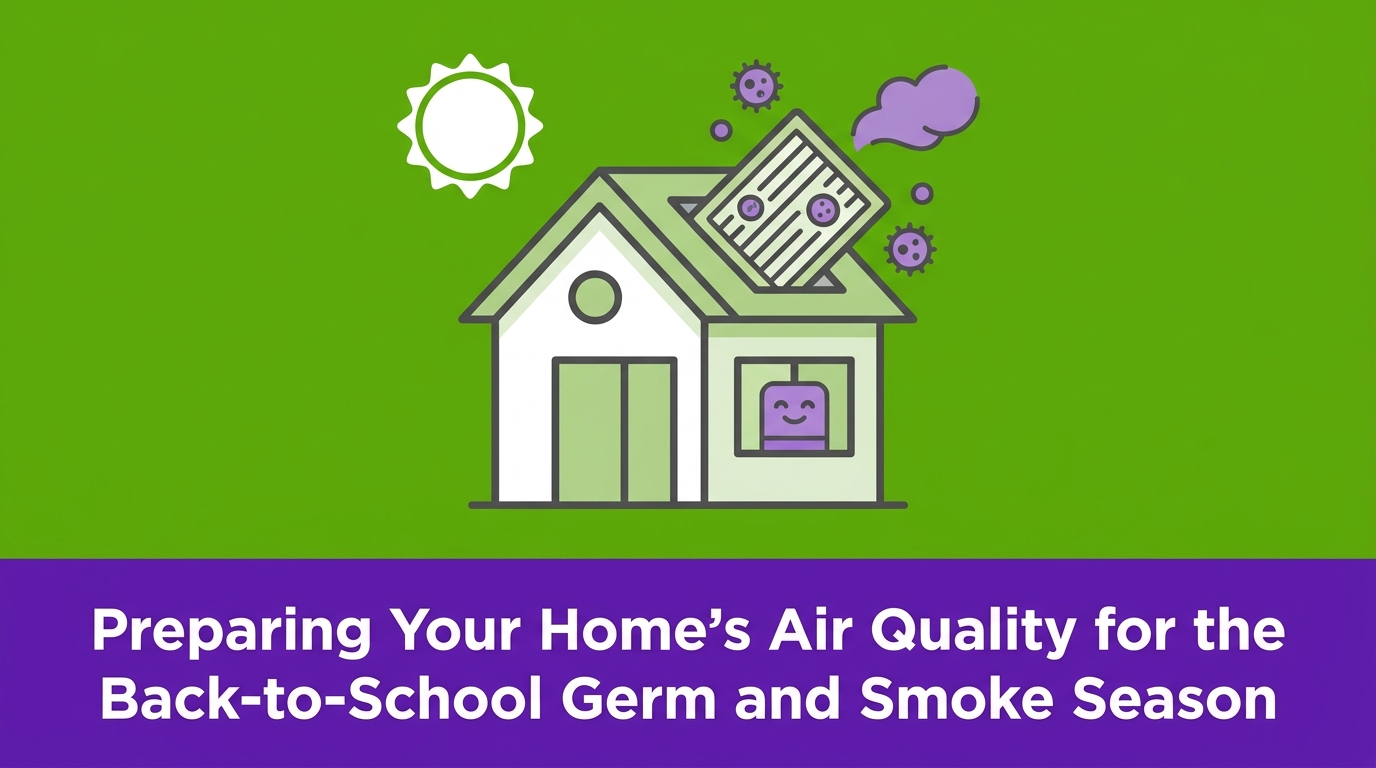
Preparing Your Home Air Quality for the Back-to-School Germ Season
The Late-Summer Dual Threat: School Illnesses and Stagnant Indoor Air
With the August back-to-school transition just around the corner, preparing your home air quality for the back-to-school germ season is one of the smartest moves you can make as a homeowner. At Plum HVAC, a pattern we see often as kids return to crowded Mountain View classrooms is a sudden uptick in airborne illnesses within the household. Colds, flus, and everyday schoolyard germs hitch a ride home on backpacks and clothing, quickly circulating through your living space.
This biological reality collides with a compounding climate problem. Extreme late-summer heat forces families to keep their windows tightly closed, trapping those newly introduced germs inside. Your air conditioning system runs around the clock to keep you comfortable, but in doing so, it constantly recirculates that same stagnant, germ-filled air through every room in the house.
This creates a critical decision point for homeowners. In our years of upgrading local HVAC systems, we've found that you must choose whether to continue relying on basic 1-inch fiberglass filters—which do virtually nothing to stop microscopic pathogens—or upgrade to high-efficiency systems that actively neutralize these threats. Taking a comprehensive approach to your indoor environment is the only way to effectively manage both your family's comfort and their daily health.
Ready to upgrade your home's defense? Explore our comprehensive home HVAC services and dedicated indoor air quality solutions to keep your family breathing easier this season.
Why Standard 1-Inch Filters Can't Stop Airborne Illnesses
One of the most common misconceptions our technicians encounter when servicing Mountain View homes is the belief that the standard air filter located in your hallway ceiling or furnace bottom is there to protect your lungs. In reality, standard 1-inch fiberglass filters typically carry a Minimum Efficiency Reporting Value (MERV) rating of just 1 to 4. These basic filters are designed solely to protect the blower motor of your air conditioning system from large dust, pet hair, and heavy debris.
Because they are highly porous, microscopic viruses and bacteria easily pass right through the fiberglass webbing of these low-MERV filters. Once they bypass the filter, these pathogens travel through your ductwork and recirculate continuously throughout your living space. This constant recirculation is a major reason why the Environmental Protection Agency (EPA) warns that indoor air can be two to five times more polluted than outdoor air, especially when homes are sealed tight against the summer heat.
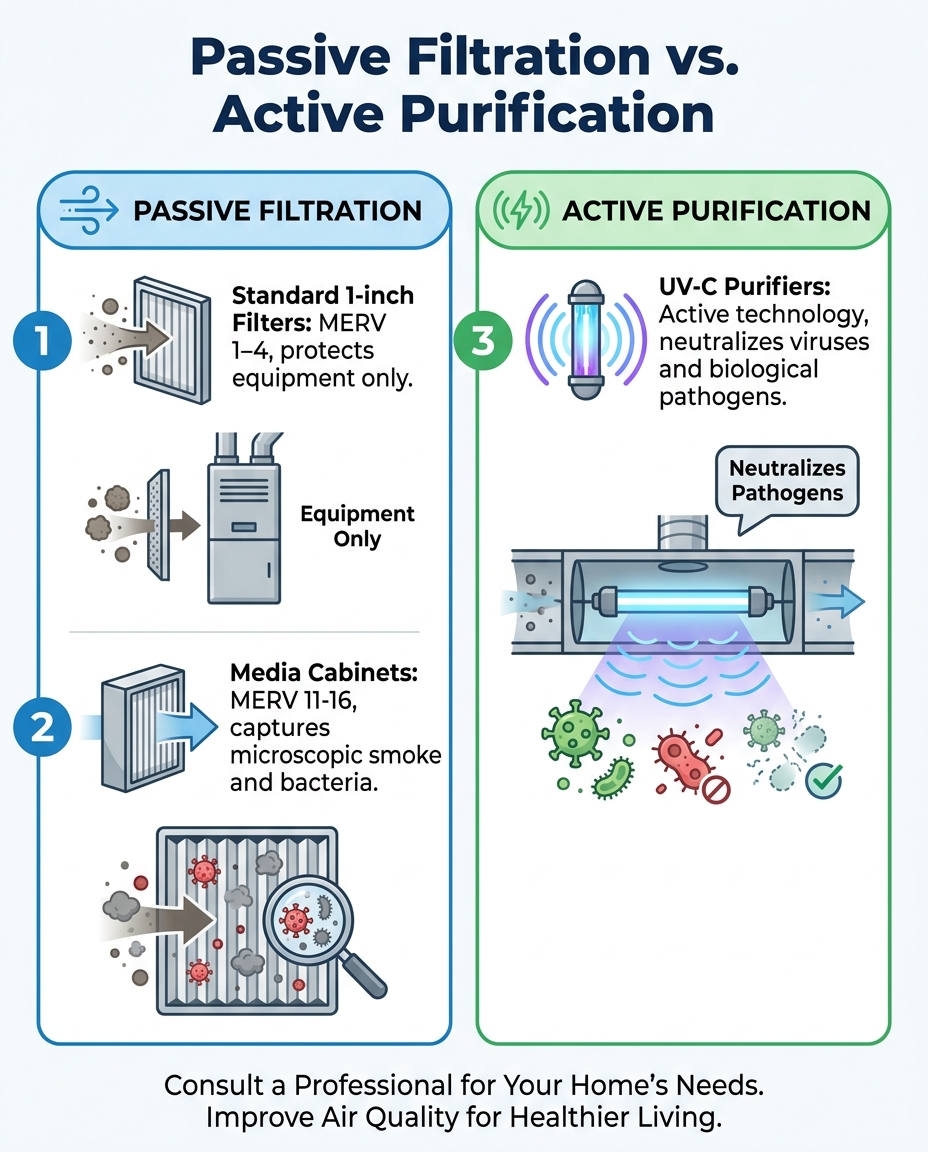
The quick fix: If you want to protect your family's health, you have to look beyond basic equipment protection. True defense against airborne illnesses requires a transition from passive filtration to active indoor air quality systems, such as high-efficiency media cabinets and UV purifiers.
The Difference Between Equipment Protection and Respiratory Protection
Understanding the mechanical limitations of standard filters is the first step in improving your home's air quality. Passive filtration relies entirely on a physical barrier to catch particles. If the holes in the barrier are larger than the particles—which is the case with 1-inch filters and microscopic viruses—the system fails to provide health benefits.
Here is a breakdown of how different indoor air quality components serve completely different purposes in your home:
• Standard 1-Inch Filter (MERV 1-4) — Primary Purpose: Equipment Protection — What It Captures or Neutralizes: Large dust, lint, pet hair, and heavy debris. — Impact on Human Health: Minimal. Microscopic pathogens and allergens pass right through.
• Media Filter Cabinet (MERV 11-16) — Primary Purpose: Respiratory Protection — What It Captures or Neutralizes: Pollen, pet dander, fine smoke particles, and larger bacteria. — Impact on Human Health: High. Significantly reduces physical respiratory irritants.
• UV-C Light Purifier — Primary Purpose: Active Biological Defense — What It Captures or Neutralizes: Viruses, mold spores, and microscopic airborne bacteria. — Impact on Human Health: Maximum. Actively scrambles pathogen DNA so they cannot infect you.
As the table illustrates, relying solely on standard filters in Mountain View leaves your home completely vulnerable to both biological threats from schools and particulate threats from the environment.
The Danger of 'Fresh Air' Ventilation During Late Summer
When someone in the house gets sick, the traditional advice has always been to "open the windows and air the place out." While natural ventilation is a great strategy in theory, our team at Plum HVAC knows firsthand that it completely fails during the reality of late summer in the Bay Area. Opening your windows during this specific time of year often introduces dangers that are far worse than the stale air you are trying to escape.
Late summer brings a dual threat to our region: extreme heat waves and heavy wildfire smoke. During these months, local authorities frequently issue "Spare the Air" alerts, which legally and practically limit your outdoor ventilation options. When you open a window to flush out school germs, you are directly inviting high levels of dangerous particulate matter (PM2.5) into your home.
The particulate threat: PM2.5 refers to microscopic particles that are 2.5 microns or smaller in width. These particles from wildfire smoke are so tiny they can bypass your body's natural respiratory defenses and enter your bloodstream. By opening windows during smoke events, you are simply replacing a biological threat (viruses) with a severe particulate threat (smoke).
Furthermore, introducing heavy particulate loads from outdoor air forces your HVAC system to work incredibly hard. The blower motor strains to push air through filters that quickly become clogged with soot and ash. This environmental reality dictates a much more rigorous approach to your equipment maintenance, and it heavily influences how wildfire smoke affects your AC filter schedule.
Because natural ventilation is off the table during the Mountain View back-to-school season, homeowners must rely entirely on their mechanical systems to clean, purify, and condition the air inside the house.
Upgrading to High-Efficiency Media Filters for Microscopic Threats
Since you cannot rely on open windows or flimsy 1-inch filters, the first foundational step in an active defense strategy is upgrading to a high-efficiency media filter cabinet. Unlike standard filters that slide into a narrow slot in your ceiling or furnace, media cabinets are robust, dedicated housings installed directly into your central ductwork.
These cabinets accommodate filters that are typically four to five inches thick. This massive increase in physical size allows for a deeply pleated surface area. When a filter is pleated, it can trap a significantly higher volume of microscopic contaminants without suffocating your HVAC equipment. This is the critical balance: you need dense filtration to catch smoke and bacteria, but if you put a dense 1-inch filter in a standard slot, you will choke the blower motor and freeze your air conditioner.
Because upgrading to a media cabinet involves custom sheet metal work, it is never a DIY project. The transition process requires a licensed professional to ensure proper airflow dynamics. When our installation team performs these upgrades, we follow a strict protocol:
1. System Assessment: A technician measures your system's current static pressure to ensure the blower motor can handle upgraded filtration without burning out.
2. Ductwork Modification: The return air duct is carefully cut and modified to physically accommodate the wider, 5-inch media cabinet housing.
3. Cabinet Installation: The heavy-duty steel cabinet is sealed securely into the ductwork, ensuring zero air bypass (meaning all air is forced through the filter, not around it).
4. Filter Placement: A high-MERV filter is inserted, establishing your home's new baseline defense against physical particles like smoke and large bacteria.
Understanding MERV Ratings for Sick Households
To effectively manage the August back-to-school transition, you need to understand the MERV scale. MERV ratings range from 1 to 16 for residential applications, measuring a filter's ability to capture particles between 0.3 and 10 microns in size.
For households looking to combat seasonal illnesses and wildfire smoke, we typically find the sweet spot is between MERV 11 and MERV 16. A MERV 11 filter will capture the vast majority of pet dander, auto emissions, and larger bacteria. Upgrading to a MERV 13 or MERV 16 filter provides hospital-grade physical filtration, successfully trapping fine smoke particles and a significant portion of airborne droplet nuclei (the particles that carry viruses).
However, it is vital to remember the difference between capturing a particle and neutralizing it. A high-MERV filter traps a virus in its fibers, holding it out of your breathing air. But to actually destroy the pathogen, you need active purification.
Active Purification: How UV-C Lights Neutralize Airborne Illnesses
While media filters act as an exceptional physical net, true active purification requires technology that attacks the biological structure of germs. This is where Ultraviolet-C (UV-C) light purifiers come into play. Long established as a standard sanitization method in hospitals, laboratories, and healthcare facilities, UV-C technology is now widely available for residential HVAC systems.
The problem: Even the best high-MERV filters cannot capture 100% of the smallest viral particles, and any moisture inside your ductwork or on your indoor cooling coil can become a breeding ground for mold and bacterial growth.
The cause: When your AC runs during the hot late-summer months, condensation naturally forms on the indoor evaporator coil. This dark, damp environment inside your HVAC system is the perfect place for biological contaminants to thrive and multiply, eventually being blown right back into your living space.
The solution: A professional HVAC technician can install a dedicated UV-C light purifier directly over the evaporator coil or within the main supply ductwork. When airborne viruses, bacteria, and mold spores pass through the intense UV-C light field, the energy penetrates their cellular walls. This specific wavelength of light actively scrambles the DNA and RNA of the pathogens. Once their genetic code is altered, they are completely neutralized—meaning they can no longer replicate or cause infection in your family.
To answer one of the most common questions our technicians hear from homeowners: Yes, properly installed UV lights in HVAC systems absolutely work to neutralize the viruses and bacteria circulating through a Mountain View home.
The Synergy of Filtration and Purification
The most effective indoor air quality strategy does not rely on a single device; it uses a layered approach. Think of it as a comprehensive shield for your home.
• The Physical Net: High-efficiency media filters catch the physical irritants—the wildfire smoke, the heavy dust, the pollen, and the larger airborne droplets.
• The Biological Neutralizer: UV-C lights handle the microscopic biological threats—the viruses, the mold spores, and the microscopic bacteria that slip past the physical net.
• The Combined Result: Together, they create a pristine indoor environment that protects your family from both the environmental hazards of late summer and the biological hazards of the school year.
A Proactive Fall Strategy for Healthier Indoor Air
As the August back-to-school transition ramps up, hoping for the best is not a reliable strategy for your family's health. Taking proactive steps now ensures that your home remains a safe, clean sanctuary, regardless of what germs the kids bring home or what smoke blows into the region.
Implementing a healthier indoor air strategy requires a multi-layered approach. You need to ensure your home is properly sealed against outdoor pollutants, your filtration is upgraded to handle heavy particulate loads, and your system is equipped to actively neutralize biological threats. Because every home's ductwork and airflow dynamics are unique, this process always begins with a professional assessment.
After years of troubleshooting HVAC systems across the Bay Area, our team at Plum HVAC has developed deep, localized expertise in managing these specific air quality challenges. We understand that a generic approach doesn't work when you are simultaneously battling seasonal school germs and regional threats like wildfire smoke. We ensure that any upgrades to your filtration or purification systems are perfectly calibrated to your existing equipment, preventing airflow restrictions and maximizing efficiency.
To keep your defenses strong all year long, we recommend following this proactive checklist:
• Schedule a system assessment: Have a professional evaluate your static pressure to determine if your blower motor can support a MERV 13 to MERV 16 media cabinet.
• Upgrade your physical filtration: Ditch the 1-inch fiberglass filters and transition to a deep-pleated media cabinet to capture smoke and large bacteria.
• Install active purification: Add a UV-C light system over your evaporator coil to neutralize viruses and prevent mold growth in damp areas.
• Enroll in ongoing maintenance: Join a preventative maintenance plan to ensure your heavy-duty filters are changed on the correct schedule and your UV bulbs are replaced before they lose their germ-killing intensity.
• Keep doors and windows sealed: During "Spare the Air" days and peak heat waves, rely entirely on your upgraded mechanical systems to clean your air, rather than exposing your home to outdoor particulates.
Preparing your system now not only improves your air quality but also prevents emergency breakdowns during peak heat events, keeping your household comfortable and healthy throughout the entire school year.
Frequently Asked Questions About Home Air Quality and Germs
Do UV lights in HVAC systems kill viruses?
Yes, properly installed UV-C lights are highly effective at neutralizing viruses in your HVAC system. They work by emitting a specific wavelength of light that penetrates the cellular walls of airborne pathogens. This light scrambles the DNA and RNA of the virus, rendering it unable to replicate or cause infection. For the best results, these lights should be professionally installed near the evaporator coil or in the main supply plenum where air flow is concentrated.
What MERV rating is best for viruses and bacteria?
For capturing viruses and bacteria, our technicians widely recommend a MERV rating between 13 and 16. Filters in this range are dense enough to trap microscopic droplet nuclei that carry viral infections, as well as fine smoke particles and bacteria. However, because these filters are highly restrictive, they should only be used in deep media cabinets (4 to 5 inches thick) rather than standard 1-inch slots, to avoid damaging your HVAC blower motor.
How can I improve indoor air quality during wildfire season?
The most important step during wildfire season is keeping your windows and doors tightly closed to block out PM2.5 particulate matter. Next, upgrade your home's mechanical filtration to a high-efficiency media cabinet capable of trapping fine smoke. Finally, ensure your HVAC fan is set to "ON" rather than "AUTO" during heavy smoke days, which forces the air in your home to continuously circulate through your upgraded filters, constantly scrubbing the air clean.
Does my AC filter protect my family from getting sick?
The short answer is no, a standard 1-inch AC filter does not protect your family from getting sick. These basic filters (typically MERV 1 to 4) are designed exclusively to keep large dust and hair out of your air conditioner's internal machinery. Microscopic viruses and bacteria easily pass through the wide fiberglass webbing and recirculate throughout your home, requiring upgraded media filters and UV purifiers for actual health protection.
Can I install a media filter cabinet myself?
No, installing a media filter cabinet is not a DIY project and requires a licensed HVAC professional. The installation involves physically cutting into your central ductwork and fabricating custom sheet metal transitions to accommodate the wider 5-inch housing. Furthermore, a professional must test your system's static pressure before and after installation to guarantee that the denser filtration does not choke your blower motor or cause your air conditioning coil to freeze.
Breathe Easier This School Year
As the August back-to-school transition arrives, you don't have to choose between staying cool indoors and breathing healthy air. By understanding the critical differences between passive standard filters and active purification systems, you are empowered to make the right choice for your household. Upgrading your home's defenses ensures that when the kids bring home seasonal illnesses, those germs aren't endlessly recirculated through your living space.
Don't wait until the first wave of colds hits your home or the next major smoke event blankets the region. Preparing your home air quality for the back-to-school germ season is a proactive step that pays dividends in comfort and peace of mind all year long. Reach out to our local experts at Plum HVAC today to explore comprehensive indoor air quality solutions and breathe a little easier this school year.
hear what our satisfied clients have to say

.svg)
Service areas
.avif)