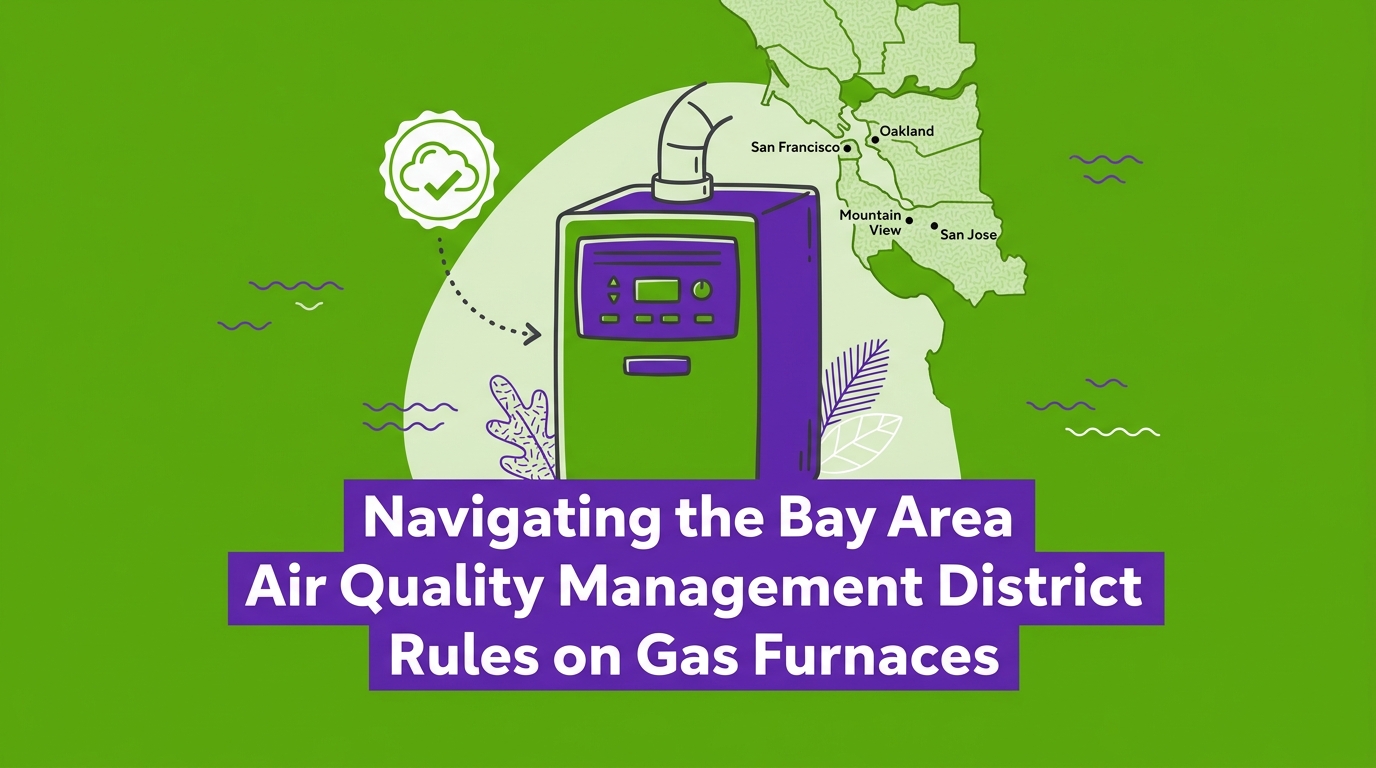
Navigating the Bay Area Air Quality Management District Rules on Gas Furnaces
Facing a Pre-Winter Heating Replacement Under Strict Bay Area Mandates
That strange rattling noise from your aging heater isn't going away on its own, and if you are facing a replacement this year, navigating the Bay Area Air Quality Management District rules on gas furnaces is now a mandatory part of the process. Your heating system is likely struggling to keep up, and finding out that local environmental regulations dictate what you can and cannot install adds an unexpected layer of stress to an already urgent situation.
Here at Plum HVAC, a pattern we see often as we enter the September pre-heating season is homeowners waiting until a complete system failure in December to call us. That delay means you will be forced into a rushed decision, potentially limiting your options or leading to delays while you secure compliant equipment. The Bay Area Air Quality Management District (BAAQMD) holds strict authority over residential emissions, and their mandates carry heavy implications for your next HVAC investment.
Need help navigating these regulations? Explore our compliant options and schedule your gas furnace replacement today.
Understanding these local mandates is the first step toward making a confident choice for your home. You are no longer simply picking a heater based on size and efficiency; you are choosing between highly specialized, compliant gas technology and advanced electric alternatives. Making the wrong choice could result in failed municipal inspections, compliance penalties, or investing in equipment that becomes obsolete long before its mechanical lifespan ends.
Decoding BAAQMD Rule 9-4 for Residential Central Furnaces
If you have started researching replacement options, you have likely encountered the term "ultra-low NOx." To understand what this means, we first need to look at what NOx is and why the Bay Area regulates it so heavily. Nitrogen oxides (NOx) are highly reactive gases formed when fuel is burned at high temperatures. In densely populated regions, these gases react with sunlight to create ground-level ozone, a primary component of smog that significantly impacts local air quality.
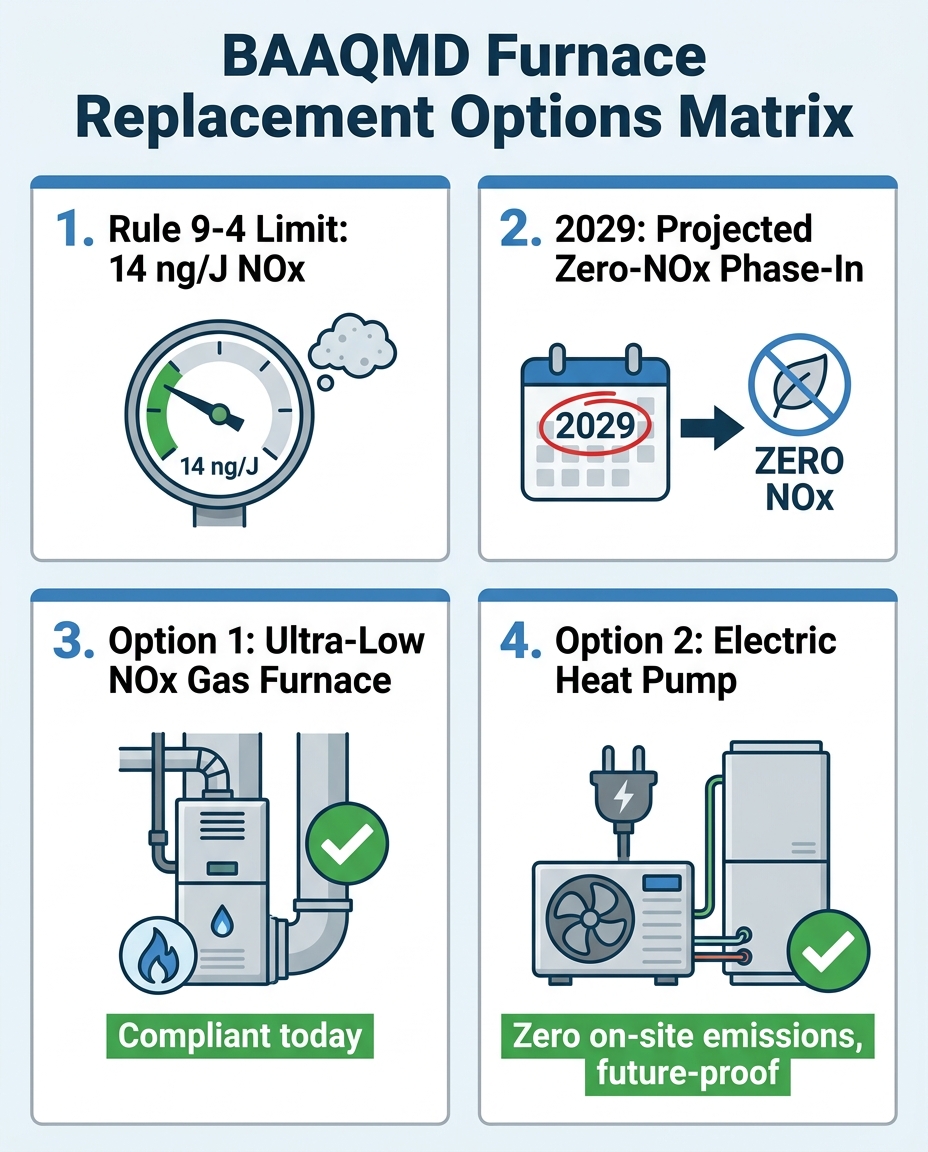
To combat this, the BAAQMD implemented Rule 9-4. This regulation mandates that all newly installed residential natural gas-fired fan-type central furnaces must meet strict ultra-low NOx emissions standards. Specifically, the rule caps emissions at 14 nanograms of NOx per Joule (ng/J) of useful heat delivered. This is a dramatic reduction from older standards and requires entirely different burner technology than the furnace currently sitting in your garage or attic.
There is a common misconception circulating that gas furnaces have already been completely banned in California. This is simply not true. You can absolutely still purchase and install a gas furnace today, provided it meets that 14 ng/J limit. In our years serving Mountain View and the surrounding communities, our team brings deep local expertise in staying up-to-date with California and Bay Area environmental regulations to ensure homeowners make future-proof investments. We understand exactly which models meet these stringent requirements and how they integrate into your existing heating systems.
What 'Ultra-Low NOx' Actually Means for Your Home
The shift to ultra-low NOx is not just a regulatory checkbox; it changes how the equipment operates physically. Traditional furnaces use standard atmospheric burners, which burn hot and produce higher levels of nitrogen oxides. Compliant furnaces utilize a pre-mix burner system.
Here is a quick look at how the technologies compare:
• Burner Design — Traditional Gas Furnace (Pre-Rule 9-4): Standard atmospheric ribbon burners. — Ultra-Low NOx Gas Furnace (Current Standard): Pre-mix burners, often utilizing a stainless steel mesh insert.
• Emissions Limit — Traditional Gas Furnace (Pre-Rule 9-4): Typically 40 ng/J or higher. — Ultra-Low NOx Gas Furnace (Current Standard): Strictly capped at 14 ng/J.
• Combustion Process — Traditional Gas Furnace (Pre-Rule 9-4): Mixes gas and air at the point of ignition. — Ultra-Low NOx Gas Furnace (Current Standard): Pre-mixes gas and air before ignition for a cooler, cleaner burn.
• Startup Sequence — Traditional Gas Furnace (Pre-Rule 9-4): Standard ignition sequence. — Ultra-Low NOx Gas Furnace (Current Standard): Often includes a pre-purge cycle, resulting in a slightly different startup sound.
This pre-mix technology ensures the flame burns at a lower temperature, drastically reducing the formation of NOx. The environmental impact of this shift is substantial, helping to clear the air across the entire region. However, as our installation crews will tell you, this specialized technology also requires precise installation and calibration to operate safely and efficiently within your home.
The 2029 Zero-NOx Phase-Out: Planning Your Long-Term Strategy
While the 14 ng/J standard is the law of the land today, the regulatory horizon is already shifting. The BAAQMD has passed amendments that will eventually require zero-NOx emissions for new residential heating equipment. This future standard is currently slated to begin phasing in around 2029. This upcoming phase-out is a critical factor you must consider before purchasing a new system.
A high-quality heating system is designed to last 15 to 20 years. If you install a compliant gas furnace in 2026, it will easily outlast the 2029 zero-NOx mandate. This creates a unique situation for homeowners in Mountain View and the wider Bay Area. While your 2026 installation will remain legal and "grandfathered in" for its operational life, the broader market will shift entirely to electric technology by the end of the decade.
California's broader decarbonization goals align perfectly with these local air district rules. The state is actively moving away from residential fossil fuel reliance, pushing toward a grid powered by renewable energy. As a homeowner, you need to weigh the immediate convenience of replacing a gas furnace with another gas furnace against a rapidly changing regulatory landscape.
Key considerations for your long-term strategy:
• Resale Value: Will a gas furnace be viewed as a liability or a "stranded asset" by potential homebuyers in the 2030s?
• Parts and Maintenance: As manufacturers shift production to zero-NOx electric systems, will replacement parts for ultra-low NOx gas burners become harder to source a decade from now?
• Utility Trends: As the state pushes for electrification, natural gas infrastructure and delivery rates may fluctuate differently than electricity rates over the next two decades.
Understanding this timeline ensures you aren't caught off guard. You are making an investment for the next two decades, and that investment needs to make sense both today and ten years down the line.
Option 1: Installing a Compliant Ultra-Low NOx Gas Furnace
If you prefer to stick with natural gas, installing an ultra-low NOx furnace is a completely viable and legal option right now. As long as the unit is certified to meet the 14 ng/J limit, you will remain in full compliance with current BAAQMD rules. However, from what our technicians typically see in older Mountain View homes, upgrading to this new technology is rarely a simple "plug-and-play" swap with your old equipment.
Because ultra-low NOx emissions standards require precise airflow and combustion parameters, your existing ductwork and venting systems may need modifications. The pre-mix burners are highly sensitive to backpressure. If your old ductwork is undersized, restricted, or poorly sealed, the new furnace will struggle to operate correctly. It may frequently trip safety switches or fail to ignite entirely. A thorough evaluation of your home's static pressure is required before a compliant gas model can be installed.
You may also notice operational differences. Because these units must precisely control the air-to-fuel ratio before ignition, they often run a longer "pre-purge" cycle to clear the heat exchanger. This means you might hear the inducer motor running for several seconds longer before the burner actually ignites. Additionally, the stainless steel mesh used in many of these burners requires strict, regular maintenance by a professional to prevent clogging from household dust and pet dander.
Despite these adjustments, a compliant gas furnace remains the most practical choice for certain homes. If your home's electrical panel is outdated—perhaps an older 100-amp service—transitioning to a fully electric heating system might require a costly and time-consuming panel upgrade. In these scenarios, sticking with a compliant gas furnace allows us to restore reliable heat immediately without waiting on municipal permits for a heavy electrical overhaul.
Option 2: Future-Proofing with Electric Heat Pump Technology
At Plum HVAC, we often recommend electric heat pump technology for homeowners looking to bypass BAAQMD Rule 9-4 entirely. Because heat pumps do not burn fossil fuels to generate heat, they produce zero on-site emissions. This means they are completely exempt from the current 14 ng/J limit and are fully insulated against the upcoming 2029 zero-NOx phase-out.
A heat pump operates by moving heat rather than creating it. During the winter, it extracts ambient thermal energy from the outside air, compresses it to a higher temperature, and circulates it through your home. The dual benefit of this technology is that the process is entirely reversible. When summer arrives, the heat pump acts exactly like a high-efficiency air conditioner, pulling heat out of your living space and rejecting it outdoors.
Modern heat pumps integrate seamlessly with the existing forced-air ductwork used by your old gas furnace. The indoor air handler simply takes the place of the furnace cabinet. By scheduling a heat pump installation during the September pre-heating season, you solve your immediate heating crisis while simultaneously upgrading your home's summer cooling capabilities.
Furthermore, transitioning away from gas often unlocks significant financial incentives. While specific amounts vary by location and tax bracket, generic federal tax credits and state energy rebates frequently apply to qualifying high-efficiency heat pump installations. We always advise our customers to verify current rebate programs with their utility provider or a qualified tax professional, as these incentives can dramatically offset the initial cost of electrification.
Bypassing Emissions Rules Entirely
Choosing an electric heat pump provides profound long-term peace of mind. You are investing once for the next two decades, knowing that no future Bay Area air district mandate will force you to abandon your equipment. Zero on-site emissions means immunity to the shifting regulatory landscape, allowing you to focus purely on your family's comfort.
Why the Local Climate Makes Compliance Easier
When discussing heat pumps, a common objection we hear is their performance in cold weather. While older models struggled in freezing temperatures, modern inverter-driven heat pumps are highly effective even in sub-zero climates. However, the specific geographical and meteorological realities of our region make the transition exceptionally easy.
Based on our experience keeping local families comfortable, Mountain View's mild winter climate creates the absolute ideal operating environment for electric heat pumps. Our winter lows rarely drop into extreme freezing territory. Because the outside air retains plenty of thermal energy even at 40°F, a heat pump can extract that heat with incredible efficiency, often delivering three to four units of heat energy for every one unit of electricity it consumes.
In colder parts of the country, homeowners transitioning to heat pumps often need to install "dual-fuel" systems—pairing a heat pump with a backup gas furnace for severe cold snaps. Avoiding those severe cold snaps means homeowners in Mountain View and the wider Bay Area do not have to rely on complex dual-fuel setups. A standalone electric heat pump is more than capable of keeping your home exceptionally warm and comfortable on the chilliest January nights.
By leveraging local weather patterns, you gain a highly efficient, regulation-proof heating solution without sacrificing an ounce of comfort. If you are exploring how this technology fits your specific property, our team is ready to provide tailored Mountain View heating services that account for both local climate data and BAAQMD compliance.
Aligning Your Choice with Local Building Codes and Permits
Navigating BAAQMD rules is only one half of the compliance equation; the other half happens at the municipal level. BAAQMD regulations are enforced in tandem with local building permits. You cannot legally install a new furnace or heat pump without pulling the appropriate permits from your city's building department.
Working with a dedicated local contractor like Plum HVAC who strictly follows these procedures is non-negotiable. When a permit is pulled, the installation must adhere to California's Title 24 energy efficiency standards. Title 24 often requires independent third-party duct testing by a certified HERS (Home Energy Rating System) rater to ensure your ductwork isn't leaking conditioned air into your attic or crawlspace.
What to expect during a municipal inspection for your new system:
• Equipment Verification: The inspector will check the manufacturer's data plate to confirm the unit meets current ultra-low NOx emissions standards (if sticking with gas).
• Clearances and Safety: Verification that the unit has proper clearances from combustible materials and that venting is securely installed.
• Electrical Integrity: Ensuring the disconnect switches and breaker sizing match the equipment requirements (especially critical for heat pumps).
• Title 24 Documentation: Reviewing the HERS rater's report to confirm duct leakage falls within acceptable state limits.
Attempting an "under-the-table" installation to bypass these rules carries severe risks. Unpermitted work is a massive liability. If a non-compliant, standard-emissions furnace is installed illegally, you will face significant hurdles when it comes time to sell your home. Buyers' inspectors will flag the unpermitted, non-compliant equipment, often forcing you to pay for a second, legal replacement just to close the sale. For a deeper dive into the municipal side of things, review our guide on local HVAC permits and building codes in the SF Bay Area.
Frequently Asked Questions About Bay Area Furnace Regulations
Can I still install a gas furnace in the Bay Area?
Yes, you can still legally install a gas furnace as long as it complies with BAAQMD Rule 9-4. The unit must utilize ultra-low NOx technology and emit no more than 14 nanograms of NOx per Joule of heat. Standard gas furnaces that exceed this limit cannot be legally sold or installed in the region.
What exactly is an ultra-low NOx furnace?
An ultra-low NOx furnace uses specialized pre-mix burner technology to significantly reduce nitrogen oxide emissions during combustion. By mixing gas and air before ignition and burning the fuel at a lower temperature, these furnaces help reduce the formation of ground-level smog. They operate differently than traditional atmospheric burners and require precise installation by an HVAC professional.
Are gas furnaces being completely banned in California?
Gas furnaces are not currently banned, but the regulatory landscape is actively shifting away from them. While you can install a compliant 14 ng/J gas furnace today, the BAAQMD is planning a phase-out that will require zero-NOx emissions for new installations beginning around 2029. This effectively means future replacements will need to be electric.
Do I have to switch to a heat pump in California?
You are not legally required to switch to a heat pump today if you are replacing an existing system. However, a heat pump is the most effective way to future-proof your home against upcoming zero-NOx mandates. Because they produce zero on-site emissions, they bypass the strict gas regulations affecting Mountain View and the wider Bay Area.
How do BAAQMD rules impact emergency furnace replacements?
The rules apply regardless of whether the replacement is planned or an emergency. If your furnace fails in the middle of winter, your contractor must still source and install a compliant ultra-low NOx model or an electric heat pump. This is why proactive replacement before a breakdown is highly recommended to avoid delays.
Make a Confident, Compliant Heating Choice Before Winter
The transition away from traditional gas heating doesn't have to be overwhelming. You have viable, legal options available today—whether that means sticking with a compliant ultra-low NOx gas furnace or making the leap to a future-proof electric heat pump. The key is understanding how these regulations impact your specific home infrastructure and making a choice that aligns with your long-term goals.
By acting proactively during the September pre-heating season, you avoid the stress of an emergency breakdown and the potential delays of sourcing compliant equipment mid-winter. Consult with our local experts at Plum HVAC to evaluate your ductwork, electrical capacity, and heating needs. We are here to provide a clear, jargon-free explanation of your options so you can make a confident, compliant decision that keeps your family comfortable for decades to come.
hear what our satisfied clients have to say

.svg)
Service areas
.avif)