

The Importance of Static Pressure Testing During a Fall HVAC Inspection

Transitioning to Heating Season: Why Your Ductwork Needs a Health Check
September is officially here, and as the weather begins to shift, understanding the importance of static pressure testing during a fall HVAC inspection can mean the difference between a cozy winter and a frustrating mid-season breakdown. During the September pre-heating season, your system makes a critical transition from months of heavy air conditioning to preparing for evening chills. Over the long summer, dust, pet dander, and microscopic allergens have quietly built up inside your ductwork, air filters, and cooling coils. This accumulation often creates hidden blockages that a simple glance with a flashlight will never reveal. Our team at Plum HVAC often sees systems fail mid-winter because homeowners accepted a superficial visual tune-up instead of demanding a true diagnostic inspection that checks the actual internal stress on their equipment.
To ensure your equipment is fully prepared, explore our heating services or secure your spot on our HVAC maintenance plan today.
Many homeowners assume that if their air conditioner kept them cool in July, their furnace will automatically keep them warm in November. Unfortunately, HVAC systems share the same ductwork and blower motor year-round. Any airflow restriction that developed over the summer will directly impact your heating performance in the fall. In our experience, when you skip a comprehensive airflow check, you leave your system vulnerable to unexpected failures just when you need it most.
Taking a proactive approach means looking beyond the surface. A thorough fall evaluation should always include taking the system's "blood pressure" to ensure air is moving freely. When technicians measure the resistance inside your ducts, they gather concrete data about your system's health. This objective measurement eliminates the guesswork, allowing you to address minor airflow restrictions before they escalate into major mechanical failures during the coldest nights of the year.
What Is Static Pressure Testing? (The 'Blood Pressure' of Your HVAC System)
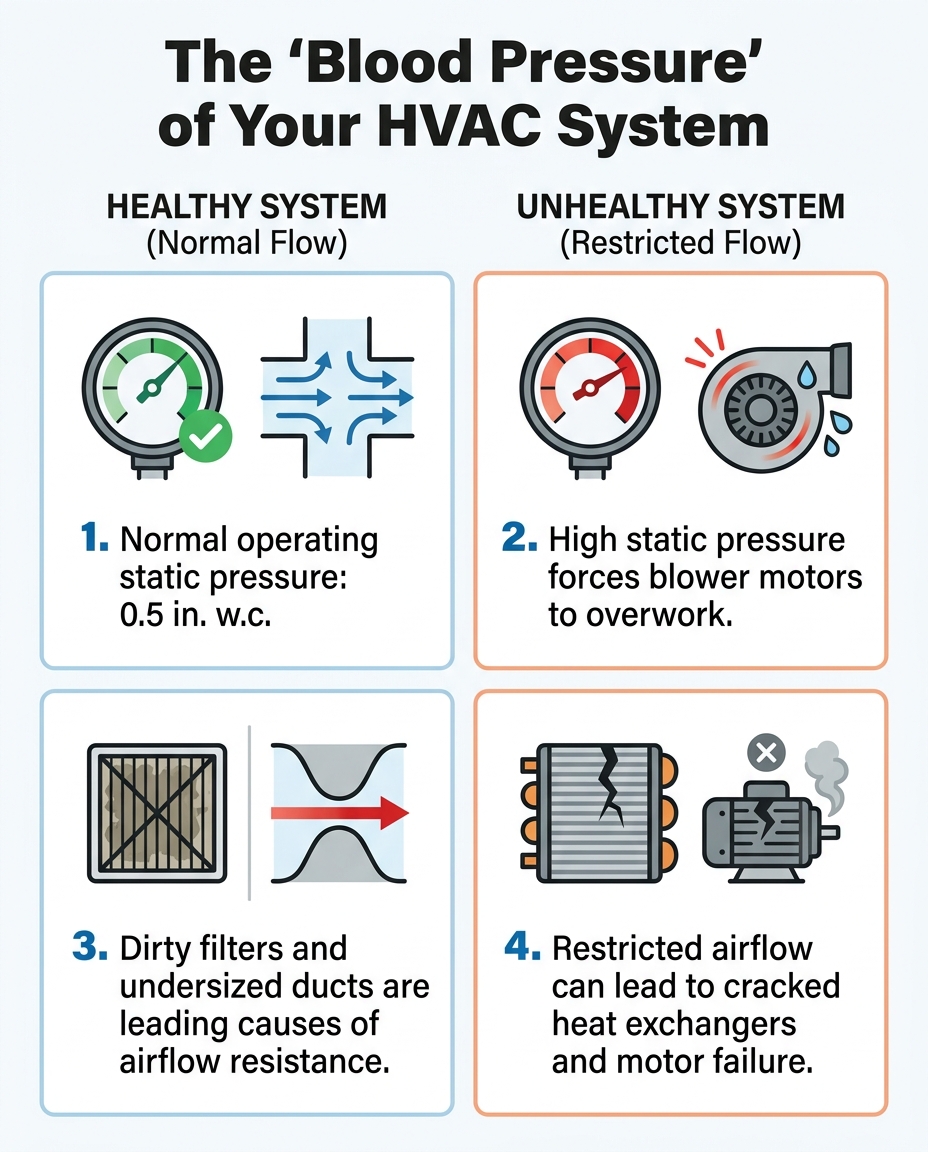
To understand static pressure, it helps to think of your HVAC system like the human circulatory system. Your blower motor acts as the heart, pumping air (blood) through the ductwork (arteries and veins) to deliver comfort to every room. Static pressure is simply the resistance to that airflow within the ductwork. When resistance is too high, the "heart" has to work exponentially harder to push the same amount of air through the system.
Just as a doctor uses a blood pressure cuff to measure the strain on your cardiovascular system, an HVAC technician uses specialized tools to measure the strain on your blower motor. Professionals measure static pressure in inches of water column (in. w.c.). This metric calculates how much pressure it takes to push a column of water up by one inch. While it sounds highly technical, our technicians rely on it as the most dependable way to gauge exactly how hard your equipment is working.
Most standard residential HVAC systems are engineered to operate at a total external static pressure of exactly 0.5 in. w.c. When the system operates at this baseline, the blower motor runs efficiently, the house heats evenly, and energy bills remain predictable. Deviations from this standard baseline indicate underlying health issues within the system.
• 0.4 to 0.5 — System Status: Optimal Health — Typical Meaning for Homeowners: Airflow is balanced. The blower motor operates efficiently with minimal strain.
• 0.6 to 0.7 — System Status: Elevated Stress — Typical Meaning for Homeowners: Airflow is restricted. The system is working harder than designed, increasing wear and tear.
• 0.8 and Above — System Status: Critical Danger — Typical Meaning for Homeowners: Severe restriction. The blower motor is at high risk of overheating and premature failure.
If our team reads a static pressure of 0.8 in. w.c. or higher, we know immediately that the system is choking. The air cannot move freely, and the equipment is fighting a losing battle against internal friction. Identifying this metric is the first critical step in restoring your system to peak operating condition.

Why Visual Inspections Aren't Enough for True Fall Preparedness
The Problem: A basic visual inspection relies entirely on what a technician can see with the naked eye. They can look at the furnace burners, check the electrical connections, and shine a flashlight down the main trunk line. However, you cannot "see" airflow resistance. A pattern we see often in the field is a duct system that looks perfectly intact from the outside while suffering from severe internal pressure imbalances.
The Cause: Invisible issues frequently plague residential ductwork. A section of flexible duct in the attic might have collapsed internally, or a forgotten dampener might be stuck in the closed position. Over the summer, a dense layer of dust can blanket the underside of the evaporator coil, creating a hidden wall that blocks air from reaching the furnace. Without objective measurements, these silent killers go completely unnoticed during a standard visual check.
The Solution: A true diagnostic approach is the only way to guarantee reliability. At Plum HVAC, our Mountain View HVAC professionals take a different approach based on years of local field experience. We are committed to comprehensive diagnostics. By taking the system's "blood pressure" rather than just performing basic visual checks, we uncover hidden restrictions before they cause damage. We believe that Mountain View homeowners need absolute certainty, not guesswork, before the cold weather arrives.
Relying on a visual-only check is like a doctor telling you that your heart is healthy just by looking at your face. It might seem fine on the outside, but the internal metrics tell the real story. By insisting on a static pressure test, you upgrade your fall maintenance from a simple cleaning to a comprehensive health evaluation.
The Hidden Causes of High Static Pressure in Residential Systems
When a static pressure test reveals restricted airflow, the next step is identifying the culprit. Several common issues can choke your system, especially as we enter the September pre-heating season. Here are the primary offenders our professionals look for:
1. Summer Particulate Buildup: Your air conditioner runs relentlessly from June through August. As it pulls warm air from the house, it also pulls in dust, pet hair, and airborne debris. Even with a good filter, some of this material bypasses the media and coats the indoor evaporator coil. This thick mat of dust acts like a blanket, severely restricting the amount of air that can pass through the system.
2. Highly Restrictive Pleated Filters: Homeowners often purchase the most expensive, highest-MERV-rated filters available, hoping to eliminate household allergens. Unfortunately, many residential systems lack the blower capacity to pull air through these dense, heavily pleated filters. Our technicians routinely pull out expensive filters that act like a brick wall in the return duct, instantly skyrocketing the static pressure and starving the equipment of air.
3. Closed Supply Registers: A common misconception is that closing vents in unused rooms saves energy. In reality, your blower motor pushes a fixed volume of air. When you close registers, that air has nowhere to go. It backs up into the ductwork, increasing internal pressure and forcing the motor to work against a dead end.
4. Poor Ductwork Sizing and Design: Sometimes the issue isn't dirt or closed vents; it's the architecture of the ducts themselves. In many of the older Mountain View homes we service, we frequently encounter undersized returns or excessive sharp turns in the sheet metal, causing the air to constantly fight friction. Understanding residential ductwork design and sizing is crucial, as structurally inadequate ducts will cause high static pressure from the day the system is turned on.
5. Crushed or Sagging Flexible Ducts: In attics and crawlspaces, flexible ductwork can easily become compromised. A heavy box stored on top of a duct, or a hanging strap that has pinched the material, will choke off the airflow to an entire section of the house.
Connecting these hidden causes to a thorough pre-heating season check ensures that summer's wear and tear doesn't become winter's emergency breakdown. Catching a clogged coil or an overly restrictive filter now saves you from costly repairs later.
How Restricted Airflow Damages Blower Motors and Heat Exchangers
Ignoring high static pressure isn't just inefficient; it is actively destructive to your equipment. When static pressure in inches of water column (in. w.c.) climbs past the safe operating threshold, the physical components of your furnace take a massive beating.
The strain on the blower motor: Modern HVAC systems often feature variable-speed ECM (Electronically Commutated Motor) blowers. These "smart" motors are designed to ramp up their speed to deliver a consistent volume of air. When they encounter high static pressure, they spin faster and faster to overcome the resistance. This constant overworking causes the motor to draw excessive electrical current, leading to severe overheating. Eventually, the internal electronics fry, resulting in a premature and entirely preventable motor failure. In fact, we've replaced countless blower motors that could have survived another decade if a simple static pressure issue had been caught early.
The danger to the heat exchanger: Your furnace generates intense heat. The blower motor's job is to push cool household air over the metal heat exchanger, warming the air and simultaneously cooling the metal. If restricted airflow prevents enough air from crossing the heat exchanger, the metal cannot cool down. It overheats rapidly. Over time, the constant extreme expansion and contraction weakens the metal, leading to stress cracks. A cracked heat exchanger is a fatal diagnosis for furnace systems, requiring either a highly expensive repair or a full system replacement.
Furthermore, modern furnaces are equipped with high-limit safety switches that shut the system down if it gets too hot. If your furnace constantly short-cycles—turning on for a few minutes and then shutting off before the house is warm—high static pressure is often the root cause. The system is literally turning itself off to prevent a fire.
Catching abnormal pressure readings early prevents these mid-winter disasters. A simple filter change or duct adjustment in the fall can add years to the lifespan of your blower motor and heat exchanger.
The Diagnostic Process: Measuring Airflow Resistance Safely
Because static pressure is invisible, professionals rely on highly sensitive diagnostic tools to measure it accurately. The process involves using a digital manometer, a device specifically designed to measure minute differences in air pressure.
To get an accurate reading of the total external static pressure in inches of water column (in. w.c.), a technician must measure the pressure on both the supply side (where air is pushed out) and the return side (where air is pulled in). They carefully insert specialized static pressure probes—often called pitot tubes—directly into the ductwork. One probe is placed between the air filter and the blower motor to measure the return vacuum. The second probe is placed between the furnace and the evaporator coil to measure the supply push.
By interpreting the pressure drop across specific components, like the air filter and the indoor coil, technicians can pinpoint the exact location of a blockage. If the pressure drops dramatically after the filter, the filter is too restrictive. If it drops significantly across the coil, the coil is clogged with dirt.
Why This Requires Licensed Expertise
While the concept is straightforward, executing a static pressure test is absolutely not a DIY project for homeowners. It requires specialized knowledge and precision.
• Precision Probe Placement: Technicians must drill small test holes into the sheet metal plenum. If a homeowner attempts this without knowing exactly what is behind the metal, they can easily drill straight into the delicate A-coil, instantly venting all the system's refrigerant and causing thousands of dollars in damage.
• Interpreting Technical Standards: Getting a reading on a manometer is only half the battle. The technician must know how to interpret that reading against ACCA Manual D standards and the specific manufacturer's blower performance data for that exact furnace model.
• Safe Resealing: Once the test is complete, professionals use approved materials to safely plug and seal the test ports, ensuring no conditioned air escapes into the attic or garage.
This diagnostic process is a non-negotiable part of a thorough system evaluation. It separates the professionals who truly understand airflow dynamics from the contractors who merely wipe down the cabinet and change the filter.
Preparing Your System for Sudden Temperature Drops
The transition from summer to fall in our area is rarely a smooth, gradual decline in temperature. In our years serving this community, the Plum HVAC team has grown very familiar with Mountain View's autumn temperature fluctuations, where mild fall days quickly drop to chilly nights, forcing sudden, heavy reliance on the furnace blower motor. You might have the windows open at 3:00 PM, only to find yourself shivering and turning on the heat by 9:00 PM.
These sudden temperature drops demand a rapidly responsive heating system. When the thermostat calls for heat, the furnace needs to ignite and distribute that warmth immediately. If your ductwork is suffering from high static pressure, the system will struggle to push that warm air into the furthest rooms of your home. You will end up with a house that is roasting in the hallway but freezing in the master bedroom.
Proper airflow, verified by a professional static pressure test, ensures your system can handle this sudden heavy usage. When the blower motor isn't fighting against restricted ducts or clogged filters, it can circulate the air effortlessly, balancing the temperature throughout the home.
For a Mountain View homeowner, there is immense peace of mind that comes from knowing the system's internal stress levels are normal. You don't have to cross your fingers and hope the furnace survives the first freeze; you have the diagnostic data proving it is ready to perform.
Ensure Your System's Vital Signs Are Ready for Winter
Treating a static pressure test as a non-negotiable vital sign is the smartest way to protect your HVAC investment. Just as you wouldn't skip a blood pressure check at your annual physical, you shouldn't skip an airflow diagnostic during your September pre-heating season maintenance. It is the single most effective way to catch hidden duct issues, prevent premature blower motor failure, and ensure your home heats evenly.
As you schedule your upcoming fall prep, verify with your technician that their inspection includes this critical diagnostic. Don't settle for a superficial visual check when your comfort and safety are on the line. Ensure your system is genuinely prepared for the winter months ahead.
Ready to schedule a comprehensive evaluation? Secure your spot on our HVAC maintenance plan today and rest easy knowing your system's vital signs are in expert hands.
Frequently Asked Questions
What happens if HVAC static pressure is too high?
High static pressure forces your blower motor to work exponentially harder to circulate air throughout your home. This excessive strain leads to increased energy consumption, poor temperature balance between rooms, and a high risk of premature blower motor failure. Over time, the restricted airflow can also cause your furnace heat exchanger to overheat and crack.
Why is my furnace blower motor so loud?
A loud or whining blower motor is often a direct symptom of high static pressure. When the system struggles to pull air through a restrictive filter or push it through undersized ducts, variable-speed motors ramp up their RPMs to compensate. This overworking creates a noticeable roaring or whistling sound at the return vents and places severe electrical strain on the motor itself.
How do professionals measure HVAC static pressure?
Professionals use a sensitive digital tool called a manometer connected to specialized pitot tubes. They drill small, precise test ports into the ductwork—one before the blower and one after the furnace—to measure the pressure difference. They then compare these readings against the manufacturer's specific performance data to determine if the airflow is restricted.
Can a dirty air filter cause high static pressure?
Yes, a dirty or overly restrictive air filter is one of the most common causes of high static pressure. When a filter is clogged with dust, or if you use a high-MERV pleated filter that your system wasn't designed to handle, it acts like a wall blocking the return air. This starves the blower motor of air and immediately spikes the internal pressure.
What is considered a normal static pressure reading for a residential HVAC system?
For most standard residential HVAC systems, the ideal total external static pressure is designed to be around 0.5 inches of water column (in. w.c.). Readings that climb to 0.7 in. w.c. or higher indicate significant airflow restriction that requires professional attention to prevent long-term equipment damage.
hear what our satisfied clients have to say

.svg)
Service areas
.avif)