
The Impact of Coastal Fog on Outdoor HVAC Units in the Peninsula
Unseen Damage: How the Peninsula Marine Layer Threatens Your HVAC
The impact of coastal fog on outdoor HVAC units in the Peninsula is something most homeowners don't think about until their system starts struggling to keep the house cool. At Plum HVAC, we often hear from customers who walk past their outdoor condenser unit every day, assuming that because we don't get heavy snow or extreme tropical storms, their equipment is perfectly safe. However, the exact weather pattern that provides our beautiful, natural coastal cooling is simultaneously acting as a silent destroyer of your expensive home comfort equipment.
For homeowners living in SF Peninsula coastal-adjacent areas, the daily influx of the marine layer introduces a unique and aggressive environmental challenge. This isn't just regular water vapor. The fog that rolls over the hills is heavily laden with microscopic salt particles and persistent moisture. When this damp, salty air settles over your property, it coats everything outside—including the sensitive internal metals of your air conditioning system.
If you want to protect your system, exploring professional Air Conditioning solutions and proactive maintenance strategies is the best place to start.
The Hidden Cost of Natural Cooling
We often celebrate the marine layer for keeping our summer utility bills manageable. While inland cities are baking in triple-digit heat, the Peninsula enjoys a natural, misty air conditioning effect. But that same atmospheric condition is quietly attacking the structural integrity of your outdoor HVAC unit. Every time the fan spins, it pulls thousands of cubic feet of this damp, salty air directly across the tightly packed metal fins inside the cabinet.
Over time, this continuous exposure creates a severe degradation problem. You are eventually faced with a critical decision point during your pre-fall maintenance: do you address this hidden corrosion proactively by investing in specialized protective coatings, or do you wait until the metal deteriorates so badly that the entire system suffers a catastrophic failure? Ignoring the effects of the coastal climate almost always guarantees a premature replacement of the unit.
Beyond the Beach: The Hidden Reach of Salt-Laden Coastal Fog
A common misconception is that you only need to worry about salt air corrosion if your home sits directly on the beach, with ocean waves crashing in your backyard. Many homeowners further inland assume their equipment is safe from marine degradation. The reality of our regional weather patterns tells a very different story. In our years servicing neighborhoods throughout the Peninsula, our technicians regularly see the effects of this marine degradation miles inland.
The daily push of the marine layer carries microscopic salt particles deep into inland neighborhoods. As the sun warms the inland valleys, rising hot air creates a vacuum that aggressively pulls the cold, dense, salt-heavy marine air over the hills and straight through communities miles away from the shoreline. This means your HVAC unit is constantly breathing in salt, even if you can't see or smell the ocean from your front porch.
The Difference Between Ocean Spray and Marine Fog
• Direct Ocean Spray — Delivery Method: Heavy water droplets carried by high winds near the shore. — Impact on HVAC Equipment: Rapid, highly visible rusting on the outer cabinet and fast internal degradation.
• Inland Marine Layer — Delivery Method: Microscopic airborne salt suspended in dense daily fog. — Impact on HVAC Equipment: Slower, hidden internal corrosion that eats away at coils before outer rust appears.
• Standard Inland Rain — Delivery Method: Freshwater precipitation without salt content. — Impact on HVAC Equipment: Minimal threat; actually helps wash away dust and debris from the unit.
Because the inland fog delivers salt in such a fine, microscopic mist, the dampness penetrates deep into the tightly spaced fins of your outdoor unit. It doesn't wash away easily. Instead, it sits there, keeping the metals continuously damp for hours every single morning. This continuous, hidden dampness slowly degrades the metals over time, eating away at the system's ability to transfer heat. Booking routine AC maintenance in Mountain View and surrounding inland communities is just as critical as it is for homes right on the coast.
The Chemical Reaction Slowly Destroying Your AC
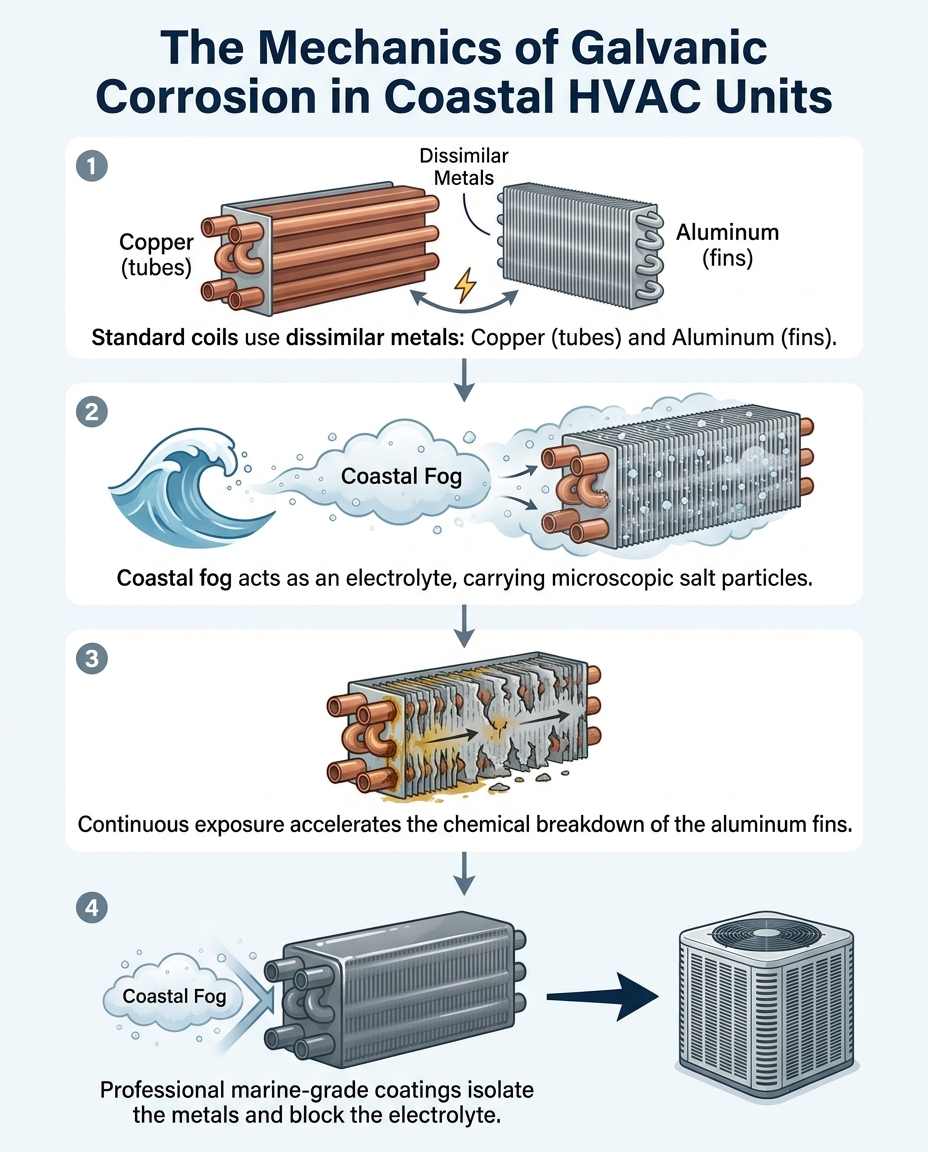
To understand why the marine layer is so destructive, we have to look at the exact metals used to build your air conditioner. Inside your outdoor unit, there is a large, curved component called the condenser coil. This part is responsible for releasing the heat your system absorbs from inside your house. For maximum thermal efficiency, outdoor condenser coils and fins are typically manufactured using two distinct metals: copper for the refrigerant tubes and aluminum for the surrounding fins.
Copper and aluminum are fantastic at transferring heat. Unfortunately, when you put these two dissimilar metals right next to each other and introduce moisture, you set the stage for a destructive chemical process called galvanic corrosion.
How Galvanic Corrosion Works
Galvanic corrosion happens when two different types of metal are in physical contact and are exposed to an electrolyte. An electrolyte is simply a liquid that can conduct electricity. In a dry environment, the copper and aluminum sit together peacefully for decades. But when the Peninsula marine layer rolls in, it provides the missing ingredient.
The Chemical Breakdown Process:
• The Setup: The copper tubes and aluminum fins are tightly bonded together at the factory to ensure heat moves easily between them.
• The Catalyst: The salt-laden fog settles on the unit, coating the metals in a thin layer of highly conductive saltwater (the electrolyte).
• The Reaction: A microscopic electrical current begins to flow between the copper and the aluminum through the saltwater.
• The Destruction: Because aluminum is a softer, more reactive metal than copper, it acts as the "sacrificial anode." The chemical reaction literally eats the aluminum away, turning solid metal into a brittle, powdery residue.
Salt-laden fog acts as the perfect electrolyte to rapidly accelerate this chemical breakdown. What might take twenty years to corrode in a dry climate can begin falling apart in just a few years under the constant dampness of the coastal fog. Having a professional handle your San Mateo AC maintenance ensures that this chemical reaction is monitored and managed before it destroys the efficiency of your equipment.

Why Standard Factory Equipment Struggles in Bay Area Microclimates
When major HVAC manufacturers design and build their air conditioning units, they are engineering them for the average North American climate. A standard, out-of-the-box system is built to survive the dry heat of the Southwest, the seasonal rains of the Midwest, and the humidity of the South. They are not specifically engineered to withstand the continuous, salty dampness of the San Francisco Peninsula.
In our experience replacing worn-out units across the region, standard factory units simply lack the specialized armor required to survive here long-term. Without intervention, standard units in this microclimate suffer a significantly reduced lifespan. The coils lose their structural integrity, the system works twice as hard to release heat, and internal components like the compressor eventually burn out from the extra strain.
Visual Signs of Premature Failure
Because the damage happens on a microscopic chemical level, you might not notice it right away. However, as the galvanic corrosion progresses on the outdoor condenser coils and fins, the physical symptoms become impossible to ignore. If you walk outside and look closely at the thin metal grilles on your unit, you might spot these warning signs:
• White powdery residue: This is aluminum oxide, the byproduct of the aluminum fins chemically breaking down.
• Flaking or crumbling fins: The fins become so brittle that they flake off at the slightest touch, or even just from the force of the fan blowing air across them.
• Pitted copper tubing: Small, dark divots appear on the copper lines where the metal has begun to weaken.
• Rust on the outer cabinet: While the coils suffer galvanic corrosion, the steel screws and base pan of the cabinet will begin to show traditional red rust.
Our team at Plum HVAC brings a deep, first-hand understanding of Bay Area microclimates to every service call. We've seen exactly what happens when standard units are installed without localized protection—it's a reliable recipe for early failure. Local expertise is required to identify these specific regional wear patterns and mitigate them before they ruin the system. Scheduling targeted Daly City AC maintenance ensures your equipment is evaluated by technicians who actually understand and regularly treat the unique atmospheric pressures of the Peninsula.
Defending Your System with Marine-Grade Coil Coatings
You cannot change the weather, and you certainly don't want to block the marine layer that keeps the region so comfortable. But you can change how your air conditioning equipment interacts with that environment. The most effective way to stop galvanic corrosion is to remove the electrolyte from the equation entirely. We achieve this through the application of professional anti-corrosion coil coatings.
These polyurethane and epoxy coil coatings act as essential armor against salt and moisture. By applying a microscopic, highly durable barrier directly over the outdoor condenser coils and fins, the coating effectively isolates the dissimilar metals. When the coastal fog rolls in, the salty moisture sits on top of the epoxy barrier rather than touching the raw copper and aluminum. No contact means no chemical reaction, and no chemical reaction means your unit stays intact.
Why This is Strictly Professional Work
Applying a marine-grade coating is not a weekend project you can tackle with a spray can from the hardware store. The process requires a licensed professional because the application tolerances are incredibly strict. If a coating is applied too thickly, it acts as an insulator, trapping heat inside the coils and destroying the efficiency of the air conditioner. If it is applied too thinly, the salt air will find microscopic pinholes and begin corroding the metal from underneath the coating.
The professional application process our technicians follow involves:
• Heavy Chemical Cleaning: Technicians use specialized, foaming coil cleaners to strip away all existing dirt, oxidation, and salt residue. The metal must be perfectly bare.
• Complete Dehumidification: The coils must be entirely dry. Any trapped moisture will cause the new coating to bubble and fail.
• Precision Application: The epoxy or polyurethane is applied using specialized spray equipment to ensure an exact, uniform thickness that protects the metal without blocking heat transfer.
• Proper Curing: The system must remain off while the coating cures into a hardened, protective shell.
Attempting to paint or coat your own coils will almost certainly void your manufacturer warranty and ruin the equipment. Always rely on a certified technician to apply these advanced protective measures.
Why the Early Fall Transition is the Critical Window for Inspection
Timing is everything when it comes to defending your home comfort systems. While you might assume summer is the most important time to think about your air conditioner, the transition into autumn is actually the most critical period for coastal HVAC maintenance. September marks a distinct seasonal transition where our summer fog patterns begin to shift toward heavy fall and winter dampness.
The early fall transition (September) is the ideal time to wash away the accumulated summer salt. For months, your outdoor unit has been breathing in the daily marine layer. All that microscopic salt is currently sitting on your coils. If you leave it there as the weather turns colder and wetter, you are giving the galvanic corrosion process a massive head start on destroying your equipment over the winter.
Preparing for the Heating Season
This early fall window is also a vital time to inspect for early-stage corrosion before you switch your system over to heating. If you use a heat pump, that exact same outdoor unit is going to be running all winter long to pull ambient heat from the outside air. It needs to be in peak physical condition to operate efficiently in the cold.
Positioning your pre-heating-season tune-ups in September gives our technicians the perfect opportunity to clean the coils, assess the structural integrity of the aluminum fins, and apply protective marine-grade coatings before severe weather sets in. It is also a great time to check your indoor air quality components; for example, understanding how wildfire smoke changes your AC filter schedule during the late summer and fall fire season is just as important as protecting the outdoor unit from salt.
By taking action during the early fall transition, you ensure your system is clean, protected, and ready to handle whatever the Peninsula microclimate throws at it. A clear, climate-specific approach to maintenance is the only way to get the full lifespan out of your investment.
Frequently Asked Questions
Does coastal fog cause rust on air conditioners?
Yes, coastal fog is a primary cause of rust and corrosion on outdoor air conditioning units. The fog carries microscopic salt particles and persistent moisture that settle on the metal components. This combination accelerates traditional rust on steel parts and triggers rapid galvanic corrosion on the internal copper and aluminum coils.
How far inland does salt air affect HVAC units?
Salt air can affect HVAC units several miles inland, especially in areas with distinct marine layers like the SF Peninsula. As the sun warms the inland valleys, it creates a pull that drags the dense, salty fog far beyond the immediate beachfront. Even homes that are a 20-minute drive from the water can experience accelerated salt corrosion over time.
How do you protect an outside AC unit from salt air?
The most effective way to protect an outside AC unit from salt air is by having a professional apply a marine-grade polyurethane or epoxy coil coating. Additionally, scheduling regular maintenance to wash away accumulated salt and keeping the area around the unit clear of dense, moisture-trapping vegetation will help extend the life of the equipment.
What is a coastal coating for HVAC coils?
A coastal coating is a specialized, professional-grade chemical barrier applied directly to the copper tubes and aluminum fins of an HVAC unit. It isolates the dissimilar metals from the salty, damp air, preventing the fog from acting as an electrolyte. This stops galvanic corrosion without insulating the coils so heavily that they lose their ability to transfer heat.
Can I apply a protective anti-corrosion coating to my AC coils myself?
No, applying an anti-corrosion coating is strictly a job for licensed HVAC professionals. The coils must be chemically cleaned and perfectly dried before application, and the coating must be sprayed to an exact, microscopic thickness. A DIY application will likely trap heat, ruin the system's efficiency, and completely void the manufacturer's warranty.
hear what our satisfied clients have to say

.svg)
Service areas
.avif)