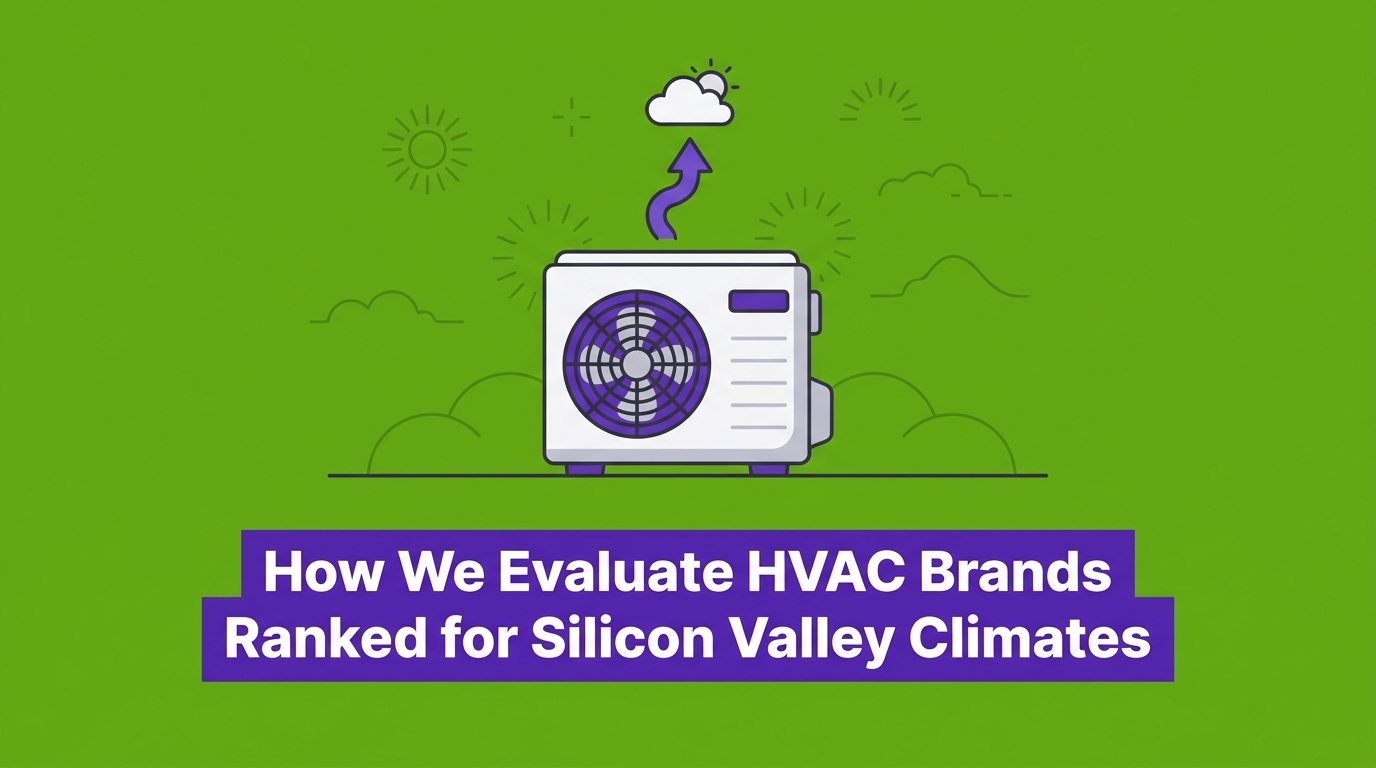
How We Evaluate and Rank HVAC Brands for Silicon Valley Climates
The Myth of National Prestige When Choosing an HVAC System
A glossy brochure and a top spot in a national consumer magazine do not mean a thing when your air conditioner breaks down in July. Many homeowners searching for how we evaluate and rank HVAC brands for Silicon Valley climates assume that national brand prestige automatically guarantees local performance. Here is the reality: choosing an HVAC system based on national marketing claims rather than local realities is one of the most common missteps we see in Mountain View CA and surrounding Silicon Valley.
Deciding which brand to install requires a hard shift in focus. You have to move away from brand name recognition and look closely at local serviceability and climate-specific efficiency. A high-ranking national brand can easily fail to deliver if it isn't suited for our specific regional microclimates or lacks a robust local supply chain. When evaluating your options for air conditioning systems, making the right choice means looking past the commercials and prioritizing what actually works in your neighborhood.
To understand why national prestige often falls short, it helps to look at how these lists are built compared to what your home actually needs.
• Climate Focus — National Magazine Rankings: National averages, heavily weighted toward humid Southern or Eastern states. — Local Silicon Valley Reality: Specific focus on dry-heat performance and high sensible cooling loads.
• Parts Availability — National Magazine Rankings: Assumes parts are equally available nationwide based on overall company size. — Local Silicon Valley Reality: Requires parts to be physically stocked in Northern California warehouses.
• Efficiency Standards — National Magazine Rankings: General federal minimums (often 13.4 SEER2 for Northern states). — Local Silicon Valley Reality: Strict adherence to California Title 24 and Southwest region 14.3 SEER2 minimums.
• Warranty Value — National Magazine Rankings: Based purely on the length of the written manufacturer warranty. — Local Silicon Valley Reality: Based on how fast the local distributor actually processes and fulfills warranty claims.
Why Generic HVAC Brands Ranked Lists Fail Bay Area Homeowners
National consumer magazines base their rankings on broad data that ignores local supply chain realities. A system that scores a perfect ten in a nationwide poll might rely on a distribution network that heavily favors the East Coast. If that manufacturer does not have a strong presence in Northern California, you will be the one waiting for shipping when a proprietary control board fails.
The Sensible vs. Latent Cooling Gap: Standard comparison lists often fail to differentiate between sensible cooling and latent cooling. Sensible cooling is the physical drop in temperature you feel in dry heat. Latent cooling is the energy a system spends removing humidity from the air. A system optimized for humid Southern climates will spend a significant amount of its energy on latent cooling. That same unit will not operate at peak efficiency in Northern California, where humidity is low but afternoon temperatures soar.
The Need for a Local Filter: Because national lists combine data from completely different climates, they create a false sense of security. You might read up on the top residential HVAC brands and pick the number one option, only to find it struggles to keep your upstairs cool during a heat wave. This is why a localized, insider filter is absolutely necessary for evaluating equipment.
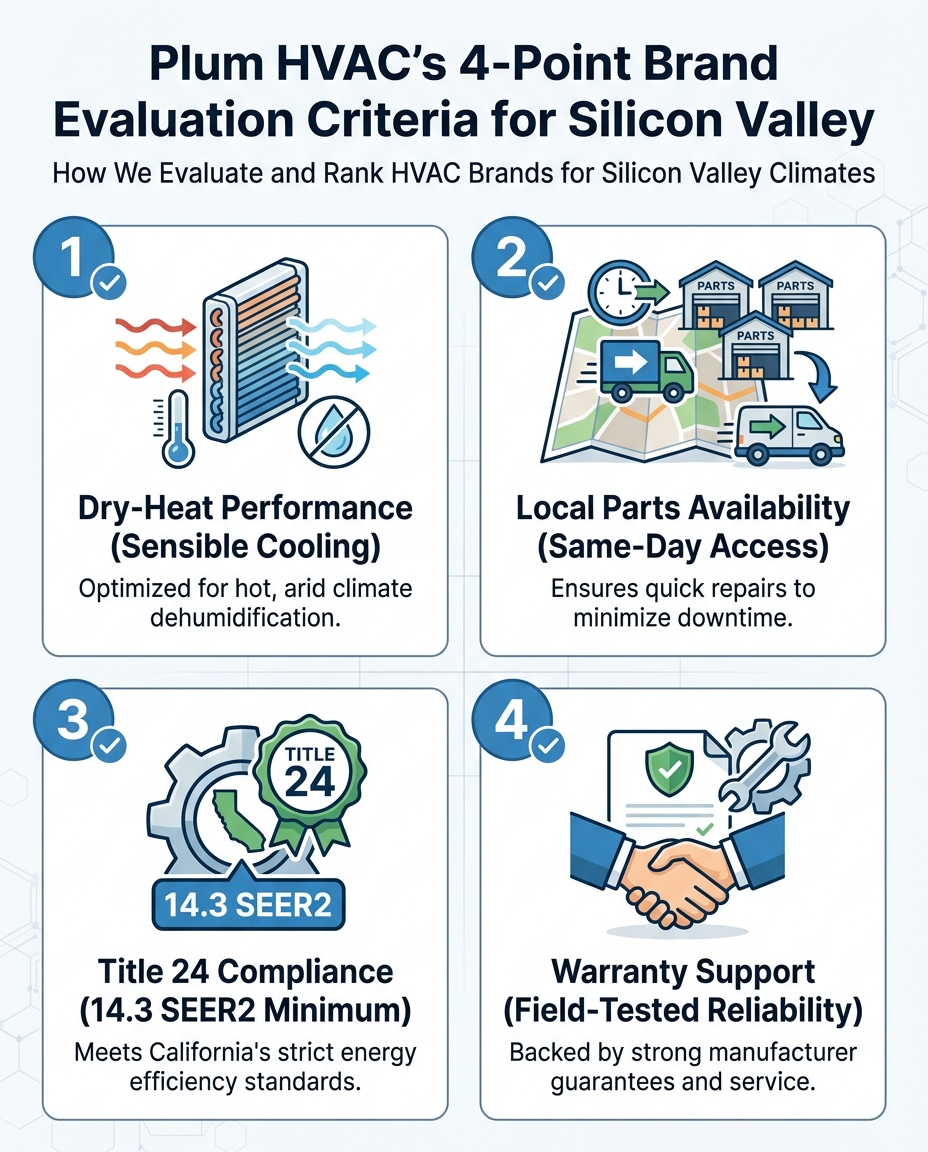
Plum HVAC's 4-Point Brand Evaluation Criteria
To protect homeowners from the pitfalls of generic rankings, we use a strict, localized methodology to filter out equipment that looks good on paper but underperforms in the real world. Whether you need a minor upgrade or a complete AC installation in Mountain View, every brand we recommend must pass these four specific tests.
1. Dry-Heat Performance: The equipment must feature a high sensible cooling capacity specifically engineered for peak summer loads, ensuring it cools the air rapidly without wasting energy on unnecessary dehumidification.
2. Local Parts Availability: The manufacturer must maintain robust Northern California distributor networks. If a brand does not stock replacement parts within a same-day driving distance, it fails our evaluation.
3. Title 24 Compliance: The system must comfortably meet or exceed California's strict energy standards, including the Southwest region's baseline requirements, without suffering performance drop-offs under heavy load.
4. Warranty Support: The brand must offer reliable, field-tested manufacturer backing. A ten-year warranty is useless if the local distributor takes three weeks to approve a claim.
Prioritizing Sensible Cooling for Peak Summer Loads
When we evaluate an air conditioner's performance for a dry-heat summer, we look closely at the technical difference between sensible and latent cooling. In the Silicon Valley microclimate, summer temperatures often sit in the 80s and 90s with very low humidity. This specific weather pattern demands a very specific type of mechanical response.
Matching the Cooling Load: Peak July heat waves demand equipment optimized for sensible heat ratios. If an air conditioner is designed primarily to wring moisture out of humid air, it will run longer cycles at lower speeds. In our climate, you need a system that focuses its energy on rapidly dropping the indoor temperature. Brands that prioritize sensible cooling capacity keep your home comfortable without wasting electricity on unnecessary dehumidification.
The Role of Variable-Speed Compressors: We highly rank brands that offer reliable variable-speed technology. Unlike older single-stage units that blast cold air at 100% capacity and then shut off, variable-speed compressors adjust their output in tiny increments. This precisely matches the cooling load of your home at any given hour. In dry climates, this continuous, precise adjustment prevents temperature swings and significantly reduces your monthly energy consumption.
The Critical Role of Local Parts Availability
A top-ranked national brand is a poor choice locally if their nearest parts warehouse is out of state. HVAC systems are mechanical, and mechanical things eventually break down. When that happens during a peak summer heat wave, the speed of your repair depends entirely on the brand's supply chain logistics.
The Reality of Proprietary Parts: Modern, high-efficiency air conditioners rely on proprietary electronic control boards and specialized variable-speed fan motors. You cannot simply swap in a generic part from a hardware store. If the manufacturer does not have a warehouse in the Bay Area, a simple repair can turn into a multi-week ordeal while you wait for a shipping truck to cross the country.
Our Supply Chain Standard: This is where our evaluation process differs from consumer magazines. Plum HVAC explicitly rejects brands—even famous, highly rated ones—if they have poor local supply chains in the Bay Area. We frame our rankings around actual serviceability. Evaluating distributor networks ensures that peak-summer repair times can be reduced to a single day, rather than stretching into weeks of uncomfortable heat.
Aligning Equipment with California Title 24 Standards
California has some of the strictest energy regulations in the country, and any brand installed in your home must comply with these laws. Evaluating brands based on their ability to comfortably meet or exceed these standards is a core part of our process.
The 14.3 SEER2 Baseline: California requires a minimum of 14.3 SEER2 for residential air conditioners in the Southwest region. However, hitting the bare minimum on a laboratory test is not enough. We evaluate how well a brand maintains its efficiency when the outdoor temperature spikes. Some lower-tier brands meet the SEER2 requirement on paper but experience severe performance drop-offs under heavy load, causing your utility bills to spike unexpectedly.
Long-Term Efficiency Impact: Compliance with Title 24 is about more than just passing an inspection; it directly impacts your long-term energy efficiency and utility costs. Brands that engineer their equipment to exceed these standards naturally use less electricity. We rank manufacturers higher when their equipment features advanced coil designs and efficient airflow management that naturally align with California's goals, ensuring your home stays cool without straining the local power grid.
Evaluating Warranty Support Across Different System Types
Manufacturer warranty lengths are only as good as the local distributor's willingness to fulfill them quickly. Almost every major brand offers a 10-year registered parts warranty, making them look identical on a comparison chart. The real difference lies in field-tested reliability and how the manufacturer handles claims.
The Fulfillment Test: We track how quickly different brands process warranty parts. If a manufacturer routinely denies claims on technicalities or requires extensive, time-consuming paperwork that delays your repair, they drop in our rankings. The importance of field-tested reliability always outweighs marketing claims when investing in a replacement system.
Consistent Standards for Alternative Systems
The same strict criteria for parts, performance, and warranty support apply when evaluating alternative or dual-fuel setups. If you are exploring furnace options for the winter months, or considering transitioning to modern heat pump systems, the evaluation filter remains the same.
• Seamless Integration: The brand must offer components that communicate flawlessly with each other, ensuring energy-efficient configurations work exactly as designed.
• Local Expertise: The manufacturer must provide robust technical support to local technicians, ensuring that complex dual-fuel setups can be diagnosed and serviced accurately.
• Year-Round Reliability: Whether the system is cooling in July or heating in December, the brand must prove its durability in our specific regional climate.
Frequently Asked Questions
Which AC brand is best for hot dry climates?
The best AC brand for a hot, dry climate is one that prioritizes sensible cooling capacity over latent cooling. Brands that utilize variable-speed compressors excel in dry heat because they can precisely match the cooling load of the home without wasting energy on unnecessary dehumidification. We evaluate options based on how well they handle high temperatures while maintaining energy efficiency.
Does HVAC brand really matter?
Yes, the brand matters significantly, but not for the reasons most people think. While many brands share similar internal components, they differ wildly in their local parts availability, warranty fulfillment speed, and quality control. Choosing a brand with a strong local distributor network in Northern California is far more important than picking a name you recognize from a television commercial.
What is the most reliable HVAC brand?
The most reliable HVAC brand is the one installed correctly and supported locally. Reliability is a combination of robust manufacturing, precise installation sizing, and the ability to get replacement parts on the same day if something goes wrong. We track field-tested reliability across hundreds of installations to determine which brands actually hold up in our specific microclimate.
How do I choose an HVAC system for my house?
You should choose an HVAC system by evaluating your home's specific cooling load, your local climate, and the strict energy standards of your state. Focus on equipment that meets California Title 24 requirements and features a high sensible cooling ratio. Partnering with a professional who understands local supply chain logistics ensures you select a system that is both efficient and easily serviceable.
How does local parts availability affect my AC repair timeline?
Local parts availability is the single biggest factor in how fast your air conditioner gets fixed during a breakdown. If a brand stocks proprietary parts in a nearby warehouse, a repair can often be completed in a single afternoon. If the brand relies on out-of-state shipping, that same repair could leave your home without cooling for several weeks during peak summer heat.
Making a Confident Decision for Your Home
Navigating how we evaluate and rank HVAC brands for Silicon Valley climates comes down to ignoring the national hype and focusing on local reality. By relying on a transparent, logical framework that prioritizes dry-heat performance and local parts availability, you protect your investment. When you are ready to upgrade your comfort with equipment proven to thrive in our specific microclimate, our team is here to guide you to the perfect fit.
hear what our satisfied clients have to say

.svg)
Service areas
.avif)