
How a 1.5 Ton AC Unit Actually Performs in a Standard Palo Alto Condo
Evaluating the Cooling Power of a 1.5 Ton System in Multi-Family Spaces
Your current air conditioner runs nonstop during the mid-afternoon heat, leaving you wondering exactly how a 1.5 ton AC unit actually performs in a standard Palo Alto condo. In our years of serving Mountain View and the surrounding Peninsula, the most common problem our Plum HVAC technicians see homeowners face when upgrading their HVAC equipment is finding the exact balance between adequate cooling capacity and the severe risks of oversizing the system. If you choose a unit that is too small, it will struggle and drive up your energy bills. If you choose a unit that is too large, it will create a host of humidity and mechanical issues that degrade your indoor comfort.
Whether you need routine air conditioning services or are preparing for a full AC installation in Palo Alto, getting the tonnage right is the most critical step in the process.
The Challenge with Generic Sizing Charts
Most national HVAC sizing charts base their recommendations entirely on raw square footage, assuming the equipment is being installed in a standalone single-family home. These generic guidelines often fail completely when applied to multi-family buildings. A standalone house loses heating and cooling energy through four exterior walls, a roof, and a foundation. A condominium, however, is heavily insulated by the surrounding units.
Because of this structural difference, a 1.5 Ton AC System often represents the perfect sweet spot for efficiency and comfort in a typical condo layout. It provides enough power to handle peak summer temperatures without being so large that it short-cycles. Making the correct decision on this sizing ensures you get the right performance value for your specific floor plan.
Why 18,000 BTUs Fits the 700 to 1,000 Square Foot Condo Layout
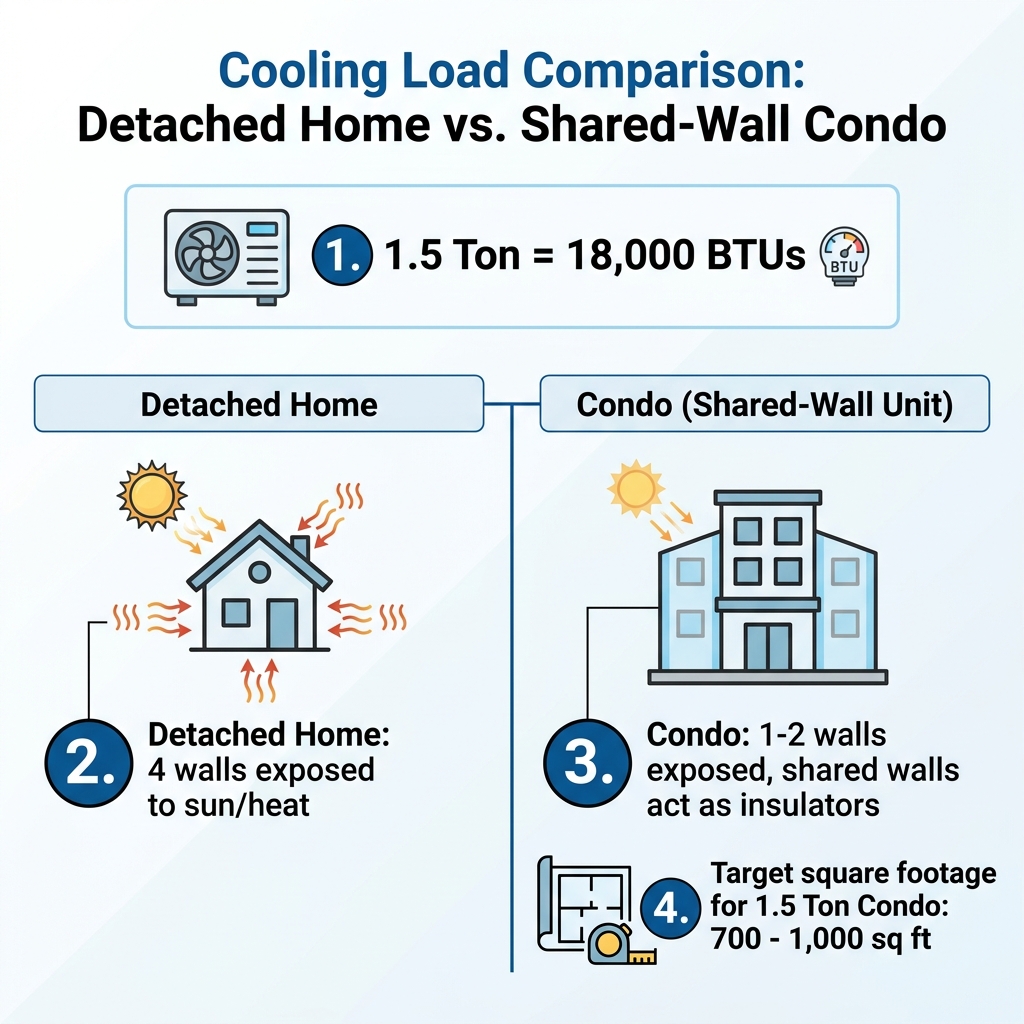
To understand how air conditioners are sized, you have to look at the technical measurements behind the tonnage. In the HVAC industry, a "ton" has nothing to do with the physical weight of the equipment. Instead, it refers to the unit's ability to remove heat from a space, measured in British Thermal Units (BTUs). A 1.5-ton AC unit produces exactly 18,000 BTUs of cooling capacity per hour.
The Department of Energy Baseline
The standard baseline provided by the Department of Energy suggests that a home requires roughly 20 BTUs of cooling output for every square foot of living space. When you apply this math to a 1.5-ton system, the numbers align perfectly with the average footprint of Palo Alto / Peninsula multi-family buildings.
• 700 sq ft — Estimated BTU Requirement (20 BTUs/sq ft): 14,000 BTUs — Recommended AC Tonnage: 1.5 Tons (18,000 BTUs provides a safe buffer)
• 850 sq ft — Estimated BTU Requirement (20 BTUs/sq ft): 17,000 BTUs — Recommended AC Tonnage: 1.5 Tons (Nearly exact match)
• 1,000 sq ft — Estimated BTU Requirement (20 BTUs/sq ft): 20,000 BTUs — Recommended AC Tonnage: 1.5 Tons to 2.0 Tons (Depending on sun exposure)
When you map this 18,000 BTU output directly to a 700 to 1,000 square foot condo, you can see why going larger often leads to diminishing returns. Stepping up to a 2-ton system (24,000 BTUs) in an 800-square-foot space means the unit is producing significantly more cold air than the space actually requires. This excess capacity forces the system to shut down prematurely, which disrupts the natural cooling cycle and leads to uneven temperatures throughout the bedrooms and living areas.
Shared Walls and Heat Load Reductions in Condominiums
The Problem: Overestimating the Cooling Load
One pattern we see constantly at Plum HVAC is condo owners assuming their space requires the same size air conditioner as a similarly sized detached house. When contractors rely solely on square footage rather than performing a comprehensive load calculation, they frequently recommend oversized equipment. This happens because they fail to account for the unique thermodynamics of multi-family architecture.
The Cause: Ignoring the Insulation of Shared Architecture
In Palo Alto / Peninsula multi-family buildings, shared floors, ceilings, and walls act as massive, highly effective insulators. If you live in a middle-floor unit, the condo above you and the condo below you are both running their own climate control systems. Your side walls are likely shared with neighbors who are also cooling their spaces. This architectural reality drastically reduces your overall cooling load. Instead of fighting the outdoor heat on all six sides of your living space, your air conditioner may only be fighting the heat coming through one or two exterior walls and a balcony sliding glass door.
The Solution: Precise Load Calculations
The solution is to insist on a precise Manual J load calculation that explicitly accounts for multi-family insulation factors. This calculation evaluates the direction your windows face, the quality of your insulation, and the number of shared walls. Once these factors are applied, it becomes clear why an 18,000 BTU system is more than capable of handling the reduced heat load of a condo, ensuring you do not pay for excess capacity you will never use.

Managing July Heat Spikes Without the Risk of Short-Cycling
Living in the Bay Area means enjoying mild, dry summers for most of the year, punctuated by occasional, intense July heat spikes. When dispatched to peak-summer cooling emergencies across Mountain View and Palo Alto, our team frequently traces poor indoor air quality and comfort issues back to improper sizing. Your air conditioning system must be versatile enough to handle both of these extremes efficiently. This is where precise sizing becomes absolutely vital for your daily comfort.
Understanding the Mechanics of Short-Cycling
If you install a unit that is too large for your condo, you will experience a phenomenon known as short-cycling. This occurs when an oversized unit blasts a massive amount of cold air into a small space, dropping the temperature rapidly. The thermostat reads the sudden drop and shuts the system off after only ten or fifteen minutes.
The hidden problem: Air conditioners do two jobs—they cool the air, and they remove humidity. Dehumidification takes time. When a system short-cycles, it cools the room too fast without actually running long enough to draw the moisture out of the air. This leaves your condo feeling cold but uncomfortably clammy and damp.
Consistent Comfort During Peak Heat
A properly sized 1.5 Ton AC System runs longer, steadier, and more efficient cycles. During a typical mild summer afternoon, it gently circulates the air, pulling out humidity and maintaining a crisp indoor environment. When those peak July heat waves hit, the unit has the exact right amount of capacity to run continuously under heavy load, maintaining your set temperature without over-straining the compressor. Keeping this system running at peak performance requires changing your filters regularly and scheduling routine AC maintenance in Palo Alto before the summer weather arrives.
Navigating HOA Restrictions and Condenser Footprints
Upgrading an air conditioning system in a condominium involves more than just selecting the right tonnage; it requires navigating strict bureaucratic and physical constraints. Multi-family housing comes with rules that simply do not apply to detached homes, and your HVAC choices must align with these regulations.
Physical Footprints and Balcony Space
The outdoor unit, known as the condenser, must fit within a highly restricted physical footprint. In many Palo Alto / Peninsula multi-family buildings, the condenser is placed on a small private balcony or squeezed onto a crowded, designated roof space. A 1.5-ton condenser is naturally more compact than a 2-ton or 3-ton unit, making it much easier to position without blocking walkways or violating clearance requirements.
Meeting Strict Decibel Limits
Homeowner Associations (HOAs) enforce strict noise regulations to ensure neighbors are not disturbed by loud mechanical equipment. Many HOAs cap the allowable noise output of an outdoor AC unit at 60 to 65 decibels (dB). Modern 1.5-ton systems are engineered with sound-dampening technology and swept-wing fan blades that easily comply with these stringent HOA decibel limits, keeping your home cool without causing friction with your neighbors or the condo board.
Municipal Permits and Approvals
Beyond the HOA, municipal building codes dictate how HVAC modifications can be performed in multi-tenant buildings. Securing the necessary permits requires detailed electrical load calculations and structural compliance documentation. Because our Plum HVAC installation crews have spent years navigating Peninsula multi-family building codes, municipal permits, and securing HOA approvals, we ensure your installation proceeds smoothly. If you live anywhere within the Palo Alto service area, ensuring your project meets both municipal and HOA standards from day one prevents costly delays and mandatory re-installations.
Energy Efficiency and Long-Term Performance Value
When evaluating the long-term performance value of a 1.5-ton unit, energy efficiency is one of the most important factors to consider. Properly sized equipment does not just improve your daily comfort; it fundamentally changes how much electricity your home consumes over the lifespan of the system.
Comparing Energy Consumption
An oversized system draws a massive surge of electricity every time it starts up. Because oversized units short-cycle, they turn on and off dozens of times a day, creating continuous power spikes. A properly sized 1.5 Ton AC System draws less power upon startup and runs efficiently at a steady pace. This steady operation consumes significantly less energy overall, allowing you to cool your condo effectively without wasting electricity.
Compressor Technology in Condos
When selecting your equipment, you will likely choose between a single-stage compressor and a variable-speed compressor.
• Single-stage compressors: These run at 100% capacity whenever they are on. In a 700 to 1,000 square foot condo, a single-stage 1.5-ton unit is highly effective because the space is small enough to cool evenly.
• Variable-speed compressors: These can ramp their output up and down (like a car's accelerator). They offer superior humidity control and are exceptionally quiet, making them ideal for condos with strict noise requirements.
Proper sizing maximizes the lifespan of whichever technology you choose. By reducing the violent start-and-stop wear on the compressor, the internal components experience less mechanical stress, meaning fewer breakdowns over the next decade. If you are curious about which manufacturers excel in these technologies, researching the top residential HVAC brands can help you identify systems known for quiet operation and long-term reliability.
Make an Informed Decision for Your Condo's Cooling Needs
Choosing the right air conditioner for a condominium is a precise science. The short answer is that 18,000 BTUs is typically the optimal target for 700 to 1,000 square foot spaces that benefit from the shared walls of a multi-family building. By relying on accurate load calculations rather than generic square-footage charts, you ensure your living space remains comfortable and dry.
Balancing cooling power with strict HOA compliance, compact physical footprints, and critical humidity control is essential for long-term satisfaction. A properly sized 1.5 Ton AC System delivers the exact price-to-performance ratio you need to keep your home comfortable during intense July heat spikes without straining the equipment.
If you are ready to explore professional sizing and installation options, reaching out to our experienced team at Plum HVAC ensures your new system meets all municipal codes and perfectly matches your condo's specific floor plan. A clear, accurate breakdown of your cooling load gives you the confidence to approve an HVAC quote knowing you are getting exactly what your home requires.
Frequently Asked Questions
How many square feet does a 1.5 ton AC cool?
A 1.5-ton AC unit is generally designed to cool between 700 and 1,000 square feet of living space. This range depends heavily on the home's insulation, ceiling height, and sun exposure. In a condo with shared walls, a 1.5-ton unit can comfortably handle spaces at the upper end of that square footage range.
Is a 1.5 ton AC enough for a 1000 sq ft condo?
Yes, in most cases, a 1.5-ton AC is perfectly adequate for a 1,000-square-foot condo. Because condos share walls, floors, and ceilings with adjacent units, they lose far less cooling energy than a standalone house. A precise load calculation will confirm this, but 18,000 BTUs is usually the ideal capacity for this layout.
Why is my condo AC short cycling?
Short cycling typically happens when an air conditioning unit is too large for the square footage it is trying to cool. The oversized system blasts cold air into the small space, satisfying the thermostat rapidly before shutting down. This prevents the system from running long enough to properly dehumidify the air, leading to a clammy indoor environment.
What happens if my AC is too big for my apartment?
If your AC is too large, it will suffer from constant on-and-off cycling, which severely increases wear and tear on the compressor. Additionally, the unit will fail to remove humidity from the air, making your apartment feel damp and uncomfortable. This constant cycling also leads to higher electricity consumption due to the frequent power surges required to start the motor.
Is 1.5 tons enough for a 2 bedroom condo?
A 1.5-ton unit is typically highly effective for a standard two-bedroom condo ranging from 800 to 1,000 square feet. The shared walls act as excellent insulators, keeping the cooling load low enough for 18,000 BTUs to manage easily. If the condo features vaulted ceilings or massive west-facing windows, a load calculation might suggest a slight increase in capacity.
How do HOA noise limits affect AC sizing?
HOA noise limits often restrict the decibel output of outdoor condenser units, forcing homeowners to select quieter, more compact equipment. Because larger tonnage units require larger compressors and fans, they are naturally louder. A 1.5-ton unit is smaller and generally operates well within standard 60 to 65 decibel limits enforced by most condo associations.
Does a 1.5-ton unit need a special permit in Palo Alto?
Yes, any permanent modification or replacement of an HVAC system in a multi-family building requires municipal permits. The city requires documentation showing that the new equipment meets current energy efficiency standards and electrical safety codes. Your installation contractor will handle the load calculations and paperwork required to secure these municipal approvals.
hear what our satisfied clients have to say

.svg)
Service areas
.avif)