The Role of Proper Attic Insulation in Supporting Your AC System
When Your AC Runs Constantly But the House Stays Hot
Your thermostat is set to 72 degrees, but the indoor temperature is stubbornly stuck at 78, and the vents have been blowing non-stop since noon. When you are dealing with this frustrating scenario, understanding the role of proper attic insulation in supporting your AC system is often the only way to find permanent relief. Many homeowners immediately assume their air conditioner is broken, undersized, or simply too old to keep up with the August and late summer cooling demand. You might hear the compressor running endlessly and brace yourself for the cost of a complete system replacement. However, in our years of responding to late-summer service calls across Mountain View, the Plum HVAC team sees this exact scenario daily—and often, the equipment itself is perfectly fine.
Here is the thing: the problem frequently has nothing to do with your cooling equipment. Instead, the real culprit is a compromised thermal boundary that allows extreme heat to intrude directly into your living space. A high-efficiency air conditioner is essentially useless if the home itself cannot hold onto the conditioned air it produces. When massive amounts of heat seep through your ceiling, your cooling equipment is forced to work overtime just to tread water. If your system is struggling to keep up, exploring comprehensive air conditioning systems requires looking at the entire home environment, starting with the space right above your head.
The Physics of Heat Transfer: Understanding Your Home's Thermal Boundary
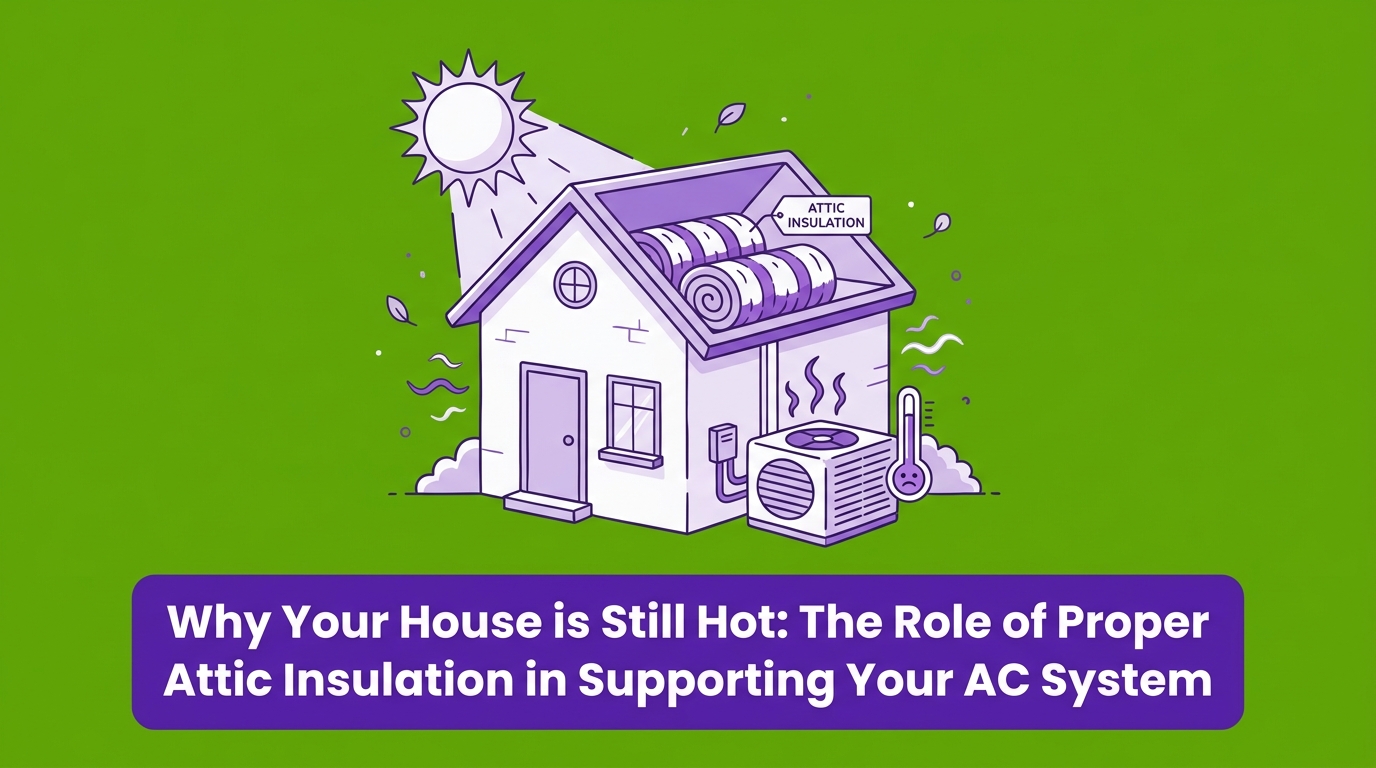
The Problem: To understand why your home stays hot despite your air conditioner's best efforts, you have to look at the physics of heat transfer. Your home relies on a "thermal boundary"—the protective envelope of insulation and air sealing that separates your conditioned indoor living spaces from the extreme outdoor temperatures. When this boundary is weak, heat naturally moves from warmer areas to cooler areas. In Mountain View and Bay Area homes, the sun beats down on the roof for hours, turning the attic into a massive radiant oven.
The Cause: Mountain View's sunny, warm afternoons create extreme radiant heat gain in attics, forcing systems to overwork despite mild morning temperatures. The roofing materials absorb solar energy and radiate it downward into the attic space. Without proper ventilation and insulation, our technicians routinely measure attic temperatures exceeding 140 degrees during peak afternoon heat. If the insulation on your attic floor is thin, degraded, or improperly installed, there is nothing stopping that 140-degree heat from pressing directly down through your ceiling drywall and into your bedrooms and living rooms.
The Solution: Upgrading your thermal boundary stops this radiant heat transfer in its tracks. Proper insulation acts as a thick, resistant barrier that keeps the intense attic heat trapped above the ceiling, preventing it from artificially inflating your home's cooling load. By keeping the heat out of your living space in the first place, your air conditioner can finally satisfy the thermostat and cycle off as intended.
Envelope Failure vs. Equipment Failure: Diagnosing Late-Summer Fatigue
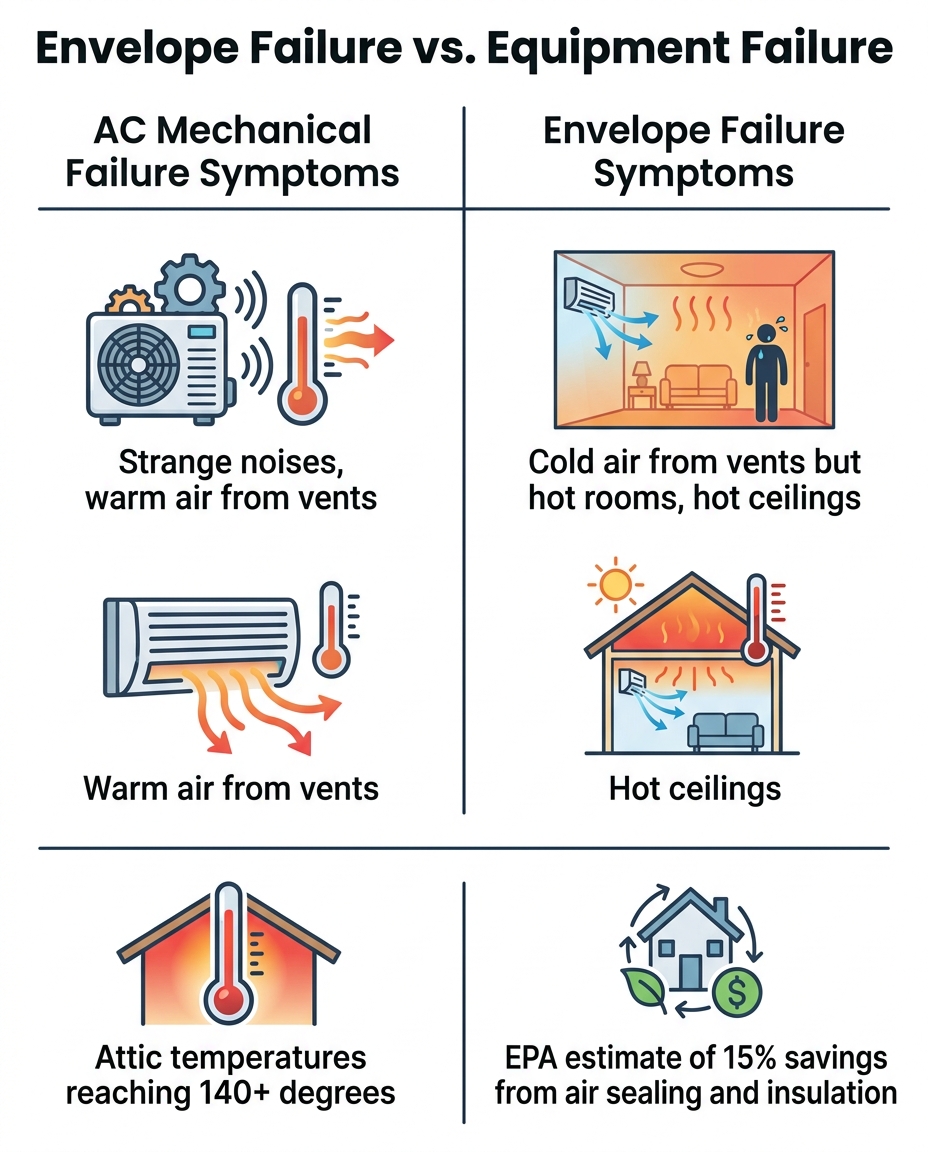
During the peak of August and late summer cooling demand, prolonged heat exposure maximizes the cumulative thermal stress on your home. This constant battle against the elements leads to what industry professionals call "late summer fatigue." Homeowners frequently misdiagnose this fatigue as a mechanical breakdown, assuming the air conditioner has finally given out after a long, hot season. However, distinguishing between a failing compressor and a failing thermal envelope is critical to solving the root cause of the problem.
At Plum HVAC, our holistic approach involves evaluating the entire home envelope to ensure the AC operates efficiently, rather than just upselling a larger unit to mask poor insulation. A pattern we see often in older Bay Area homes is that a high-efficiency air conditioner simply cannot overcome terrible insulation. If you install a massive, high-capacity unit in a poorly insulated home, the constant cycling to fight heat intrusion will cause excessive wear and tear on the new compressor, leading to premature failure. If you are considering air conditioning installation in Mountain View, evaluating your home's envelope first is a vital step.
• Airflow Temperature — Mechanical Equipment Failure: Vents blow warm, room-temperature, or weakly cooled air. — Home Envelope Failure: Vents blow ice-cold air forcefully, but the room remains hot.
• System Sounds — Mechanical Equipment Failure: Grinding, squealing, or rattling noises from the outdoor unit. — Home Envelope Failure: System sounds normal but runs continuously without stopping.
• Ceiling Temperature — Mechanical Equipment Failure: Ceilings feel neutral or cool to the touch. — Home Envelope Failure: Ceilings feel noticeably warm or hot to the touch in the late afternoon.
• Thermostat Behavior — Mechanical Equipment Failure: Thermostat registers a rising indoor temperature regardless of time of day. — Home Envelope Failure: Thermostat holds temperature in the morning but loses ground by 4:00 PM.
The Hidden Victim: How Radiant Heat Impacts Attic Ductwork
Even if your air conditioner is producing perfectly chilled air, that air still has to travel through a network of ducts to reach your living spaces. In many Mountain View and Bay Area homes we inspect, the supply and return ducts are routed directly through unconditioned attic spaces. This design creates a severe vulnerability when the thermal boundary is compromised.
Thermal stress on thin materials: Standard ductwork is made of thin sheet metal or flexible plastic, wrapped in a relatively thin layer of fiberglass insulation. When these ducts are suspended in a 140-degree attic, they are subjected to immense thermal stress. The ambient heat constantly attacks the cold air traveling inside.
Loss of cooling capacity: As the 55-degree air leaves your indoor evaporator coil and travels through the scorching attic, it absorbs heat through the duct walls. By the time that air reaches the vents in your furthest bedrooms, it may have warmed up to 65 or 70 degrees. You are essentially paying to air-condition your attic while your bedrooms remain uncomfortably warm.
The insulation connection: Proper attic insulation does more than just protect your ceilings; it helps lower the ambient temperature of the attic itself if combined with proper ventilation, and it protects the ductwork buried beneath it. Ensuring your ducts are properly sealed, insulated, and protected from radiant heat is a core component of effective residential ductwork design. When the attic is fortified, your ductwork can deliver cold air at its full capacity.
Recognizing a Compromised Thermal Boundary
You do not need specialized diagnostic equipment to tell if your home is suffering from a failing thermal envelope. When our team arrives for end-of-season cooling tune-ups, we often point out signs that are quite apparent once you know what to look for, especially during the peak of August and late summer cooling demand. If you notice these symptoms, your insulation is likely inadequate:
• Warm ceilings: Place your hand flat against the ceiling of your topmost floor around 5:00 PM. If the drywall feels noticeably warm to the touch, radiant heat is actively passing through your insulation.
• Significant temperature disparities: If your second floor is consistently 10 degrees hotter than your first floor, the attic heat is overpowering your upstairs cooling zones.
• Continuous system operation: An air conditioner that runs for hours on end without satisfying the thermostat is fighting a losing battle against heat intrusion.
• Unexplained cooling cost spikes: If your energy bills surge drastically during peak summer months despite normal thermostat settings, your system is wasting energy compensating for a leaky envelope.
The Role of R-Value
When evaluating your thermal boundary, the most important metric is the "R-value." R-value is the standard measure of thermal resistance—essentially, how well a specific material resists the conductive flow of heat. The higher the R-value, the greater the insulating effectiveness. Many older homes were built long before modern energy codes were established, leaving them severely under-insulated by today's standards. Upgrading your attic to meet current recommended R-values is the most effective way to block radiant heat and reduce your cooling load.
The Holistic Approach to Restoring HVAC Efficiency
Restoring your home's thermal boundary is a comprehensive process that directly supports and preserves the lifespan of your cooling equipment. The U.S. Environmental Protection Agency (EPA) estimates that homeowners can save an average of 15% on heating and cooling costs simply by air sealing their homes and adding insulation in attics. Furthermore, generic federal tax credits or local utility incentive programs may apply to qualifying energy-efficiency improvements, so we always advise readers to verify current programs with their utility provider or a tax professional. For Mountain View and Bay Area homes, this process involves two critical steps that work together to lower the cooling load.
1. Air Sealing the Attic Floor: Insulation alone cannot stop air movement. Before new insulation is added, professionals must locate and seal all the hidden gaps, cracks, and penetrations around light fixtures, plumbing stacks, and wire holes. This stops the conditioned air you paid for from leaking out into the attic.
2. Upgrading the Insulation Layer: Once the air leaks are sealed, a thick, continuous layer of high-quality insulation is blown in or laid down over the attic floor. This creates a robust barrier against radiant heat transfer, locking the extreme summer temperatures out of your living space.
3. System Recalibration and Support: With a restored thermal boundary, your home's cooling load drops significantly. The air conditioner no longer has to run constantly to maintain a comfortable temperature. It can cycle on, cool the house quickly, and cycle off, reducing emergency breakdowns. To keep this optimized system running smoothly, regular air conditioning maintenance ensures the mechanical components take full advantage of the improved home envelope.
Beyond Cooling: Insulation and Indoor Air Quality
While the primary focus of attic insulation is thermal resistance, a properly sealed and insulated attic also plays a massive role in protecting your home's overall health and air quality. A compromised thermal boundary does not just let heat in; it also allows airborne contaminants to infiltrate your living spaces. Many Mountain View and Bay Area homes suffer from poor air quality simply because the attic is leaking directly into the house.
Blocking dust and allergens: An unsealed attic is full of dust, old fiberglass particles, pollen, and even pest droppings. When your air conditioner turns on, it creates negative pressure that can suck this contaminated attic air down through unsealed ceiling gaps and recessed lighting fixtures, distributing it throughout your home.
Supporting humidity control: Your air conditioner acts as a giant dehumidifier, pulling moisture out of the indoor air. However, if outside air is constantly leaking in through a poorly insulated envelope, the system cannot keep up with the incoming humidity. This leads to a clammy, uncomfortable indoor environment.
Comprehensive air quality strategy: Proper air sealing and insulation form the foundation of any effective indoor air quality strategy by physically keeping outdoor contaminants out. When combined with dedicated indoor air quality solutions, a sealed envelope ensures you are breathing clean, filtered air rather than dusty attic runoff.
Frequently Asked Questions About AC Efficiency and Attic Insulation
Why is my AC running constantly but the house is still hot?
When your AC runs non-stop without cooling the house, it usually means the cooling load exceeds the system's capacity. During the late summer cooling demand in August, radiant heat from the roof easily penetrates poor attic insulation. The continuous running is your system's attempt to fight off the massive amount of heat actively seeping through your ceilings.
Does poor attic insulation affect AC performance?
Yes, significantly. Poor insulation forces your air conditioner to run longer cycles to overcome the constant heat intrusion from the attic. This continuous operation increases wear and tear on the compressor, reduces the system's lifespan, and leads to frequent mechanical breakdowns due to overheating.
Can adding insulation lower my cooling bill?
Absolutely. By creating a strong thermal boundary, proper insulation keeps the extreme outdoor heat out and the conditioned indoor air in. This drastically reduces the amount of time your air conditioner needs to run, directly lowering your monthly energy consumption and cooling costs.
How much insulation do I need in my attic for summer?
The amount of insulation needed is measured in R-value, and the recommendation depends on your local climate zone. Most energy guidelines suggest an attic R-value between R-38 and R-60 for optimal thermal resistance. A professional evaluation can determine your current R-value and how much material is required to reach modern efficiency standards.
How does radiant heat impact ductwork in the attic?
Radiant heat turns an unconditioned attic into an oven, which places immense thermal stress on the ductwork routed through it. As cold air travels through these ducts, the ambient heat penetrates the thin duct walls, warming the air before it ever reaches your rooms. Proper attic insulation helps protect the ductwork and preserves your system's cooling capacity.
Evaluate Your Envelope Before Replacing Your Equipment
Jumping straight to an equipment replacement without evaluating your home's thermal boundary is a missed opportunity. Upgrading to a high-efficiency air conditioner will not solve your comfort issues if the underlying problem is massive heat intrusion through the ceiling. In many Mountain View and Bay Area homes our team has serviced, fortifying the attic is the true secret to restoring comfort, lowering energy bills, and extending the life of your cooling equipment.
Before you spend resources on a larger cooling unit to fight the relentless late-summer heat, take a step back and look at the whole picture. Seek a holistic evaluation of your home's thermal boundary to identify where the heat is actually entering. By addressing the envelope first, you ensure that whatever cooling system you rely on will operate at peak performance for years to come.
hear what our satisfied clients have to say

.svg)
Service areas
.avif)