
Why Mountain View Homes Struggle with Afternoon Heat Waves Despite New AC Units

The Frustration of a Hot, Sticky House After a Recent Upgrade
At Plum HVAC, our team frequently hears from residents whose air conditioner is running in short, loud bursts, but the living room still feels uncomfortably warm and clammy. Figuring out exactly why Mountain View homes struggle with afternoon heat waves despite new AC units is incredibly frustrating, especially right after you invest in a brand new, high-efficiency system. You expect a modern upgrade to handle the most intense July heat waves with ease. Instead, you find yourself sweating in your own home while the thermostat insists the temperature is dropping.
Here is the thing we always tell our customers: a hot, sticky house after a recent upgrade is rarely caused by a defective machine. More often than not, the issue traces back to a fundamental flaw in how the system's capacity was matched to your home's actual thermal load. Upgrading your cooling equipment requires more than just picking a unit with a high efficiency rating. It requires a precise understanding of how air conditioners remove both heat and moisture from your indoor air.
If you are tired of paying for a system that cannot keep up, exploring proper air conditioning solutions and securing professional AC installation in Mountain View is the first step toward lasting comfort.
Why Oversized Air Conditioners Fail to Dehumidify
In our years of serving the local community, a common misconception we encounter in the HVAC industry is that a bigger air conditioner will automatically cool your house better and faster. While an oversized unit will certainly drop the temperature quickly, it completely fails at one of its most important jobs: removing humidity from the air. To understand why this happens, you have to look at how an air conditioning system actually processes the air inside your home.
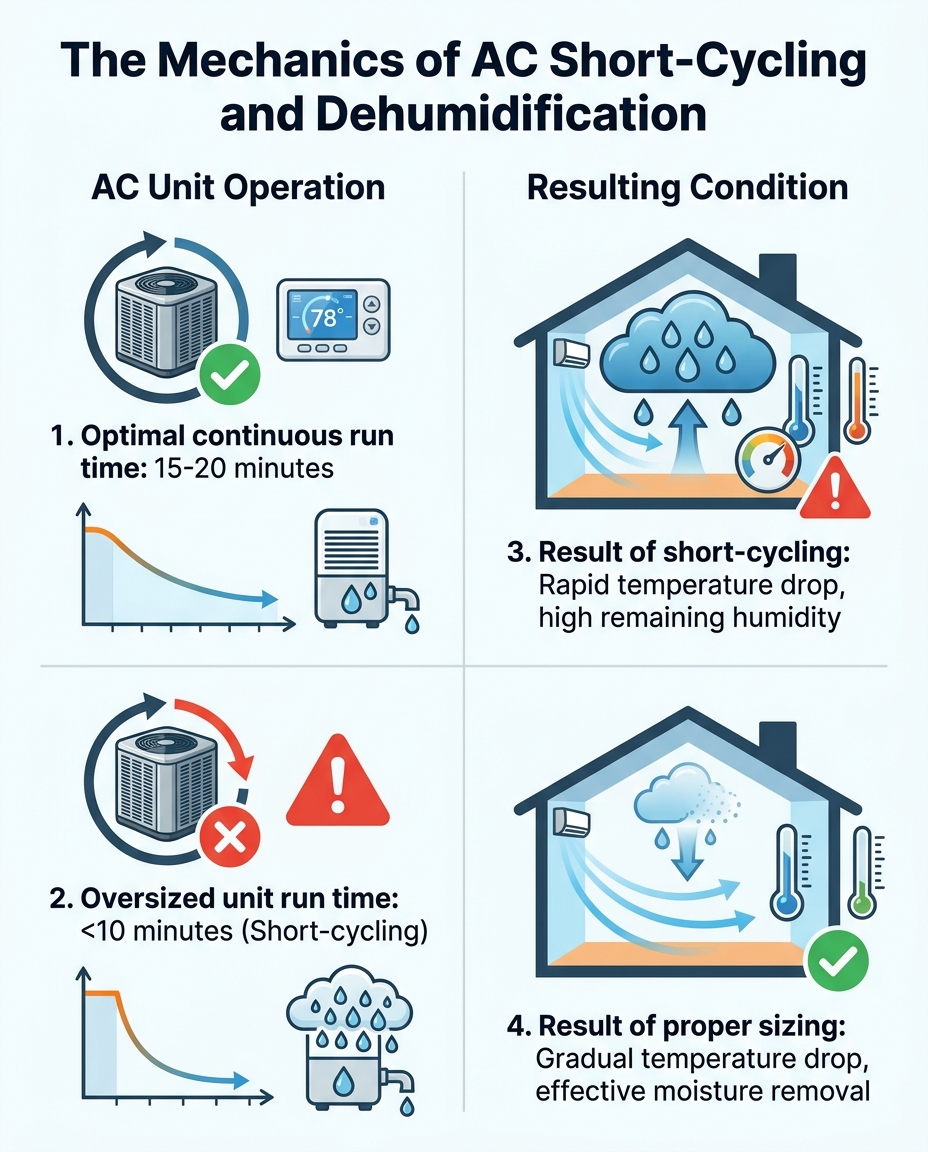
An air conditioner typically needs to run continuously for at least 15 to 20 minutes to effectively remove humidity from indoor air. During a cooling cycle, the indoor evaporator coil gets extremely cold. As warm, moist air from your house blows across this cold coil, the moisture in the air condenses into water droplets—much like water forming on the outside of a cold glass on a hot day. That water then drains away, leaving your indoor air drier and more comfortable.
When a unit is too large for the space, it cools the air far too rapidly. The thermostat detects that the target temperature has been reached and shuts the system down after just five or ten minutes. Because the cycle is so brief, the evaporator coil never has enough time to condense and extract a meaningful amount of moisture. The result is a home that feels cold but clammy, forcing you to constantly adjust the thermostat to find relief.
Sensible vs. Latent Cooling Explained
To truly understand indoor comfort, you need to know the difference between sensible cooling and latent cooling. These two concepts dictate how your system performs during the hottest parts of the year.
• Sensible Cooling — What It Means: Lowering the actual air temperature (the number on the thermostat). — How You Feel It: The air blowing out of the vents feels cold against your skin. — System Requirement: Requires the compressor to run just long enough to hit the target temperature.
• Latent Cooling — What It Means: Removing moisture (water vapor) from the indoor air. — How You Feel It: The air feels crisp and dry, preventing that sticky, heavy feeling. — System Requirement: Requires long, continuous run times (15+ minutes) to allow condensation.
According to Energy.gov guidelines—and a pattern we see often in the field—installing an oversized air conditioner is one of the most common pitfalls in home cooling. A system that only provides sensible cooling without adequate latent cooling will leave your Mountain View home feeling like a damp cave. Bigger is definitely not better when it comes to HVAC replacement; precise sizing is the only way to achieve both temperature control and dehumidification.
How Short-Cycling Sabotages Indoor Comfort
When our technicians inspect underperforming systems, we frequently find them experiencing a phenomenon known as short-cycling. This occurs when an oversized air conditioner turns on, blasts cold air for a few minutes, and immediately shuts off. This rapid on-and-off behavior is the direct result of a system having too much capacity for the space it is trying to cool. While it might seem like a powerful unit is just doing its job quickly, short-cycling actually sabotages your indoor comfort and destroys the efficiency of your new equipment.
During intense July heat waves, a properly sized system will run in long, steady cycles to manage the sudden thermal load. An oversized system, however, panics. It dumps a massive amount of cold air into the house, satisfies the thermostat in a matter of minutes, and shuts down. Because the walls, furniture, and floors are still radiating heat, the thermostat quickly registers that the house is warm again, forcing the system to kick right back on. This constant starting and stopping prevents the system from ever reaching its peak energy efficiency, completely negating the benefits of that expensive high-SEER rating.
The Hidden Costs of Rapid System Cycling
Short-cycling does more than just ruin your comfort; it takes a massive mechanical toll on your equipment. Every time an air conditioner starts up, the compressor draws a massive surge of electricity—often five to seven times more power than it takes to keep the system running continuously.
• Spiked energy consumption: The constant demand for start-up power causes your electricity bills to skyrocket, even though the unit is technically running for less total time.
• Compressor wear and tear: The compressor is the heart of your cooling system. Rapid cycling forces it to start under high pressure repeatedly, leading to overheating and premature failure.
• Electrical component stress: Capacitors, contactors, and relays take a beating from the constant electrical surges, leading to frequent breakdowns.
• Uneven cooling: Short, aggressive blasts of air often fail to reach the furthest rooms in the house, leaving some areas freezing and others hot.
If you notice your brand new unit turning on and off constantly, it is critical to seek out professional AC maintenance services to have the cycle times evaluated before the compressor suffers permanent damage.

The Crucial Role of Manual J Load Calculations
The primary reason we see new units fail to perform under pressure is that the original installer skipped the most important step in the design process: the ACCA Manual J load calculation. This technical standard is the only mathematically proven way to determine exactly how much cooling capacity a specific home requires. Guesswork, rules of thumb, and relying on the size of the old unit simply do not work in modern HVAC installations.
Our installation team at Plum HVAC insists that replacing an old unit with a new one of the exact same tonnage is a deeply flawed practice. If your home's thermal envelope has changed—perhaps you added new insulation, upgraded to double-pane windows, or replaced the roof—your cooling requirements have also changed. Furthermore, there is no guarantee that the original unit was properly sized when the house was built twenty years ago. True Bay Area microclimate system design requires a deep understanding of Manual J calculations to engineer a system that fits the home perfectly, setting our approach at Plum HVAC apart from contractors who simply swap boxes and hope for the best.
Beyond Square Footage: What Goes Into the Math
A professional load calculation goes far beyond just looking at the square footage of your floor plan. A house with massive west-facing windows will require significantly more cooling power than a house of the exact same size heavily shaded by trees.
1. Window orientation and type: The calculation factors in solar heat gain from the sun hitting specific sides of the house at different times of day.
2. Insulation levels (R-value): The thickness and quality of insulation in your attic, walls, and crawlspace dictate how much heat leaks into the home.
3. Air infiltration rates: How tightly sealed the home is against outside air drastically impacts the latent (humidity) load.
4. Ductwork condition and location: Ducts running through a 130-degree attic lose significant cooling capacity before the air ever reaches your living room.
5. Ceiling height and architecture: Vaulted ceilings increase the total volume of air that needs to be conditioned.
Understanding these variables is essential for compliance with modern efficiency standards and navigating local HVAC permits and building codes, ensuring your installation is both legal and effective.
Navigating Local Climate Data for Optimal System Sizing
A crucial component of any load calculation is the integration of highly specific local climate data. The American Society of Heating, Refrigerating and Air-Conditioning Engineers (ASHRAE) publishes climate design conditions for cities across the country. This data tells engineers exactly what the extreme high temperatures and humidity levels look like for a given area, allowing them to size equipment for the hardest days of the year without drastically oversizing it for the mild days.
In our experience, Mountain View falls into a specific microclimate that presents unique challenges for HVAC design. The region experiences warm, dry summers, but intense July afternoon heat spikes demand a system that can handle sudden thermal loads efficiently without short-cycling during the milder morning and evening hours. If a system is sized only for the absolute hottest hour of the year using standard single-stage equipment, it will be massively oversized for the other 95% of the summer, leading straight back to the dehumidification problems we discussed earlier.
Designing for the Afternoon Heat Spike
Engineering a system that performs optimally during a 4:00 p.m. heat spike while remaining efficient at 9:00 a.m. requires advanced technology. This is where the type of equipment installed becomes just as important as the size.
• Single-Stage AC — How It Operates: Runs at 100% capacity or is completely off. — Performance During a Heat Spike: Handles the peak heat well, but short-cycles heavily during milder parts of the day.
• Two-Stage AC — How It Operates: Has a high gear (100%) and a low gear (usually around 65%). — Performance During a Heat Spike: Runs in low gear most of the day for great dehumidification, shifting to high gear only during the afternoon spike.
• Variable-Speed AC — How It Operates: Adjusts output in tiny increments (often from 25% to 100%). — Performance During a Heat Spike: Precisely matches the exact cooling demand at any given minute, offering the ultimate balance of temperature control and moisture removal.
Interpreting this climate data and matching it to the right technology requires deep regional expertise. Relying on seasoned Mountain View HVAC experts ensures your system is balanced to handle the peak afternoon thermal load perfectly.
How to Discuss an Installation Audit With Your Contractor
If you suspect your new air conditioner is oversized and failing to dehumidify your home, the next step is to have a structured conversation with the contractor who installed it. Approaching this discussion with concrete data and specific questions will help you get to the root of the problem without unnecessary conflict.
Start by observing your system's behavior during a warm afternoon. Grab a stopwatch and time exactly how long the system runs from the moment it kicks on to the moment it shuts off. If it consistently runs for less than ten minutes during the hottest part of the day, you have a strong indicator of short-cycling. Write down these run times, along with notes about how humid the house feels, so you can provide concrete feedback to the technician.
Key Questions for Your HVAC Installer
When you call the original installer back for an audit, our team recommends using these specific questions to guide the conversation:
1. Was a Manual J load calculation performed? Ask to see the actual documentation and the printout of the software calculation. If they say they sized it based on square footage alone, the system is likely improperly sized.
2. How were the local climate design conditions factored into the sizing? Ask what outdoor design temperature they used for Mountain View. If they used a generic national average, the calculation is flawed.
3. Can the blower speed be adjusted? Sometimes, a system that struggles to dehumidify can be improved by lowering the indoor blower motor speed. Moving air across the coil more slowly gives it more time to extract moisture.
4. Are there ductwork modifications that can help? If the equipment size is borderline, expanding the return air ductwork or adjusting dampers might improve the cycle times.
In severe cases where the unit is drastically oversized, the only true remedy is replacing the equipment with a properly sized unit. Having the load calculation data in hand is critical for making that determination.
Frequently Asked Questions About New AC Performance
Why is my brand new AC not cooling the house?
A brand new AC may fail to cool your house if it was improperly sized during installation, leading to short-cycling. When a unit is too large, it shuts off before removing humidity, leaving the air feeling warm and sticky. Other potential causes include restricted airflow from undersized ductwork, improper refrigerant charge, or a thermostat located in a poor spot. A professional load calculation audit is usually required to pinpoint the exact sizing failure.
Can an AC unit be too big for a house?
Yes, an AC unit can absolutely be too big for a house, and oversizing is one of the most common installation errors we encounter. An oversized unit cools the indoor air too rapidly and shuts down before it has time to extract moisture from the air. This results in a home that feels cold but extremely clammy. Furthermore, the constant starting and stopping causes severe wear and tear on the compressor.
What is AC short cycling?
Short-cycling occurs when an air conditioning system turns on and off rapidly without completing a full, normal cooling cycle. A healthy cooling cycle should last 15 to 20 minutes, but a short-cycling unit may run for only five to eight minutes. This behavior is typically caused by an oversized unit, a clogged air filter, or a malfunctioning thermostat, and it prevents the system from dehumidifying the home efficiently.
How long should an AC run in 90-degree weather?
In 90-degree weather, a properly sized air conditioner should run in long, steady cycles lasting anywhere from 15 to 20 minutes, or even longer depending on the exact thermal load. During the absolute hottest hours of the day, it is completely normal for a well-designed system to run almost continuously to maintain the indoor temperature. Long run times are essential for pulling latent heat (humidity) out of the indoor air.
Why does my new AC feel humid during the afternoon?
Your new AC likely feels humid during the afternoon because it is short-cycling and failing to provide adequate latent cooling. If the unit is oversized, it drops the sensible temperature quickly and shuts off before the evaporator coil can condense the moisture out of the air. Adjusting the blower speed or having a technician audit the system's sizing can help address this lack of dehumidification.
How do I request a Manual J load calculation?
You can request a Manual J load calculation by contacting a licensed HVAC contractor and specifically asking for a comprehensive home energy audit prior to discussing equipment sizes. A reputable technician will measure your home's square footage, inspect your insulation, check window orientations, and input local climate data into specialized software. Be wary of any contractor who provides a quote without performing this specific mathematical calculation first.
Ensuring Your System is Built for Peak Summer Demand
Investing in a new air conditioner should guarantee relief during the worst July heat waves, providing both reliable cooling and effective dehumidification. When a system leaves you sweating in a clammy room, it is a clear sign that the equipment's capacity does not match your home's unique thermal profile. Proper sizing through a rigorous Manual J calculation is the only way to ensure your home stays consistently comfortable without stressing the compressor through rapid short-cycling.
If your recent upgrade is underperforming and failing to manage afternoon heat spikes, do not settle for subpar comfort. Our team at Plum HVAC is ready to help. It is time to seek a professional audit of the original installation to review the load calculations and cycle times. Taking action now ensures your system will be properly calibrated to handle the heat efficiently for years to come.
hear what our satisfied clients have to say

.svg)
Service areas
.avif)