
Single-Stage vs. Variable-Speed AC for Managing Late Summer Humidity
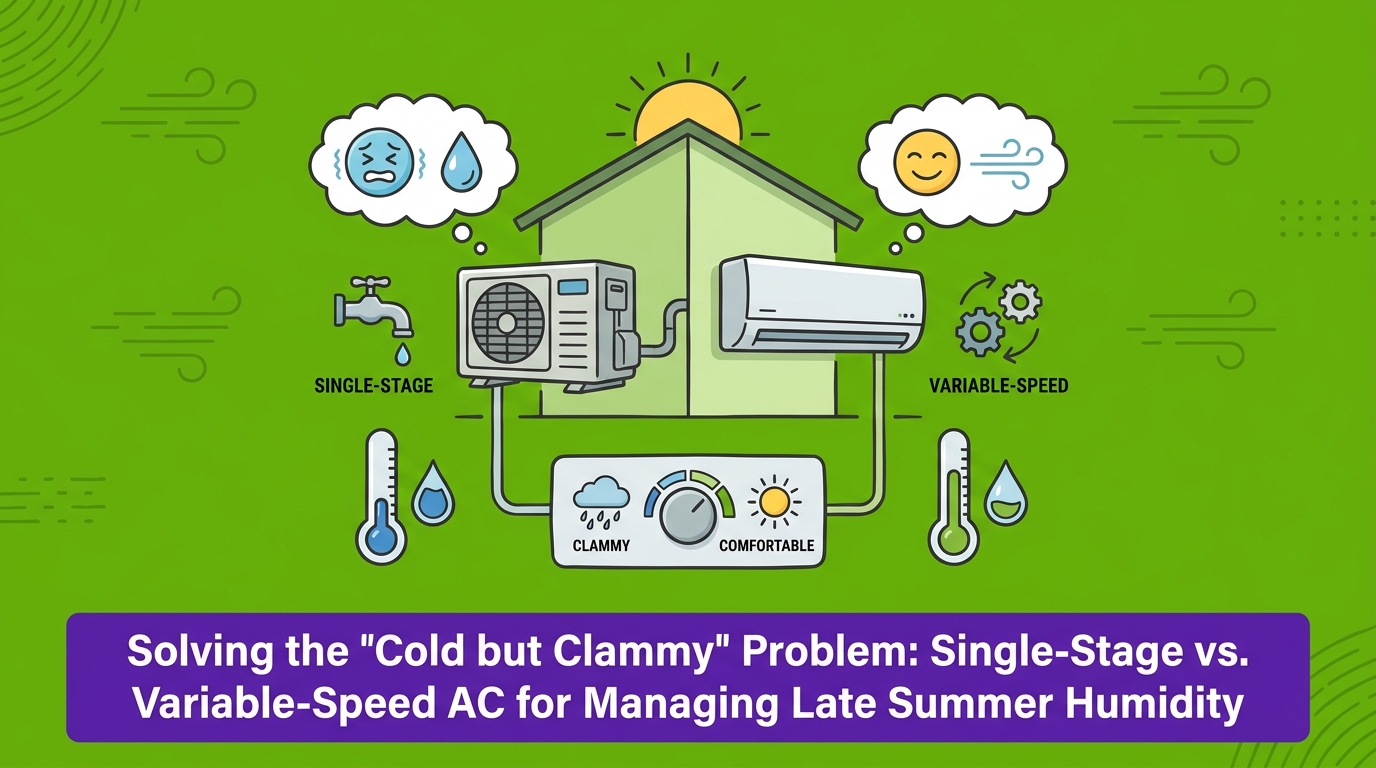
Why Your House Feels Cold but Clammy When the AC is Running
Are you constantly lowering your thermostat, yet your living room still feels like a damp basement? When evaluating a single-stage vs. variable-speed AC for managing late summer humidity, understanding why your house feels cold but clammy is the critical first step. Lowering the temperature on your thermostat does not automatically equal comfort if heavy moisture remains trapped in the air. Here at Plum HVAC, as families navigate the back-to-school transition and late August muggy air settles into the region, our team constantly hears from homeowners who find themselves shivering while still feeling sticky—a frustrating combination that makes it impossible to relax.
This uncomfortable sensation happens because your air conditioning system is dropping the air temperature without adequately extracting the lingering moisture. During these late-summer Indian Summers, the outdoor air often becomes stagnant, trapping humidity inside your home. The decision point usually comes down to whether you should upgrade to an advanced variable-speed compressor or replace an aging system with a standard single-stage model. Achieving true indoor comfort requires a system that handles both temperature and moisture simultaneously.
For expert help evaluating your home's cooling needs, explore our air conditioning services or schedule your AC installation in Mountain View today.
The Hidden Role of Your Air Conditioner: Sensible vs. Latent Heat
Most homeowners assume an air conditioner has only one job: blowing cold air into the house until the thermostat clicks off. However, a properly functioning cooling system actually performs two distinct jobs simultaneously. It lowers the temperature of the air, and it extracts suspended moisture. To understand why some systems leave you feeling sticky, you have to look at how they handle two different types of heat.
Sensible heat is the heat you can easily measure with a thermometer. When your thermostat drops from 78 degrees to 72 degrees, you are witnessing a reduction in sensible heat. Latent heat, on the other hand, is the heat energy trapped within the moisture in the air. You cannot measure latent heat with a standard thermometer, but your body absolutely feels it. High latent heat prevents your sweat from evaporating, which is why a 75-degree day in dry weather feels perfectly pleasant, while a 75-degree day with high humidity feels suffocating.
Here is how your system removes that latent heat:
• The cold coil effect: Inside your indoor unit sits an evaporator coil filled with cold refrigerant. As warm, moist indoor air blows across this coil, the moisture condenses on the cold metal—exactly like water beads forming on the outside of a cold glass of iced tea.
• The drainage process: Once enough condensation builds up on the coil, the water drips down into a condensate drain pan and is safely channeled outside your home.
• The time factor: This condensation process takes time. The air must flow over the cold coil long enough for the moisture to be wrung out continuously.
The core rule of dehumidification is that longer, slower cooling cycles extract significantly more moisture than short, powerful blasts of cold air. If your system cools the house too quickly and shuts off, the evaporator coil never has enough time to collect that moisture and drain it away. In areas like Mountain View CA, where unique microclimates can bring sudden shifts in humidity, our technicians have found that having a system that runs long enough to manage latent heat is the absolute key to maintaining a comfortable home.
How Single-Stage Compressors Handle Stagnant Heatwaves
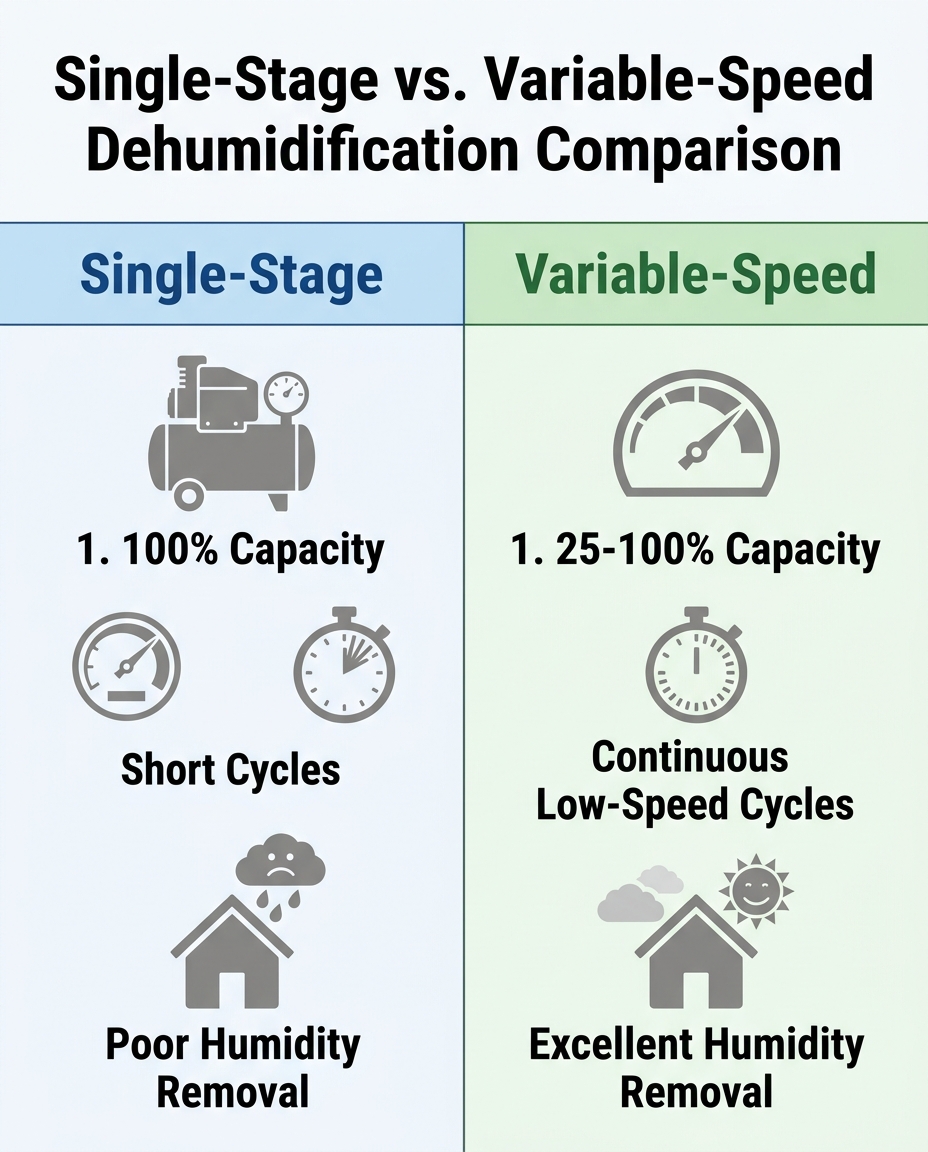
Traditional air conditioners rely on single-stage compressors. The term "single-stage" means the compressor operates at only one speed: 100% capacity. Whenever your thermostat calls for cooling, the system turns on at full blast, pumps maximum cold air into your home until the target temperature is reached, and then shuts off completely. There is no middle ground, no low gear, and no gradual adjustment.
While this aggressive cooling approach lowers the sensible heat very quickly, it is notoriously poor at managing latent heat. Because the system pushes so much cold air at once, it satisfies the thermostat reading rapidly. The system turns off before the moisture has a chance to condense and drain away.
Here is the step-by-step process of how a single-stage system struggles with humidity:
1. The initial blast: The thermostat detects rising temperatures and triggers the single-stage compressor to turn on at 100% power.
2. Rapid cooling: A massive volume of cold air floods the rooms, dropping the ambient temperature by several degrees in just 10 to 15 minutes.
3. Premature satisfaction: The thermostat registers the target temperature and shuts the entire system down.
4. Moisture abandonment: Because the cycle only lasted 15 minutes, the evaporator coil barely had time to collect condensation. The late August muggy air remains suspended in the rooms, leaving the environment feeling damp and chilly.
Keeping these traditional systems running at their best requires diligent upkeep, which is why staying on top of routine AC maintenance is so important. A dirty filter or a clogged drain line will only make a single-stage system's poor dehumidification even worse.
The Short-Cycling Dilemma
When our technicians are called out to troubleshoot end-of-season cooling issues, we frequently find that a single-stage unit is slightly oversized for a home—a very common issue that leads to a phenomenon known as short-cycling. The system blasts the house with cold air so rapidly that it shuts down in less than ten minutes. A few minutes later, the lingering humidity makes the house feel warm again, prompting the thermostat to kick the system back on at 100% capacity.
These frequent, rapid on-and-off cycles are terrible for your indoor comfort. They leave moisture suspended in the air, creating hot spots and cold pockets throughout the house. Furthermore, the constant starting and stopping puts immense strain on the compressor and electrical components, significantly increasing wear and tear while driving up your monthly energy consumption.
The Variable-Speed Advantage for Continuous Dehumidification
Variable-speed technology fundamentally changes how an air conditioner interacts with the air inside your home. Instead of operating purely on a basic on/off switch, a variable-speed compressor functions more like the accelerator pedal in a car. It can dial its cooling capacity up or down in precise increments, often running at just 25% to 30% of its total capacity to match the exact cooling load your home requires at any given moment.
Because the system can operate at such low capacities, it runs for much longer periods without overcooling the house. This continuous, slow circulation of air over the cold evaporator coil is the ultimate solution to indoor humidity. The system acts as a dedicated dehumidifier, constantly wringing moisture out of the air while maintaining a perfectly steady temperature.
This continuous circulation is especially effective at combating the specific stagnant air and marine layer shifts experienced locally. As part of Plum HVAC's Silicon Valley microclimate expertise, our team specifically sizes and calibrates these advanced systems to handle local weather patterns, ensuring your home stays dry regardless of what the coastal fog or late summer heat is doing outside. In our experience, a homeowner in Mountain View CA with a variable-speed system will often find they can set their thermostat to 74 or 75 degrees and feel significantly cooler than they would at 70 degrees with a single-stage unit, simply because the heavy moisture has been removed.
Continuous Low-Speed Operation
The benefits of continuous low-speed operation extend far beyond just moisture removal. By running constantly at a low hum, a variable-speed system completely eliminates the dramatic temperature swings and hot spots that plague single-stage setups.
Additionally, because the air is constantly moving through your return vents, it is continuously passing through your air filters. This provides non-stop air purification, capturing dust, dander, and allergens that would otherwise settle on your furniture during the long off-cycles of a traditional system. Finally, by avoiding the massive energy spikes associated with constantly starting a heavy compressor from a dead stop, variable-speed units operate with remarkable efficiency.
Head-to-Head: Single-Stage vs. Variable-Speed AC Systems
When comparing these two technologies side-by-side, the differences in performance, comfort, and moisture management become starkly clear. While traditional units have been the standard for decades, modern advanced compressors offer a completely different tier of climate control.
Understanding these differences helps you evaluate which system aligns with your goals for indoor comfort, especially when dealing with late August muggy air that refuses to budge. If you are also researching specific manufacturers during your upgrade process, reviewing the top residential HVAC brands can help you see how different companies implement these compressor technologies.
• Compressor Operation — Single-Stage AC: Runs strictly at 100% capacity (On/Off) — Variable-Speed AC: Adjusts capacity seamlessly (typically 25% to 100%)
• Humidity Removal — Single-Stage AC: Poor; cycles are too short to extract heavy moisture — Variable-Speed AC: Excellent; long, slow cycles continuously wring out water
• Cycle Length — Single-Stage AC: Short, powerful blasts (10-15 minutes) — Variable-Speed AC: Continuous, low-speed operation (often running all day)
• Temperature Consistency — Single-Stage AC: Noticeable swings; creates hot and cold spots — Variable-Speed AC: Precise; holds the target temperature within half a degree
• Noise Levels — Single-Stage AC: Loud start-ups; noticeable airflow noise — Variable-Speed AC: Ultra-quiet; operates at a low, barely noticeable hum
• Overall Comfort Impact — Single-Stage AC: Often results in a "cold but clammy" indoor environment — Variable-Speed AC: Creates a dry, crisp, and deeply comfortable environment

Which Compressor Technology is Right for Your Next Upgrade?
Choosing the right compressor technology requires looking at your specific home, your comfort frustrations, and how your current system is failing you. While variable-speed technology is vastly superior for comfort, there are specific scenarios where understanding the nuances of both options is helpful.
A single-stage unit might still be appropriate in extremely dry, arid climates where indoor humidity is virtually non-existent. In those rare environments, simply dropping the sensible temperature quickly is enough to achieve comfort. However, for most modern homes—especially those dealing with shifting microclimates—that basic approach falls short.
If your primary complaint every summer is that your house feels sticky, heavy, or clammy despite the AC running constantly, we strongly recommend variable-speed systems as the definitive solution. They treat the root cause of your discomfort rather than just masking it with cold air. Additionally, upgrading to a high-efficiency variable-speed unit may qualify you for generic federal tax credits or local utility incentive programs (we always advise verifying current programs with your utility provider or a tax professional). Making the transition does require careful planning, however. Here are the steps the Plum HVAC team takes to ensure your upgrade is successful:
1. Performing a load calculation: Our technicians measure your home's exact cooling requirements. Slapping a variable-speed unit onto a home without doing the math can hinder its ability to perform properly.
2. Evaluating the ductwork: Variable-speed systems rely on specific static pressure and airflow dynamics. We inspect your existing ductwork to ensure it can handle continuous, low-speed air delivery without losing pressure.
3. Assessing thermostat compatibility: These advanced systems require proprietary communicating thermostats that can send precise percentage requests to the compressor, rather than just a basic "on/off" signal.
If you are ready to evaluate your home's infrastructure and explore your options, scheduling a professional Palo Alto AC installation consultation will give you the exact specifications needed for your specific property in Mountain View CA.
Frequently Asked Questions About AC Humidity Control
Why does my AC make the house cold but clammy?
Your house feels cold but clammy because the air conditioner is lowering the temperature too quickly without running long enough to extract the moisture from the air. Traditional single-stage units blast cold air at 100% capacity, satisfying the thermostat and shutting off before the late August muggy air can condense on the indoor coil. This leaves the humidity suspended in your rooms, creating a damp, chilly sensation.
Does a variable speed AC remove more humidity?
Yes, variable-speed air conditioners remove significantly more humidity than standard models. Because they can ramp down their cooling capacity to run at lower speeds (often 25% to 30%), they operate for much longer cycles. This continuous airflow over the cold evaporator coil gives the system ample time to constantly wring moisture out of your indoor air.
Is a variable speed AC worth it in California?
A variable-speed AC is highly beneficial in California, especially in areas that experience distinct microclimates, marine layer shifts, or stagnant late-summer heatwaves. The continuous air circulation prevents hot spots in multi-level homes and provides superior dehumidification during muggy weather, resulting in much higher indoor comfort and better overall energy efficiency.
How do I reduce humidity with my air conditioner?
The best way to reduce humidity with your air conditioner is to ensure it runs in longer, slower cycles. You can help facilitate this by keeping your fan setting on "auto" rather than "on," which allows condensed moisture to drain rather than being blown back into the house. Ensure your filter is clean to maintain proper airflow, and if your system is severely oversized, consider upgrading to a variable-speed unit designed specifically for moisture control.
Can a single-stage AC be modified to dehumidify better?
While you cannot physically turn a single-stage compressor into a variable-speed one, you can make minor adjustments to improve its moisture removal. Lowering the blower motor speed slightly can give the air more time to cool and condense over the coil, though a professional must do this to prevent the coil from freezing. Ultimately, a single-stage unit will always be limited by its fundamental on/off design.
Restore Your Indoor Comfort This Summer
Achieving true comfort in your home requires a system that effectively manages both the temperature and the heavy moisture in the air. If you are tired of shivering in a damp, sticky living room, upgrading to a system that actively dehumidifies is the most reliable way to transform your indoor environment.
You don't have to settle for the cold but clammy feeling. Reach out to our team at Plum HVAC to evaluate your home's unique cooling load, assess your ductwork, and discuss the best replacement options for your specific needs in Mountain View CA. A properly sized, modern system will ensure you enjoy a dry, crisp, and perfectly comfortable home throughout the rest of the back-to-school season and beyond.
hear what our satisfied clients have to say

.svg)
Service areas
.avif)