
The Specific Challenges of Retrofitting HVAC in Eichler Homes Around Palo Alto
The Late-Summer Cooling Crisis in Mid-Century Modern Homes
Your floor-to-ceiling windows are stunning, but when the late-summer August heat hits, that same glass turns your living room into a greenhouse. The specific challenges of retrofitting HVAC in Eichler homes around Palo Alto often leave homeowners sweating through the end of the season, especially as the kids head back to school and the sweltering weather refuses to break. At Plum HVAC, we regularly hear from homeowners frustrated by contractors who take one look at the flat roof and concrete slab before declaring that a modern cooling system is impossible to install. With intense afternoon sun beating down on expansive, unshaded glass, the interior temperature of these iconic mid-century properties can quickly surpass the temperature outside, creating an uncomfortable and inescapable heat box.
To solve this, you need air conditioning solutions that balance robust cooling power with strict architectural preservation. The core decision point for Eichler owners is selecting specialized retrofit methods that deliver modern comfort without destroying the open, airy aesthetic that makes these homes so desirable. The right non-traditional cooling technologies can integrate seamlessly into these unique properties, provided you work with professionals who have first-hand experience navigating the structural realities involved.
Structural Hurdles: Flat Roofs, Concrete Slabs, and Radiant Heating
The very features that define mid-century modern architecture are the exact elements that make standard central air conditioning installations nearly impossible. In traditional construction, bulky sheet metal ductwork is hidden out of sight in spacious attics or expansive crawlspaces. In our years of servicing Mountain View and Palo Alto Eichler tracts, our team has seen firsthand that those spaces simply do not exist. The iconic flat roofs and post-and-beam construction leave zero overhead clearance for standard air distribution systems.
The concrete slab dilemma: Furthermore, Eichler homes are built directly on concrete slab foundations. This prevents any under-floor routing for ducts or refrigerant lines. Compounding the issue, these slabs often house the original, fragile radiant heating pipes. Our technicians know that drilling into the floor blindly to route new HVAC components risks puncturing a water line, leading to catastrophic leaks and the loss of your primary winter heating source.
Standard workarounds proposed by general contractors—such as installing drop-ceilings, building bulky interior drywall soffits, or framing out false walls—are completely unacceptable for mid-century modern preservation. These intrusive modifications destroy the clean lines, exposed beams, and open, airy feel that define the property. Because traditional central air is off the table, homeowners must look to non-traditional, low-profile cooling technologies designed specifically for structurally constrained environments.
• Ductwork Routing — Traditional Home Reality: Hidden in attic or crawlspace — Eichler Home Constraint: No attic; exposed tongue-and-groove ceilings
• Floor Penetrations — Traditional Home Reality: Simple cuts through wood subfloors — Eichler Home Constraint: Solid concrete slab with embedded radiant heat
• Equipment Placement — Traditional Home Reality: Large air handler in attic/basement — Eichler Home Constraint: No interior utility space; requires low-profile units
Navigating Palo Alto Municipal Codes and Property Line Noise Limits
Cooling an Eichler isn't just a physical and structural challenge; it is a complex regulatory hurdle. The lots in Palo Alto Eichler tracts are notoriously tight, with homes built very close to the property lines. When you add an exterior air conditioning condenser to a tight side yard, the noise it generates becomes a significant legal concern.
The city of Palo Alto dictates strict, specific decibel limits at the property line to prevent noise pollution in dense residential neighborhoods. If you install a standard, builder-grade AC condenser too close to your neighbor's fence, the operating noise will likely violate these municipal ordinances. The penalties for non-compliance can be severe, ranging from hefty fines to forced relocation of the equipment, which can disrupt your landscaping and require costly electrical and refrigerant line rerouting.
The compliance strategy: As your local Silicon Valley architectural HVAC specialists, the Plum HVAC team understands that selecting ultra-quiet equipment is not a luxury—it is a legal necessity. Modern inverter-driven compressors operate at a fraction of the decibel level of traditional single-stage units, keeping your neighbors happy and your installation fully compliant. Navigating these requirements demands a contractor who deeply understands local HVAC permits and building codes, ensuring that your system is legally sound before the first piece of equipment is ever ordered.
Solution 1: Zoned Comfort with Ductless Mini-Split Systems
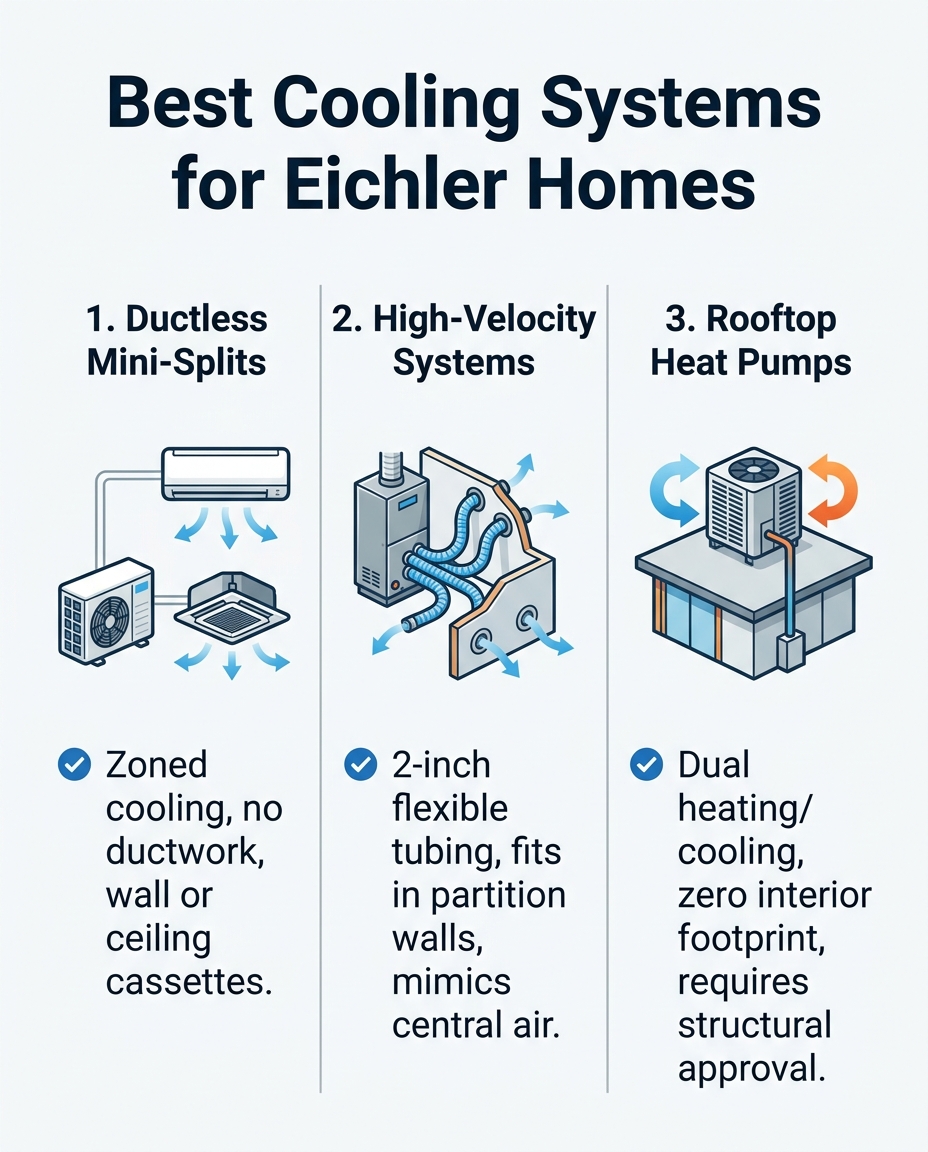
When traditional ductwork is structurally impossible, the most straightforward and highly effective solution our team recommends is bypassing ducts entirely. Zoned comfort systems utilize advanced heat pump technology to deliver cool air directly into specific rooms. Because they require no internal ducting, they are a premier choice for mid-century modern retrofits.
These systems consist of a quiet outdoor compressor connected to one or more indoor air handlers via a small bundle of refrigerant lines and electrical cables. This configuration requires only a three-inch hole through an exterior wall, completely preserving the integrity of your flat roof and concrete slab. We frequently install ductless mini-split systems to combat the late-summer August heat, as they provide rapid, highly efficient cooling right where you need it.
Placement options for indoor units:
• High-wall mounts: The most common option, installed high on an exterior wall to distribute air evenly across the room.
• Floor-mounted consoles: Ideal for rooms with extensive glass where high wall space is limited, sitting low to the ground like a traditional radiator.
• Ceiling cassettes: In the rare instances where a small utility closet or dropped hallway ceiling exists, these units sit flush with the ceiling for near-invisibility.
To address aesthetic concerns, the exterior linesets connecting the units can be hidden within custom architectural conduit. When painted to perfectly match the home's exterior siding, these conduits blend into the background, ensuring the technology does not detract from the mid-century curb appeal.
Solution 2: Preserving Clean Lines with High-Velocity HVAC
A pattern we see often when consulting with Mountain View and Palo Alto homeowners is a strong desire for the invisible feel of central air without the bulky sheet metal. For these clients, high-velocity systems offer a brilliant compromise. Instead of large, rigid metal ducts, high-velocity HVAC uses flexible, small-diameter tubing—often just two inches wide—to distribute conditioned air throughout the home.
This narrow tubing is incredibly pliable and can be carefully snaked through existing interior partition walls, inside customized slim chases, or through the back of built-in cabinetry. Because the tubes are so small, they can be routed without lowering the main ceiling or destroying the exposed post-and-beam architecture. The air is delivered into the living space through small, unobtrusive round vents that can be painted or finished in wood grain to blend seamlessly into the mid-century modern aesthetic.
The aspiration principle: High-velocity systems cool differently than traditional AC. Instead of dumping cold air into a room and waiting for it to slowly mix, the two-inch vents deliver air at a very high speed, creating an "aspiration" effect. This rapid air delivery creates gentle, draft-free circulation that mixes the room's air instantly. When sudden afternoon heat spikes hit your unshaded floor-to-ceiling windows, high-velocity systems pull the temperature down rapidly, making them an exceptional choice for managing extreme solar heat gain.
Solution 3: Utilizing Rooftop Heat Pump Technology
When our team evaluates Eichler homes, we sometimes find the best place to hide the HVAC equipment is completely out of sight on top of the home itself. Modern, low-profile heat pumps can sometimes be mounted directly onto flat roofs, provided the structural load requirements are carefully met and verified by an engineer.
Placing the equipment on the roof solves several major problems at once. First, it keeps the machinery entirely away from tight property lines, drastically simplifying compliance with municipal noise ordinances. Second, it frees up valuable side-yard space for landscaping, patios, or pathways. Utilizing heat pump technology in this manner provides a dual benefit: robust summer cooling to combat the greenhouse effect, and highly efficient winter heating to supplement or replace aging radiant floor systems.
Critical considerations for rooftop installations:
• Structural load bearing: Eichler roofs were not originally designed to hold heavy machinery; the framing must be evaluated and potentially reinforced.
• Vibration isolation: A flat roof can act like a giant drum. Heavy-duty vibration dampening pads are required so the hum of the compressor does not resonate through the ceiling beams.
• Weatherproofing: All roof penetrations for electrical and refrigerant lines must be meticulously flashed and sealed to prevent water intrusion during winter rains.
Upgrading to modern, high-efficiency heat pump systems often qualifies homeowners for various energy efficiency incentives and utility programs. While specific programs fluctuate, federal tax credits may apply to qualifying heat pump installations. It is always advisable to verify current programs with your utility provider or a tax professional to see how upgrading your home's energy profile can offset the initial investment.

The Art of the Install: Protecting the Exposed Beam Aesthetic
For us at Plum HVAC, surviving the heat should never mean sacrificing the home's iconic architectural beauty. The true challenge of retrofitting Palo Alto Eichler tracts is not just making the home cold—it is making the installation invisible. The art of the install lies in meticulous planning and creative routing strategies that protect the exposed tongue-and-groove ceilings at all costs.
When routing electrical and refrigerant lines, our architectural HVAC specialists look for non-load-bearing partition walls, exterior chases, and hidden utility voids rather than taking the easiest, most destructive path. We know that piercing an original ceiling beam is an irreversible error. Every wire, tube, and pipe must be strategically placed to respect the original vision of the home's designer.
Camouflage and integration: Beyond the interior, the exterior components must also be treated with respect. Custom-painted exterior covers are used to hide linesets, matching the exact hue of the exterior siding. Strategic landscaping, such as planting dense, acoustic-dampening shrubs, can be utilized to camouflage outdoor condenser units and further absorb operating sound. A successful retrofit requires a contractor who respects mid-century design as much as the homeowner does, treating the house not just as a job site, but as a piece of architectural history.
Frequently Asked Questions About Eichler Cooling Retrofits
Can you put central air in an Eichler home?
Traditional central air with large sheet metal ducts is generally not feasible due to the lack of an attic or crawlspace. Because the homes sit on concrete slabs and feature flat, exposed-beam ceilings, there is nowhere to hide standard ductwork. Alternative "central" feeling systems, like high-velocity HVAC, can be installed using small-diameter tubing routed carefully through interior partition walls.
How do you cool a house with a flat roof and no attic?
The methods our team most frequently recommends are ductless mini-splits, which bypass the need for ductwork entirely, or low-profile rooftop units if the roof structure permits the weight. In Palo Alto Eichler tracts, these non-traditional systems provide powerful cooling without requiring ceiling modifications. Additionally, proper insulation and solar-reflective window treatments help reduce the overall cooling load caused by expansive glass.
Are ductless mini-splits good for mid-century modern homes?
Yes, they are highly recommended because they require no ductwork and offer precise zoned cooling. This allows you to cool only the rooms you are actively using, which is highly efficient. Indoor units can be discreetly mounted on walls, low to the floor, or flush with small dropped ceilings, preserving the home's clean lines and architectural integrity.
Where do you put the exterior HVAC condenser on a tight lot?
Condensers must be strategically placed to comply with local noise ordinances, which are notoriously strict in dense neighborhoods. Options include narrow side yards utilizing acoustic shielding to prevent noise bleed, or, in some cases, structurally reinforced flat roofs. Working with a contractor who understands local property line codes is critical to avoid fines.
Will adding AC ruin my exposed beam ceilings?
Not if the system is installed by an architectural HVAC specialist. A professional will ensure that linesets are routed externally or strictly through interior non-load-bearing walls. By using custom-painted exterior conduits and careful planning, the iconic tongue-and-groove ceilings remain completely untouched and preserved.
Schedule an Inspection for Your Mid-Century Home
You do not have to suffer through the late-summer August heat just because your home lacks an attic. At Plum HVAC, we provide a clear, expert breakdown of viable cooling options for your specific property, tailored to respect its unique structural constraints. Before the extreme temperatures peak and your living room becomes unlivable, talk to a local expert who understands mid-century architecture.
Protect your home's aesthetic while upgrading its comfort. Contact us today to book a consultation for air conditioning installation in Palo Alto and discover the perfect retrofit solution for your Eichler home.
hear what our satisfied clients have to say

.svg)
Service areas
.avif)