

Why Stanford Faculty Housing Requires Specific HVAC Noise Level Considerations
The Late-Summer Cooling Dilemma in University Housing
If your aging air conditioner is struggling during the late-summer heat, understanding exactly Why Stanford Faculty Housing Requires Specific HVAC Noise Level Considerations is the critical first step before you even think about a replacement. As August peaks and the back-to-school transition begins, replacing an outdoor condensing unit isn't just about picking a new system off the shelf. In highly regulated neighborhoods, you have to find a way to upgrade your cooling without violating strict university housing and HOA decibel (dB) limits. Choosing an HVAC system and outdoor placement strategy that satisfies stringent local noise regulations while providing adequate cooling is a critical decision point. You need a system that keeps your home comfortable without triggering a noise complaint from the architectural review board.
If you need help navigating these regulations, explore our AC installation in Stanford to ensure your next system meets every local requirement.
At Plum HVAC, our team knows that the South Bay Area experiences uniquely warm late summers that demand high-capacity, reliable cooling. Just as the academic year kicks into gear, the local micro-climate often delivers its most intense heatwaves. This creates a stressful urgency for homeowners whose systems fail in August or September. You need a replacement immediately, but the architectural review board requires a comprehensive noise compliance plan before you can pull a permit or schedule an installation. Rushing into a purchase without verifying the outdoor condensing unit decibel (dB) ratings will almost certainly lead to a rejected application or, worse, a costly mandate to remove a newly installed system.
Understanding property line acoustics and local municipal codes is the foundation of a successful installation in these neighborhoods. The challenge is not just finding a unit that cools your home efficiently; the challenge is finding one that operates quietly enough to pass a rigorous post-installation audit. Navigating this intersection of urgent cooling needs and strict architectural guidelines requires careful planning and a deep understanding of modern HVAC technology.
How Dense Architectural Layouts Amplify Sound
In our years of serving the Mountain View area, we have seen firsthand how the physical layout of these neighborhoods dictates HOA noise rules. In developments like Stanford Faculty Housing, homes are intentionally built close together to maximize land use in a highly desirable area. This dense architectural layout creates unique acoustic challenges for the entire Stanford HVAC service area. When houses sit mere feet apart, the space between them acts as an acoustic corridor, trapping and amplifying mechanical noise.
Sound waves behave much like water ripples. When an air conditioner turns on, the noise travels outward until it hits a barrier. In a dense residential layout, those sound waves immediately strike hard surfaces: stucco exterior walls, concrete pathways, wooden property fences, and paved driveways. Instead of dissipating into open air, the sound bounces back and forth between these hard surfaces. This reverberation amplifies the perceived volume of the equipment, turning a moderate hum into a disruptive drone that easily penetrates a neighbor's bedroom window.
Because of this acoustic amplification, a standard off-the-shelf air conditioner that easily passes basic state energy efficiency codes will often fail a localized noise audit. The manufacturer's baseline rating might seem acceptable on paper, but once the unit is placed in a narrow side yard surrounded by reflective surfaces, the actual noise level at the property line spikes dramatically. Property line acoustics are the primary trigger for strict HOA enforcement, meaning the measurement that matters most is not right next to the unit, but exactly where your property meets your neighbor's.
The Zero-Lot Line Challenge
Many homes in these dense developments utilize zero-lot line architecture. This means the structure of the home is built directly on, or very close to, the edge of the property boundary. While this maximizes usable yard space on one side of the house, it leaves virtually no buffer zone on the other.
Key impacts of zero-lot line placement:
• Minimal physical distance: The inverse square law of sound dictates that noise drops significantly as distance increases. With zero-lot lines, you lose that natural distance buffer entirely.
• Immediate neighbor impact: An outdoor unit placed on a zero-lot line might sit less than five feet from a neighbor's living space, making acoustic impact unavoidable without specialized equipment.
• Restricted airflow: Narrow side yards not only trap sound but can also restrict the airflow necessary for the unit to run efficiently, forcing the compressor to work harder and louder.
Decoding Decibel (dB) Ratings and Municipal Noise Codes
To successfully pass an architectural review, you need to understand exactly how sound is measured and regulated. Sound intensity is measured in decibels (dB). However, because human ears do not hear all frequencies equally, regulatory bodies use A-weighted decibels (dBA). The dBA scale adjusts the raw sound measurement to reflect how the human ear actually perceives the noise, penalizing the harsh, grinding frequencies that are most annoying to neighbors. When you look at outdoor condensing unit decibel (dB) ratings, you are almost always looking at a dBA measurement.
Typical municipal noise ordinances in the region might allow for 60 to 65 dBA at the property line during daytime hours. However, strict HOA guidelines and university housing authorities frequently impose much tighter restrictions. It is common for these localized rules to restrict continuous equipment noise to 50 or 55 dBA at the property line, especially during nighttime hours. To put that into perspective, 50 dBA is roughly the volume of a quiet conversation or a running refrigerator, while 70 dBA is closer to the noise of a vacuum cleaner or a busy street.
This creates a massive compliance hurdle because standard, single-stage air conditioning units frequently operate between 70 and 75 dBA. If you install a traditional unit in a narrow side yard, it will easily violate dense housing noise ordinances. When the architectural review board conducts an audit, they use calibrated decibel meters positioned exactly at the property boundary. If the meter registers above the allowed limit while the compressor is running, the installation fails the audit.
Understanding these metrics is vital for navigating local HVAC permits and building codes. The table below illustrates the stark difference between standard equipment and the requirements of strict residential zones.
• Standard Single-Stage AC Unit — Typical Sound Level (dBA): 70 - 75 dBA — HOA Compliance Likelihood: Highly likely to fail audit
• Two-Stage AC Unit — Typical Sound Level (dBA): 65 - 70 dBA — HOA Compliance Likelihood: Borderline, often requires barriers
• Strict HOA Property Line Limit — Typical Sound Level (dBA): 50 - 60 dBA — HOA Compliance Likelihood: The regulatory target
• Variable-Speed / Inverter Heat Pump — Typical Sound Level (dBA): 54 - 56 dBA — HOA Compliance Likelihood: Highly likely to pass audit
Technological Solutions for Ultra-Quiet Cooling
Meeting strict decibel requirements without sacrificing indoor comfort requires a shift away from traditional machinery. Modern HVAC technology serves as the definitive solution for highly regulated neighborhoods. If you are upgrading your air conditioning systems, our Plum HVAC technicians strongly recommend inverter-driven heat pumps and variable-speed AC compressors as essential compliance tools. Additionally, federal tax credits may apply to qualifying heat pump installations, so we advise our clients to consult with a tax professional to verify current applicable programs.
Traditional air conditioners operate on a single-stage system, meaning they are either 100% on or 100% off. When the thermostat calls for cooling, a mechanical contactor snaps shut, and the compressor kicks on with a loud, aggressive surge of power. This harsh start-up noise is often what triggers neighbor complaints. Variable-speed technology, powered by an inverter drive, operates entirely differently. Instead of blasting on at full capacity, an inverter slowly ramps up the compressor speed, similar to gently accelerating a car. This eliminates the loud "clunk" and electrical surge associated with older units.
Because variable-speed systems can adjust their output in tiny increments (often down to 25% or 30% of their total capacity), they run at lower speeds for longer periods. Running at a lower capacity drastically reduces the operational noise. Top-tier variable-speed units can operate at sound levels as low as 54 to 56 dBA, placing them well within strict HOA limits even before any external sound dampening is applied.
These advanced systems are particularly effective at handling the South Bay micro-climate. During late-summer heatwaves, variable-speed units run continuously at a low, whisper-quiet hum, providing superior humidity control and consistent temperatures without the loud, disruptive cycling of older equipment.
Inverter vs. Single-Stage Compressors
The mechanical differences between these two technologies dictate their acoustic footprint:
• Start-up sound: Single-stage units draw massive amperage instantly, creating a loud mechanical jolt. Inverter units use a soft-start mechanism that slowly builds power, keeping start-up noise virtually undetectable.
• Running volume: Single-stage units always run at their loudest maximum capacity. Inverter units spend most of the day cruising at a low, quiet speed to maintain the temperature.
• Regulatory approval: Because of these distinct acoustic profiles, inverter technology is often the only equipment type approved in highly regulated residential zones like Stanford Faculty Housing.
Strategic Placement and Acoustic Sound Dampening
Selecting a unit with excellent outdoor condensing unit decibel (dB) ratings is only the first half of the compliance equation. Even the quietest variable-speed equipment requires strategic placement and professional installation techniques to ensure it passes a rigorous noise audit. How and where the unit is installed plays a massive role in the final decibel reading at the property line.
A poorly placed unit can easily echo off exterior walls or point directly at a neighbor's bedroom window, turning a quiet machine into a nuisance. Furthermore, we regularly remind our customers that equipment naturally becomes louder over time if neglected. Loose panels vibrate, fan blades accumulate debris, and unlubricated motors grind. Staying compliant requires both an initial acoustic strategy and ongoing routine AC maintenance to prevent delayed noise complaints years after installation.
To guarantee compliance, our Plum HVAC installers utilize a multi-layered acoustic dampening strategy:
1. Strategic Location Planning: Installers analyze the yard to find the optimal placement. This often involves rotating the unit so the fan exhaust points away from property lines, or shifting the concrete pad a few feet to break the line of sight to a neighbor's window.
2. Vibration Isolation Pads: When a compressor runs, it sends vibrations down through the base pan. If the unit sits directly on a concrete slab, that slab acts like a drum, transmitting a low-frequency hum through the ground. Heavy-duty rubber vibration isolation pads are placed under the unit's feet to absorb this kinetic energy before it reaches the concrete.
3. Compressor Sound Blankets: For units that need an extra layer of suppression, technicians wrap the internal compressor in a specialized sound blanket. These heavy, mass-loaded vinyl and fiberglass wraps absorb the high-frequency mechanical whining of the motor without restricting the necessary airflow through the outer condenser coils.
4. Acoustic Barrier Walls: In extreme zero-lot line situations, the HOA may require or approve a small acoustic fence. Unlike standard wooden fences that reflect sound, these barriers are built with sound-absorbing materials designed to catch and dissipate the noise before it crosses the property line.
Navigating the Architectural Review and Approval Process
Gaining HOA and university housing approval is a formal, heavily documented process. You cannot simply buy a unit and install it the next day. The architectural review board exists to protect the acoustic peace of the neighborhood, and they require substantial proof that your proposed project will not disturb your neighbors.
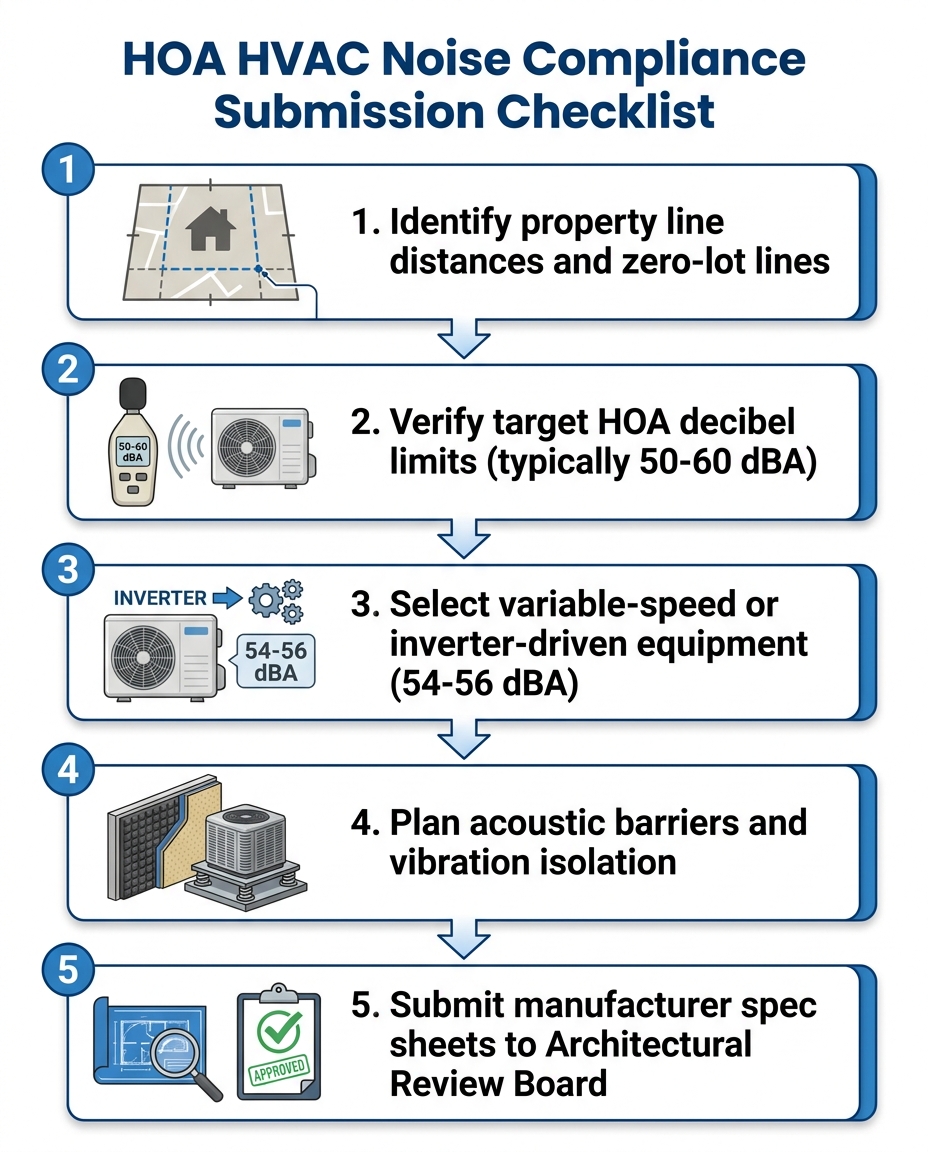
The submission process typically requires a comprehensive packet of information. You will need to provide the manufacturer's exact specification sheets highlighting the outdoor condensing unit decibel (dB) ratings. You must also submit a detailed site plan showing the exact distance from the proposed unit location to all adjacent property lines and neighboring structures. If your chosen unit's baseline rating is close to the limit, the board will likely require a written explanation of the acoustic dampening measures (like vibration pads or sound blankets) you plan to implement.
Because this process takes time, homeowners are strongly advised to start early. If your system is showing signs of failure in July, do not wait until the August back-to-school transition to begin the paperwork. The review board may take weeks to process your application, leaving you without cooling during the hottest part of the year. Partnering with professionals who understand the specific documentation and procedural nuances required by local housing authorities is invaluable. Working with Plum HVAC means benefiting from our deep experience navigating strict local building codes, university housing guidelines, and HOA noise ordinances in the Silicon Valley area to ensure a smooth, rejection-free approval process.
Checklist for HOA Compliance Submissions
Before submitting your application, ensure you have gathered:
• Manufacturer decibel (dBA) specification sheets: Official documentation proving the unit's sound rating under standard operating conditions.
• Exact property line mapping: A scale drawing showing the exact distance between the HVAC pad and the zero-lot line or neighboring fences.
• Acoustic mitigation plans: Written documentation detailing proposed vibration isolation pads, compressor blankets, or external acoustic barriers.
• Contractor license and insurance details: Proof that the installation will be performed by certified professionals familiar with local codes.

Frequently Asked Questions About Residential HVAC Noise Limits
What is the acceptable decibel level for an AC unit in an HOA?
The acceptable level is typically between 50 and 60 dBA measured at the property line, though specific rules vary by neighborhood. Strict communities, such as Stanford Faculty Housing, often enforce the lower end of that spectrum to maintain a quiet environment. It is crucial to check your specific HOA bylaws before selecting a new unit, as exceeding this limit will result in a failed architectural audit.
How do you pass an HOA noise audit for a new HVAC installation?
You pass an audit by combining ultra-quiet equipment with strategic installation techniques. Start by selecting an inverter-driven unit with low outdoor condensing unit decibel (dB) ratings (around 54-56 dBA). Then, ensure your installer uses vibration isolation pads, positions the unit away from reflective walls, and submits accurate site plans to the architectural review board prior to installation.
What is the standard noise limit for AC units in residential areas?
Most standard municipal noise ordinances cap residential continuous noise at 60 to 65 dBA during the day and lower it to 50 to 55 dBA at night. However, localized HOA rules frequently supersede municipal codes by enforcing stricter nighttime limits around the clock. Always design your installation to meet the strictest applicable local regulation.
How do I make my outside AC unit quieter to comply with local codes?
You can reduce operational noise by adding heavy-duty rubber vibration isolation pads under the unit's feet to stop ground-level humming. Additionally, a professional can install a specialized fiberglass and mass-loaded vinyl sound blanket directly over the internal compressor. Finally, keeping up with regular maintenance ensures fan motors and panels do not rattle or grind as they age.
Can an HOA force you to move your AC unit if it violates noise ordinances?
Yes, an HOA or architectural review board has the legal authority to force you to relocate or completely remove a non-compliant HVAC unit. If a post-installation audit reveals the unit exceeds the permitted property line decibel limit, the homeowner is responsible for all costs associated with mitigating the noise or moving the equipment. Proactive compliance is the only way to avoid these severe financial penalties.
Why do variable-speed compressors have lower decibel ratings than single-stage units?
Variable-speed compressors use inverter technology to slowly ramp up their cooling capacity, eliminating the loud, mechanical start-up jolt of a traditional single-stage unit. Because they can operate at a fraction of their total capacity (often as low as 30%), they spend most of the day running at a very low, quiet speed. This continuous, low-capacity operation produces significantly less noise than a unit constantly turning on and off at 100% power.
Ensure Your Next Installation Meets Every Local Requirement
Satisfying strict local noise regulations requires a careful balance of the right low-decibel equipment and expert installation strategy. You cannot afford to guess when it comes to property line acoustics. Ensuring your system operates quietly enough to pass an audit is the only way to protect your investment and maintain peace with your neighbors.
Proper planning ensures you stay cool during the August back-to-school transition without violating community codes. Do not wait until your system completely fails in the late-summer heat to start the lengthy architectural review process. Consult with our local Mountain View experts at Plum HVAC who understand the specific requirements of university and HOA housing to evaluate your yard's unique layout.
By taking a proactive approach, you gain a clear understanding of why these specific decibel ratings are enforced, how to select a fully compliant condensing unit, and how proper installation ensures HOA approval without sacrificing your indoor comfort.
hear what our satisfied clients have to say

.svg)
Service areas
.avif)