

Best HVAC Manufacturer Warranties: Reading the Fine Print on Labor Coverage
The 10-Year Guarantee Myth: What Happens When Your System Fails?
In our years of serving Mountain View homeowners, our team at Plum HVAC typically sees a common myth in the heating and cooling industry: that searching for the best HVAC manufacturer warranties: reading the fine print on labor coverage is unnecessary once you see a "10-year guarantee" stamped on the equipment box. Most homeowners assume this coverage means a full decade of zero out-of-pocket repair costs. In reality, a standard manufacturer agreement only covers the physical replacement part, leaving you fully exposed to the extensive labor required to diagnose the issue, safely handle materials, and install the new component. Discovering this reality during a late-summer August cooling season breakdown—just as families are managing the busy back-to-school transition and technicians are stretched thin—can be a harsh awakening. Evaluating different HVAC brands and extended warranty contracts to determine which actually cover the labor required to replace a faulty part is a critical decision point before committing to a new installation.
If you are evaluating new air conditioning systems or planning an AC installation in Mountain View, understanding these distinctions is the only way to protect yourself from unexpected expenses.
Parts vs. Labor: Understanding the Two Halves of HVAC Protection
When our technicians are dispatched to an air conditioning or heating system failure, we always explain that the repair process involves two distinct halves: the physical replacement part and the professional labor required to install it. Standard 10-year limited parts warranties are designed strictly for the former. If a blower motor or compressor fails due to a factory defect, the manufacturer will provide a replacement component to the local dealer. However, they do not pay the local technician for the hours spent driving to your home, diagnosing the failure, removing the broken part, and installing the new one.
This distinction is critical because labor often forms the bulk of the expense during a major repair. Modern heating and cooling equipment is highly complex, requiring specialized tools, electrical testing, and calibration. When you are comparing top residential HVAC brands, you will find that almost all of them follow this exact model. The factory supplies the hardware, but the homeowner is responsible for the human expertise required to make that hardware function.
The 60-Day Registration Trap
Another crucial detail hidden in the fine print is the registration requirement. While manufacturers proudly advertise 10-year parts coverage, that term is almost always conditional. If the equipment is not registered with the manufacturer within 60 days of installation, the warranty typically defaults to a basic 5-year term. This applies strictly to the parts. Even if you register the system perfectly on day one, you will still face warranty fine print exclusions on refrigerant recovery, disposal fees, and diagnostic time unless you have secured a separate extended labor agreement.
Uncovering the Hidden Costs in Standard Manufacturer Agreements
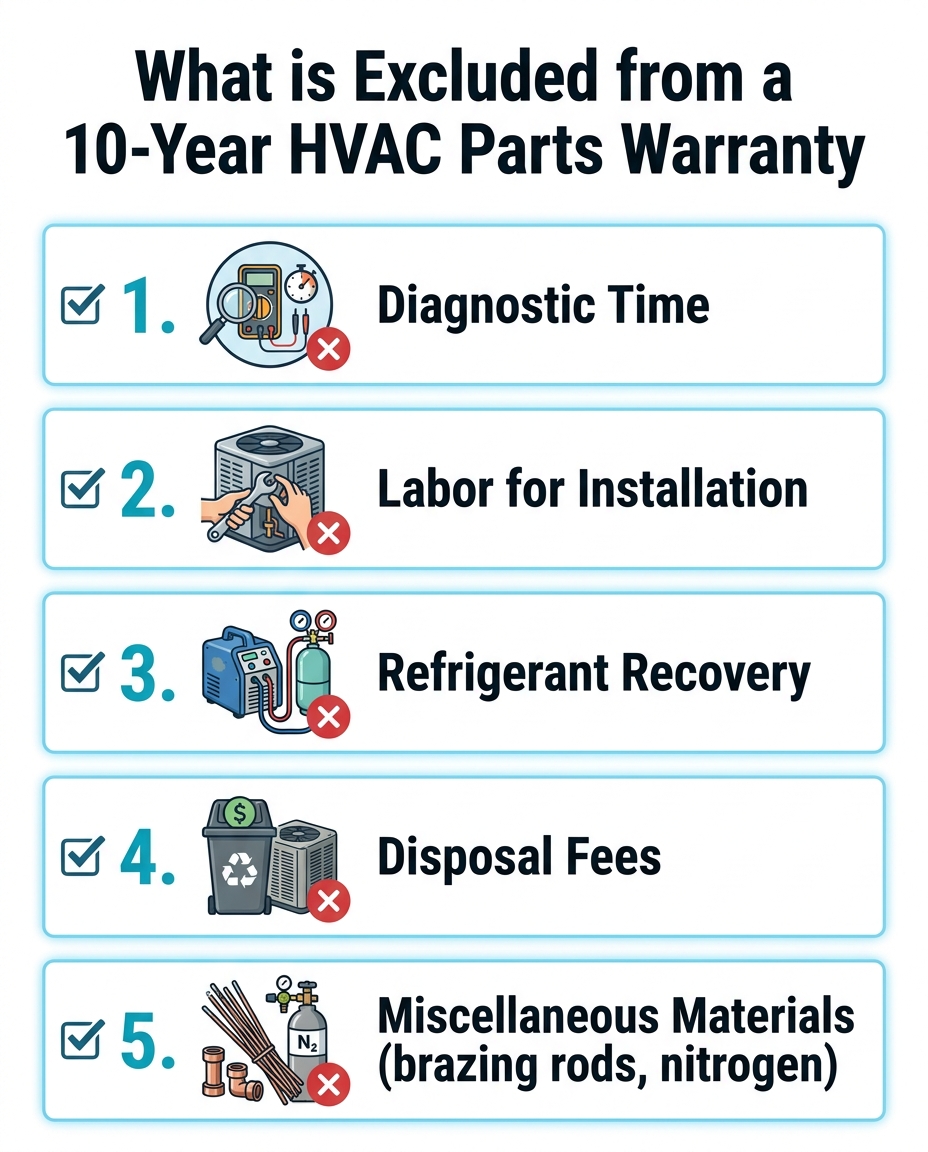
To truly understand your financial exposure during an equipment failure, you have to look closely at what the factory explicitly refuses to cover. In our experience working across the Silicon Valley area, our team has seen how exceptionally high hourly labor rates and operational overhead make these unbillable exclusions a massive financial liability compared to lower-cost regions. If you rely solely on a standard parts warranty, you will be responsible for several distinct charges.
• Diagnostic fees: Manufacturers do not pay a technician to figure out what is wrong with the system. The time spent testing capacitors, checking electrical loads, and identifying the root cause of the failure is billed directly to the homeowner.
• Refrigerant recovery: If a compressor or evaporator coil fails, the existing refrigerant must be safely removed before the repair can begin. The labor time and equipment wear-and-tear for this process are never covered by a basic parts warranty.
• Disposal fees: Broken compressors and coils cannot simply be thrown in a residential trash bin. The cost to legally and safely transport, recycle, or discard the defective heavy components is passed to the consumer.
• Miscellaneous materials: Installing a warranty part often requires supplementary supplies. Items like brazing rods, nitrogen for pressure testing, specialized fittings, and new filter driers are rarely covered, even though the primary replacement part is free.
These exclusions highlight why warranty fine print exclusions on refrigerant recovery, disposal fees, and diagnostic time consistently catch homeowners off guard. Without a comprehensive labor plan, a "free" warranty part can still result in a substantial service invoice.

The Impact of EPA Regulations on Warranty Claims
As licensed professionals, we regularly remind homeowners that much of the labor cost associated with major HVAC repairs is not arbitrary; it is mandated by federal environmental law. Under EPA Section 608 guidelines, technicians must follow strict protocols for the safe handling of chemical refrigerants. When a major component like a compressor or an evaporator coil fails, the system is essentially sealed with refrigerant inside. A technician cannot simply unbolt the broken part and swap in the new one.
Instead, they must connect specialized recovery machines, carefully extract the refrigerant into approved cylinders, and weigh it to ensure nothing vents into the atmosphere. Once the new part is brazed into place, the system must be pressure-tested with nitrogen, vacuum-pumped to remove all moisture, and finally recharged. These federally mandated steps add hours to the repair bill.
Manufacturers are fully aware of these requirements, yet they strictly limit their liability to the hardware itself. They will ship the new compressor to the local supply house, but they will not cover the extensive labor time required to meet these environmental mandates. This is precisely why warranty fine print exclusions on refrigerant recovery, disposal fees, and diagnostic time exist across virtually all major equipment brands. The factory limits its risk to the assembly line, leaving the regulatory compliance costs at the local level.
Which HVAC System Has the Best Warranty for Labor?
A pattern we see often when homeowners search for the best warranty is that they are usually looking for a brand that covers everything—parts and labor—right out of the box. The reality is that standard out-of-the-box warranties across major brands are nearly identical in excluding labor. Whether you choose a premium tier or a budget-friendly brand, the factory parts coverage will look remarkably similar on paper.
The true differentiator lies in the availability and transparency of extended labor warranties. Some manufacturers offer factory-backed extended labor contracts that you can purchase at the time of installation. Others rely on third-party insurers to provide labor coverage. If you are planning a major upgrade, such as a heating replacement, evaluating these extended options is just as important as choosing the equipment itself.
Standard Parts Warranty vs. Extended Labor Warranty
To make an informed decision, it helps to see exactly how these two levels of protection compare side-by-side.
• Replacement Components — Standard Parts Warranty (10-Year): Covered (if registered within 60 days) — Extended Labor Warranty (5 to 10-Year): Covered
• Diagnostic Time — Standard Parts Warranty (10-Year): Not Covered — Extended Labor Warranty (5 to 10-Year): Covered
• Installation Labor — Standard Parts Warranty (10-Year): Not Covered — Extended Labor Warranty (5 to 10-Year): Covered
• Refrigerant Recovery — Standard Parts Warranty (10-Year): Not Covered — Extended Labor Warranty (5 to 10-Year): Usually Covered (check specific terms)
• Upfront Cost — Standard Parts Warranty (10-Year): Included with equipment purchase — Extended Labor Warranty (5 to 10-Year): Requires an additional upfront investment
Investing in an extended labor agreement is often the only way to ensure that a late-summer August cooling season breakdown does not result in a massive, unexpected service bill. By paying for the labor coverage upfront, you lock in protection against rising hourly rates and regulatory compliance fees.
Manufacturer Policies vs. Local Contractor Labor Guarantees
It is vital to distinguish between what the factory promises and what the local installation company guarantees. While the manufacturer handles the long-term parts warranty, the installation contractor typically provides a standard 1-year labor guarantee independent of the factory. This local guarantee ensures that if a part fails shortly after installation, or if there is an issue with the workmanship, the installing company will fix it without charging for their time.
Because the factory does not pay the local dealer to perform warranty work, the quality and integrity of the installing contractor matter just as much as the brand name on the unit. A reputable contractor will handle the entire warranty claim process on your behalf, sourcing the replacement part, filing the paperwork, and ensuring the repair meets all local codes.
In our daily operations at Plum HVAC, our commitment to transparent pricing ensures customers understand exactly how manufacturer warranties work, so they are never surprised by hidden labor fees. When reviewing an installation proposal, always read the contractor's specific labor terms. Knowing exactly where the local guarantee ends and the factory parts warranty begins will save you from frustrating misunderstandings down the road, especially regarding warranty fine print exclusions on refrigerant recovery, disposal fees, and diagnostic time.
Crucial Steps to Keep Your Labor and Parts Warranties Valid
Even the most comprehensive warranties can be voided if the homeowner fails to meet specific requirements. To ensure your system remains protected throughout its lifespan, follow these mandatory steps:
1. Register the equipment immediately: Do not miss the strict 60-day window. Your installation contractor will often handle this for you, but it is ultimately your responsibility to verify that the registration was completed to secure the full 10-year term.
2. Schedule annual maintenance: Neglect is the number one reason manufacturers deny claims. If a compressor fails because a clogged filter caused it to overheat, the factory will not cover the part. Enrolling in a routine maintenance plan ensures a professional cleans and calibrates the system yearly, satisfying the manufacturer's upkeep requirements.
3. Keep thorough documentation: Retain all service invoices, installation records, and maintenance logs in a safe place. If a major component fails during a late-summer August cooling season heatwave—just as the back-to-school rush begins—having proof of continuous professional maintenance makes the claims process smooth and undeniable.
4. Use licensed professionals exclusively: Never attempt DIY repairs or hire unlicensed handymen to work on your HVAC system. Opening the cabinet, handling refrigerant, or modifying electrical components without proper certification instantly voids both factory and extended labor agreements.
Secure Your Home with Transparent Warranty Coverage
Understanding the fine print empowers you to make informed decisions long before a breakdown ever occurs. By recognizing the stark difference between a standard parts warranty and actual labor coverage, you can accurately evaluate proposals and avoid the shock of unbillable hours, diagnostic fees, and refrigerant recovery costs.
Knowing exactly what is excluded from standard parts coverage gives you the leverage to ask the right questions during an installation consultation. While generic utility incentive programs or federal tax credits may apply to qualifying heat pump installations to help offset initial costs, a strong extended labor warranty remains your best defense against future out-of-pocket repairs. We encourage you to review your current proposals or existing warranties with our trusted local experts at Plum HVAC. Reach out to schedule a consultation or an installation estimate today, and explore fully protected system options that keep your home comfortable without the hidden liabilities.
Frequently Asked Questions
Does HVAC warranty cover labor?
A standard HVAC manufacturer warranty does not cover labor. It strictly covers the physical replacement of defective parts, meaning you are responsible for paying the technician's hourly rate to diagnose, remove, and install the component. To get labor coverage, you must purchase a separate extended labor warranty or rely on the local contractor's short-term installation guarantee.
Which HVAC system has the best warranty?
Most major HVAC brands offer nearly identical standard warranties, typically providing 10 years of parts coverage if registered within 60 days. The "best" warranty usually comes down to which brand or local dealer offers the most comprehensive and transparent extended labor contract. Always compare the extended labor options, as the out-of-the-box parts coverage will be very similar across the board.
Are extended HVAC labor warranties worth it?
Extended labor warranties are generally worth the investment because labor and regulatory compliance make up the majority of a major repair bill. By paying upfront for a 5- or 10-year labor agreement, you protect yourself against rising hourly rates and unexpected diagnostic fees. This coverage provides true peace of mind when complex components fail.
What voids an HVAC warranty?
Failing to register the equipment within the required timeframe, usually 60 days, will reduce your coverage term significantly. Additionally, skipping annual professional maintenance, using unapproved replacement parts, or allowing unlicensed individuals to attempt repairs will void the manufacturer's agreement. Proper documentation of professional upkeep is essential to keep the warranty active.
How do diagnostic fees work under a standard HVAC warranty?
Diagnostic fees are entirely the homeowner's responsibility under a standard parts warranty. Manufacturers provide the replacement hardware, but they do not compensate technicians for the time it takes to troubleshoot the system and pinpoint the failure. You will always be billed for the initial service call and diagnostic time unless you have an extended labor plan.
Are refrigerant recovery costs covered if a compressor fails?
No, standard manufacturer warranties do not cover the cost of refrigerant recovery. Extracting, weighing, and safely handling chemical refrigerants is a time-consuming process mandated by the EPA. Because this is considered a labor and compliance expense, the factory passes these costs directly to the consumer during a compressor or coil replacement.
hear what our satisfied clients have to say

.svg)
Service areas
.avif)