
How Duct Leaks Compromise Your Cooling Power During Triple-Digit Heat

Why Your New AC Struggles When Temperatures Soar
Nearly 30% of the conditioned air moving through a typical home's duct system is lost to unseen leaks and holes before it ever reaches the living space. At Plum HVAC, we frequently field calls from frustrated homeowners who recently invested in a brand-new, high-efficiency air conditioning system only to find their home still feels warm. Understanding how duct leaks compromise your cooling power during triple-digit heat is the first step to finally getting the comfort you paid for. The frustration of setting the thermostat to 72 degrees, only to watch the indoor temperature hover around 78 degrees during late-summer August heatwaves, is a common experience. The immediate instinct is to simply push the system harder by cranking the thermostat down even further. However, as our technicians often discover in the field, the root cause of this discomfort rarely lies with the new equipment itself.
Most homeowners don't realize that their home's cooling infrastructure relies entirely on the delivery network hidden in the attic. When that network is compromised, you face a critical decision point: continue forcing your new AC to work overtime to compensate for lost air, or evaluate the ductwork to address the actual source of the problem. Framing this underlying issue as a delivery problem rather than an equipment failure completely changes how you approach home comfort.
To learn more about optimizing your system, explore our air conditioning systems and schedule professional AC maintenance in Mountain View today.
The Extreme Environment Inside an Unconditioned Attic
The Problem: To understand why your ductwork plays such a massive role in your home's comfort, you first have to look at the environment where most of that ductwork resides. The physics of heat transfer dictate that thermal energy always moves from warmer spaces to cooler spaces. During the peak of summer, the radiant heat from the sun beats down on your roof deck hour after hour. Because most attics are entirely unconditioned spaces, this solar radiation penetrates the shingles and roof decking, turning the enclosed attic into an absolute oven.
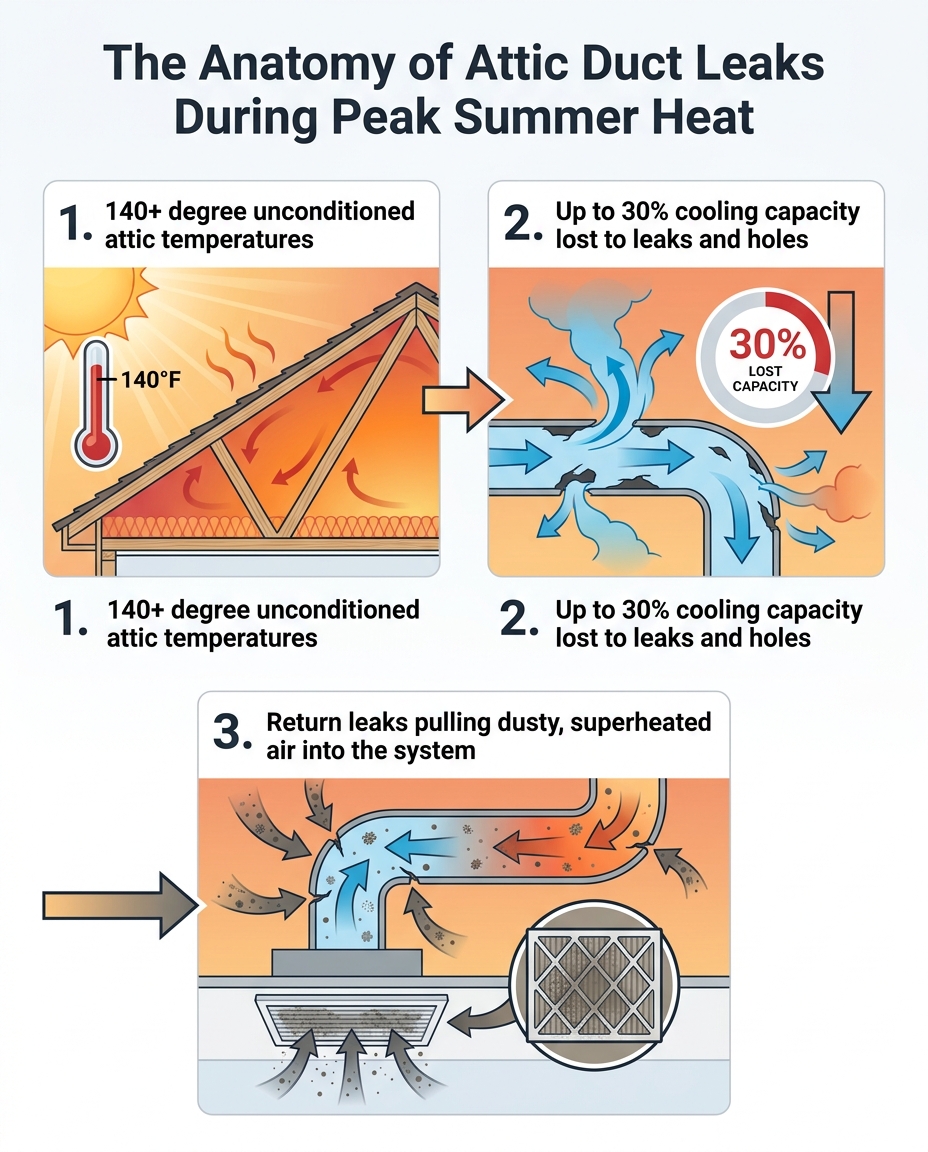
The Cause: In our years of servicing homes across Mountain View CA, our team regularly measures attic temperatures that easily exceed 140 degrees Fahrenheit by mid-afternoon. Silicon Valley's dry, triple-digit late-summer spikes create a compounding effect, turning the attic into an extreme-heat environment that actively works against your air conditioning system. When you run thin, poorly insulated, or unsealed ductwork through this sweltering zone, you incur a massive thermal penalty. The ambient heat inside the attic surrounds the ductwork, relentlessly transferring thermal energy through the thin walls of the ducts and warming the chilled air inside.
The Solution: This heat transfer happens even before we account for physical air leaks. If the air leaving your indoor air handler is 55 degrees, but it has to travel through 40 feet of unsealed, poorly insulated tubing sitting in a 140-degree environment, that air might be 65 or 70 degrees by the time it finally reaches your bedroom vents. The solution requires a comprehensive approach to the attic environment. By properly insulating the ductwork and ensuring the physical barrier between the 140-degree attic air and the 55-degree conditioned air is completely airtight, you stop the thermal penalty in its tracks. Protecting the delivery system from this extreme environment is the only way to ensure the cold air your AC produces actually makes it into your living space intact.
Where the Cold Air Goes: Understanding Capacity Loss
According to the Department of Energy and ENERGY STAR, the standard percentage of air lost to leaks, holes, and poor connections in residential duct systems is staggering. A system is only as good as its weakest seal, and in our daily field work, bridging the concept of physical leaks to broader residential ductwork design and sizing principles reveals exactly why homes fail to cool down. Experiencing up to 30% cooling capacity loss means that a massive portion of your energy investment is essentially thrown out the window—or rather, into the attic.
To fully grasp how this massive loss of efficiency occurs, we have to break down the specific mechanisms of duct leakage. The capacity loss generally falls into two distinct categories, both of which severely disrupt the delicate pressure balance required for an HVAC system to function correctly.
Supply Leaks: Cooling the Neighborhood
Supply ducts are responsible for carrying the freshly conditioned, pressurized cold air from your air handler to the various rooms in your home. Because this air is under positive pressure, any gap, tear, or disconnected joint in the supply ductwork acts as an escape valve.
• Pressurized escape: Cold air is literally blown out into the sweltering attic space instead of reaching your living room or bedrooms.
• Financial waste: You are effectively paying peak energy rates to air-condition an uninhabited, uninsulated space, wasting massive amounts of energy.
• Improper connections: Our technicians often find these leaks occurring at the plenum (the main trunk connected to the indoor unit) or at the vent boots where the duct meets the ceiling register.
Return Leaks: The Heat Infiltration
Return ducts do the opposite job: they pull warm air from inside your home back to the air handler to be cooled, dehumidified, and recirculated. Return ducts operate under negative pressure, acting like a giant vacuum cleaner.
• Heat infiltration: When there is a leak in a return duct located in the attic, the system sucks 140-degree attic air directly into the cooling loop.
• Capacity reduction: The air conditioner is suddenly forced to try and cool superheated attic air instead of the mild 75-degree air from inside your house.
• System overload: This immediate reduction in the air conditioner's ability to lower indoor temperatures is one of the primary reasons we see brand-new AC units fail to satisfy the thermostat on a hot day.
• Supply Leaks — Pressure State: Positive Pressure — Mechanism of Loss: Pushes cold, conditioned air directly into the attic space. — Impact on System Performance: Reduces the volume of cold air reaching the rooms; wastes energy cooling the attic.
• Return Leaks — Pressure State: Negative Pressure — Mechanism of Loss: Pulls 140-degree attic air into the HVAC system's cooling loop. — Impact on System Performance: Overwhelms the AC's cooling capacity; forces the system to cool superheated air.

The Hidden Cost of Overworking Your Air Conditioner
The decision to simply push your AC harder instead of addressing the underlying ductwork issues carries severe, compounding consequences. When we inspect struggling systems during end-of-season cooling cycles, a pattern we see often is that the thermostat takes significantly longer to register a drop in temperature. Because the set point is never reached, the thermostat continuously signals the air conditioner to keep running. This forces the AC to operate in continuous, extended cycles during late-summer August heatwaves, rather than the normal, healthy cycles it was designed to perform.
Accelerated mechanical wear: These extended run times place immense strain on the system's most critical and expensive components. The compressor, which is the heart of the outdoor unit, is designed to cycle on and off. When forced to run without a break, it runs hotter and works harder, significantly accelerating mechanical wear and tear. Similarly, the indoor blower motor is forced to continuously push air against compromised pressure dynamics, leading to premature motor fatigue.
Shortened lifespan: There is a painful irony in shortening the lifespan of a brand-new, expensive AC unit simply because of legacy ductwork that was never properly evaluated. A high-efficiency system is only efficient when it operates within its designed parameters. When duct leaks force the system to run nonstop, that efficiency rating plummets.
Compounding utility costs: Homeowners often upgrade to a high-efficiency system expecting a noticeable drop in their monthly energy usage. However, if the delivery system is leaking up to a third of the conditioned air into the attic, those savings never materialize. The compounding issue of high utility bills despite having upgraded the equipment is a direct result of overworking the system to compensate for a leaky, unsealed duct network.
Beyond Temperature: How Duct Leaks Affect Your Air
The Problem: The negative impacts of compromised ductwork extend far beyond just struggling to keep the house cool. Attics are inherently dirty spaces. They are full of accumulated dust, deteriorating fiberglass insulation particles, old roofing debris, and potential allergens. When your ductwork is unsealed, this hostile environment doesn't just affect the temperature of your home—it directly impacts the air you breathe.
The Cause: As discussed earlier, return duct leaks create a powerful vacuum effect. Whenever the blower motor turns on, negative pressure is generated within the return lines to pull air from the house. If there is a hole, a disconnected joint, or a poorly sealed seam in the attic portion of the return duct, that vacuum sucks the attic's contaminants directly into the HVAC system. This means that 140-degree air laden with dust, insulation fibers, and allergens is bypassing your home's primary filter and being drawn straight into the air handler.
The Solution: Once these contaminants enter the system, they are forcefully distributed throughout the living areas of your home. If you constantly find excessive dust building up on your furniture just days after cleaning, or if you notice a decline in your indoor air quality as kids head back to school and families spend more time indoors during the late summer in Mountain View CA, leaky return ducts are often the culprit. When our Plum HVAC team evaluates dusty homes, connecting duct sealing to overall home health is a priority. By securing the ductwork, you aren't just reclaiming your cooling power; you are taking a major step toward breathing cleaner, healthier air indoors. For a comprehensive approach to managing these airborne contaminants, exploring professional indoor air quality solutions alongside duct sealing provides the best defense for your home.
Why Replacing the Box Isn't Enough
A common misconception among homeowners is that upgrading to a larger tonnage AC unit will automatically solve cooling issues caused by bad ducts. If the house isn't getting cold enough, the logic suggests that a bigger, more powerful air conditioner is the answer. However, this approach completely ignores the physics of airflow and pressure. Replacing the box outside without addressing the delivery system inside is a recipe for ongoing frustration.
The dangers of oversizing: Oversizing an AC unit to compensate for leaks actually creates a host of new problems. An oversized unit will cool the immediate area around the thermostat too quickly, causing the system to shut off before it has had time to circulate air to the rest of the house or remove humidity. This phenomenon, known as short-cycling, leaves you with a home that feels cold but clammy, while still suffering from up to 30% cooling capacity loss due to the unsealed ducts.
The total-system evaluation: Shifting the narrative from hardware replacement to holistic delivery system performance is essential. At Plum HVAC, our meticulous approach to total-system evaluation ensures homeowners aren't just buying new AC units, but actually getting the cooling power they paid for through proper duct sealing and design. While generic federal tax credits or local utility incentive programs may apply to qualifying high-efficiency installations—and we always advise verifying current programs with your utility or tax professional—placing new equipment on failing ductwork negates those benefits. A professional duct evaluation by our team goes far beyond a quick glance in the attic.
1. Visual Inspection: Technicians meticulously examine the entire attic network, checking for obvious disconnects, crushed lines, or degraded insulation.
2. Static Pressure Testing: By measuring the resistance to airflow within the system, professionals can determine if the ducts are properly sized for the volume of air the AC is trying to push.
3. Airflow Measurement: Checking the actual cubic feet per minute (CFM) of air reaching the registers compared to what the equipment is producing highlights exactly how much air is being lost.
4. Seal Integrity Checks: Inspecting the plenum connections, wyes, and vent boots ensures that the most common failure points are identified and targeted for sealing.
Ensuring the entire delivery system is optimized means your equipment runs less, lasts longer, and finally delivers the comfort you expect during the hottest parts of the year.
Frequently Asked Questions About Duct Leaks and AC Performance
How much cooling is lost to leaky ducts?
In a typical residential system, up to 30 percent of the conditioned air is lost to leaks, holes, and poorly connected ducts before it reaches your living space. This massive loss forces your air conditioner to run significantly longer to achieve the desired temperature. By sealing these leaks, you ensure that the cooling power you are paying for actually makes it into your home.
Why is my new AC struggling to cool my house?
A new AC often struggles because it is attached to old, compromised ductwork that leaks conditioned air into the attic. During late-summer August heatwaves, the extreme heat of the attic combined with these leaks overwhelms the new system's capacity. Even the highest-efficiency equipment cannot overcome the thermal penalty of blowing cold air directly into a 140-degree unconditioned space.
Does sealing ductwork improve AC performance?
Yes, sealing ductwork drastically improves AC performance by restoring the proper pressure balance and ensuring all conditioned air reaches its intended destination. When ducts are sealed, the thermostat is satisfied much faster, which reduces the overall run time of the equipment. This not only lowers your energy usage but also reduces the mechanical wear and tear on your compressor and blower motor.
How do I know if my AC ducts are leaking in the attic?
Common signs of leaking ducts include uneven room temperatures, excessive dust buildup on furniture, and an air conditioner that runs constantly without fully cooling the house. You might also notice that certain rooms feel noticeably warmer than others, or that your utility bills remain stubbornly high despite upgrading to a high-efficiency system. A professional static pressure test is the most accurate way to confirm and locate these hidden leaks.
Can unsealed ducts cause my air conditioner to break down prematurely?
Absolutely. Unsealed ducts force your air conditioner into extended, continuous cycles as it struggles to compensate for the lost air. This nonstop operation puts massive strain on critical components, causing them to overheat and wear out much faster than we see under normal conditions. Addressing duct leaks is one of the most effective ways to protect your investment and extend the lifespan of your HVAC equipment.
Reclaim Your Comfort with a Professional Duct Evaluation
The hidden link between hot attics, unseen leaks, and struggling air conditioners is a reality for many homeowners in Mountain View CA. If your home is failing to stay comfortable during peak temperatures, you don't necessarily need to replace your AC unit again; you need to secure the delivery system. Reclaim your cooling power and protect your equipment by scheduling a professional duct evaluation with the Plum HVAC team to inspect and seal your ductwork before the next major heatwave strikes.
hear what our satisfied clients have to say

.svg)
Service areas
.avif)