

Navigating Santa Clara County Permits for Residential Air Conditioning Replacements
The Pressure of Late-Summer AC Failures and the Permit Dilemma
Your air conditioner is blowing warm air, the house feels like an oven, and the forecast shows another week of relentless late-summer August heat. When your system fails during a scorching heatwave, navigating Santa Clara County permits for residential air conditioning replacements might be the last thing on your mind. All you want is cool air, and you want it immediately. This urgency often creates a difficult dilemma for homeowners: do you follow the official municipal protocols, or do you accept a contractor's offer to skip the paperwork for a faster installation?
If you are navigating an unexpected breakdown and need reliable guidance, learn more about our comprehensive air conditioning services and how a professional team handles the entire process.
The False Promise of the Fast, Unpermitted Install
Losing cooling during peak heatwaves creates immense pressure to get a new system installed immediately. Homeowners are often tempted to bypass official municipal paperwork to speed up the installation timeline. Unscrupulous contractors might even suggest that permits are just a way for the city to collect fees, promising to have a new compressor running by the next afternoon if you agree to skip the official channels.
While skipping the permitting process might seem like a clever shortcut to restore your home's comfort, it introduces severe legal, financial, and performance risks. Properly navigating local compliance ensures that the new system is legally installed, structurally safe, and built to handle extreme thermal loads. An air conditioner is a high-voltage appliance that integrates with your home's electrical panel, ductwork, and structural envelope. A rushed, uninspected installation leaves you entirely reliant on the word of the person who installed it, with no independent verification that the system is safe to operate.
Why Municipal Oversight Protects You
The permitting process acts as a built-in quality control mechanism for your investment. When a local building department issues a permit, they are establishing a paper trail that holds the installing contractor accountable for their workmanship. It guarantees that the equipment is appropriately sized for your specific square footage and that all electrical connections meet the latest safety codes. Rather than viewing the permit as a bureaucratic hurdle, it is better understood as your strongest consumer protection against substandard workmanship during a vulnerable, high-stress breakdown.
Understanding the Risks of Unpermitted HVAC Work
Bypassing the local building department carries consequences that extend far beyond the initial installation day. Unpermitted residential work can lead to strict code enforcement penalties from local building departments, creating a cascade of administrative and financial headaches for the property owner.
Code Enforcement and Legal Liabilities
If a municipal code enforcement officer discovers unpermitted mechanical work—often triggered by a neighbor's complaint, a subsequent home inspection, or a mismatched visible condenser unit—the property owner is held entirely responsible. Cities and counties have the authority to issue costly citations, mandate retroactive permitting, and require you to hire a new contractor to bring the system up to current codes. In severe cases, they can even force the complete removal of the unpermitted equipment. If you are considering an AC installation in Santa Clara, securing the proper documentation upfront is the only way to shield yourself from these liabilities.
The Threat to Manufacturer Warranties
Major HVAC manufacturers frequently void equipment warranties if the system was not installed according to permitted local codes. Modern air conditioning systems come with extensive warranties covering expensive components like the compressor and evaporator coil. However, these guarantees include strict stipulations. If a component fails prematurely and the manufacturer discovers the system was installed without municipal approval or independent testing, they can—and often do—refuse to cover the replacement parts. This leaves the homeowner paying out of pocket for major repairs on a brand-new system.
Real Estate Disclosures and Future Sales
Bypassing permits can cause significant complications during future real estate transactions, including mandatory disclosures and delayed sales. California real estate law requires sellers to provide a Transfer Disclosure Statement (TDS) detailing any known defects or unpermitted alterations to the property.
• Manufacturer Warranty — Permitted Installation: Fully intact and verifiable through local documentation. — Unpermitted Installation: Subject to immediate cancellation upon discovery.
• Real Estate Sale — Permitted Installation: Clean title transfer with documented home improvements. — Unpermitted Installation: Requires mandatory disclosure; buyers may demand price cuts.
• Safety Verification — Permitted Installation: Independent municipal inspector verifies electrical and mechanical safety. — Unpermitted Installation: No guarantee that the electrical and mechanical work was performed safely.
• Code Enforcement — Permitted Installation: Fully compliant with all local ordinances. — Unpermitted Installation: Risk of citations, retroactive fees, and forced equipment removal.
When a savvy buyer's inspector notices a newer AC unit without a corresponding permit on file with the city, the buyer gains immense leverage. They will typically demand a substantial price reduction or require you to retroactively permit the system before closing—a process that is far more difficult and expensive after the walls are closed and the contractor is long gone.
Demystifying California Title 24 Energy Standards
To understand why local permits are so rigorously enforced in this state, you have to look at the broader regulatory landscape. California Title 24 Building Energy Efficiency Standards legally require mechanical permits for residential HVAC alterations. These statewide mandates drive the local permitting requirements in every municipality.
What Are Title 24 Standards?
Enacted by the California Energy Commission, Title 24 is a comprehensive set of building codes designed to reduce energy consumption, lower greenhouse gas emissions, and prevent the state's electrical grid from failing during peak summer demand. When you replace an air conditioner, the state views it as a major alteration to the home's energy profile. These standards ensure that new cooling systems meet strict energy consumption and environmental impact baselines. By enforcing high-efficiency standards, the state reduces the likelihood of rolling blackouts when everyone turns on their AC during an August heatwave.
The Role of the CF1R Document
The paperwork involved in California Title 24 compliance is highly specific. Required documentation, such as CF1R (Certificate of Compliance) forms, must be submitted to verify that the equipment sizing and efficiency match the home's specific requirements.
Key elements verified by Title 24 documentation include:
• Equipment Efficiency: Ensuring the SEER2 (Seasonal Energy Efficiency Ratio) rating meets or exceeds state minimums.
• System Sizing: Preventing contractors from installing oversized units that short-cycle and waste electricity.
• Ductwork Integrity: Confirming that the existing air distribution system can handle the new equipment without excessive leakage.
Homeowners navigating SF Bay Area HVAC permits and building codes quickly realize that Title 24 is the backbone of the entire process. The local building department cannot issue a final permit sign-off until the state's energy compliance registry receives all required documentation.
Long-Term Performance Benefits
While the paperwork can seem daunting, compliance with these standards directly translates to lower utility bills and optimized system performance. A system installed to Title 24 standards is mathematically proven to run efficiently. It uses less electricity to produce the same amount of cooling, which means the initial administrative effort pays continuous dividends every time you open your monthly utility statement.
The Role of HERS Testing in Verifying System Efficiency
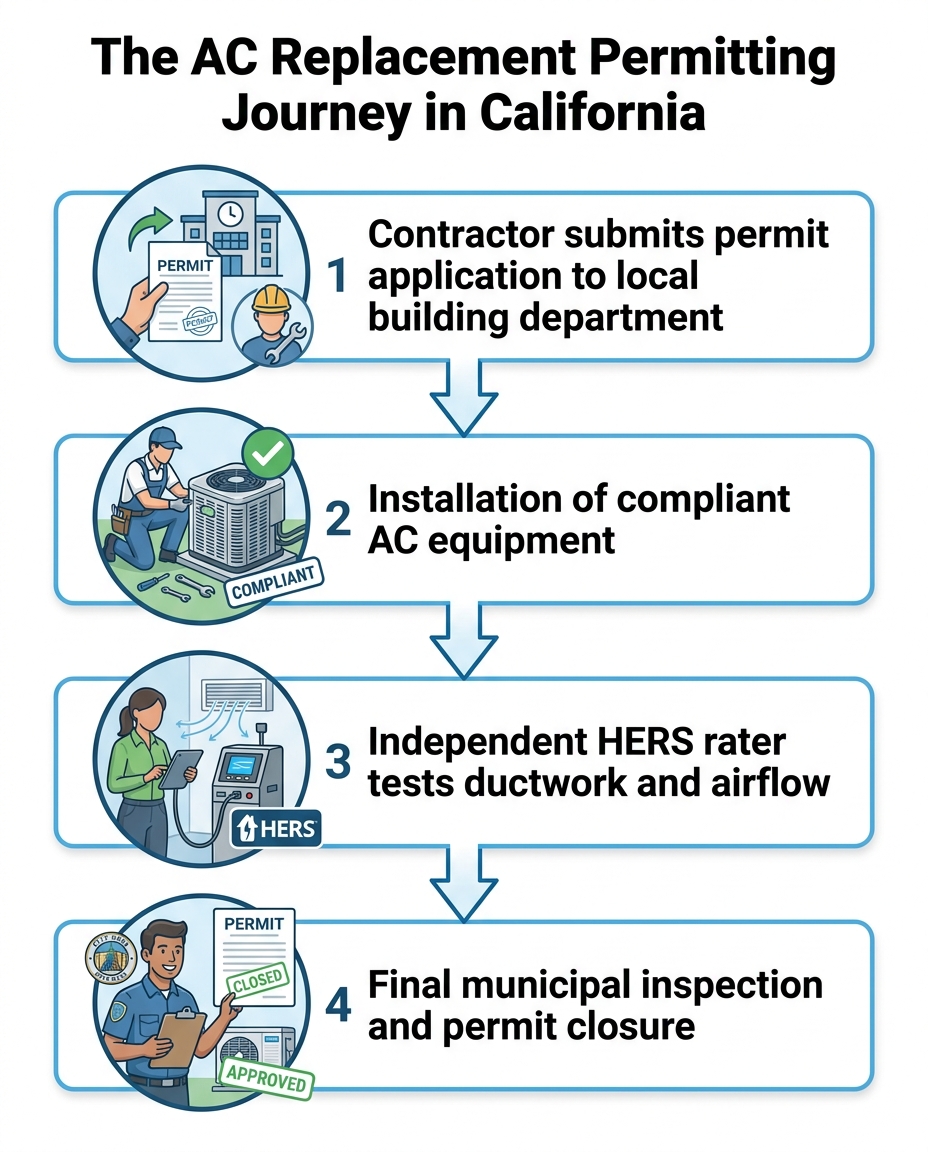
Pulling the permit and installing the equipment is only the first half of the compliance journey. To prove that the newly installed system actually meets the state's stringent efficiency goals, it must undergo independent field verification.
The Standard HERS Testing Sequence
A Home Energy Rating System (HERS) rater is a certified, independent third party required to test the newly installed system. The state mandates that the HERS rater cannot be an employee of the HVAC company that installed the equipment; this separation ensures an objective, unbiased evaluation of the workmanship.
1. Independent Verification Scheduling: Once the installation is complete, the contractor coordinates with a certified HERS rater to visit the property.
2. Duct Leakage Testing: The rater seals the registers and uses a specialized fan (a duct blaster) to pressurize the ductwork. This measures exactly how much conditioned air is escaping into unconditioned spaces like attics or crawlspaces. Testing typically involves verifying duct leakage levels to ensure they fall below the state-mandated threshold.
3. Airflow Measurement: The rater measures the cubic feet per minute (CFM) of air moving across the indoor cooling coil. Ensuring proper airflow across the cooling coil is critical for the system to absorb heat effectively and prevent the coil from freezing over.
4. Refrigerant Charge Verification: The rater connects digital gauges to the outdoor unit to confirm the contractor weighed in the exact right amount of refrigerant. An improper charge forces the compressor to overwork, drastically reducing its lifespan.
5. Final Documentation: The rater uploads the passing results (CF3R forms) to the state registry. This independent verification is a mandatory step in closing out the local municipal permit.
Accountability for the Installing Contractor
One of the greatest benefits of the HERS testing requirement is the protection it offers the homeowner. Failing a HERS test means the installing contractor must return to correct ductwork or airflow issues at no additional cost to the homeowner. You are never stuck paying for a system that underperforms. The independent rater serves as your personal quality assurance inspector, ensuring the contractor delivers exactly what was promised before the city closes the permit.

Navigating Local Jurisdictions: City Versus County Requirements
The specific steps required to secure and close a permit can shift depending on exactly where your property sits on the map. Permit requirements can vary slightly depending on whether a home is in an incorporated city or unincorporated county land.
Understanding Your Specific Building Department
In a dense region like the South Bay, jurisdictional lines can be confusing. For example, a home located squarely within the city limits of Mountain View falls under the jurisdiction of the municipal building department. However, a property just a few streets over might sit in an unincorporated pocket of Santa Clara County / Mountain View, meaning the county's Department of Planning and Development handles the oversight. Local building departments manage the review process, collect fees, and dispatch inspectors for the final sign-off, and their specific administrative procedures can differ widely.
Common jurisdictional differences include:
• Application Methods: Some cities require in-person applications, while others utilize entirely digital portals for mechanical permits.
• Review Timelines: Over-the-counter approvals are possible in some jurisdictions, whereas others require a multi-day plan check.
• Inspection Windows: The flexibility of scheduling the final physical inspection varies depending on the department's staffing levels.
The Inspection Dispatch Process
Understanding the specific jurisdiction is critical for submitting the correct paperwork and avoiding administrative delays. If an application is sent to the city for a property that technically resides in the county, the paperwork will be rejected, stalling the installation process. A reputable local contractor will already know the nuances of the specific building department governing the property. If you are scheduling a Mountain View AC replacement, a knowledgeable professional will pull the parcel data beforehand to ensure the application goes to the right desk on the first attempt.
Streamlining the Bureaucracy: Why Professional Management Matters
Reading through energy standards, HERS testing protocols, and jurisdictional maps can make upgrading your cooling system feel like a full-time administrative job. However, this burden should never fall on your shoulders.
The Backend Administrative Burden
Managing permit applications, coordinating HERS raters, and scheduling municipal inspectors is a time-consuming process. Gathering the equipment specifications, generating the CF1R compliance forms, and navigating the state's digital registry requires specialized knowledge of building codes. Homeowners should not be expected to navigate complex building codes or wait in line at the local planning department. If a contractor asks you to pull the permit yourself as an "owner-builder," it is a massive red flag. This tactic shifts all legal liability onto you and usually indicates the contractor lacks the proper licensing or insurance to pull the permit themselves.
A Truly Seamless Installation Experience
A dedicated professional handles the entire backend process, ensuring compliance without adding stress to the homeowner. Plum HVAC handles all local municipal paperwork, Title 24 compliance, and inspection scheduling, ensuring a seamless and stress-free installation. From the moment the initial load calculation is performed to the day the city inspector signs off on the final permit card, every administrative detail is managed behind the scenes.
This comprehensive approach guarantees a smooth transition from a broken system to a fully permitted, high-performance cooling solution. When you invest in a San Jose air conditioning installation managed by experienced professionals, you receive more than just cold air. You gain the assurance that your system is legally compliant, mathematically optimized for efficiency, and fully protected by the manufacturer's warranty.
Frequently Asked Questions
Do I need a permit to replace my AC in California?
Yes, a mechanical permit is legally required for replacing an air conditioning system in California. The state mandates this oversight to ensure the new equipment meets strict electrical safety codes and energy efficiency standards. Bypassing this requirement can result in code violations and complicate future real estate sales.
Why is Title 24 required for AC replacement?
Title 24 is required to enforce statewide energy efficiency baselines and reduce strain on the electrical grid. When you replace an AC, the state requires documentation proving the new unit is appropriately sized and efficient enough to minimize environmental impact. Compliance helps prevent rolling blackouts during peak summer demand while lowering your monthly utility bills.
What happens if you don't get an HVAC permit?
Failing to secure a permit leaves you vulnerable to strict code enforcement, which can include retroactive permitting fees or forced removal of the equipment. Additionally, major manufacturers will often void the warranty on unpermitted systems. It also creates significant hurdles when selling your home, as buyers can demand price reductions for unpermitted alterations.
What is a HERS test for AC replacement?
A HERS test is an independent verification process required by the state to prove your new AC operates efficiently. A certified third-party rater measures duct leakage, verifies proper airflow, and checks the refrigerant charge. If the system fails the test, the installing contractor is legally obligated to fix the underlying issues at no cost to you.
Can unpermitted HVAC work void my manufacturer warranty?
Yes, most major HVAC manufacturers explicitly state that their equipment must be installed in accordance with all local building codes to maintain warranty coverage. If a compressor fails and the manufacturer discovers the system was installed without a permit or independent testing, they can deny your claim for replacement parts.
How long does the AC permitting process take in Santa Clara County?
The timeline varies based on your specific jurisdiction, but many local building departments offer expedited or over-the-counter approvals for standard residential AC replacements. While the initial permit can often be pulled quickly to allow for immediate installation, the final sign-off takes longer, as it requires scheduling the independent HERS rater and the final municipal inspector.
Secure Your Comfort with Confidence
Navigating municipal regulations shouldn't stand between you and a comfortable home. By insisting on a permitted installation, you ensure your new air conditioner is safe, efficient, and fully protected for years to come. Our team provides a clear, demystified explanation of the process while handling every piece of paperwork on your behalf. Schedule your consultation today to enjoy reliable cooling that protects your investment and your property value.
hear what our satisfied clients have to say

.svg)
Service areas
.avif)